सीखने के लिए तैयार हैं?
अपने शैक्षणिक लक्ष्यों को प्राप्त करने की दिशा में पहला कदम उठाएँ। चाहे आप परीक्षा की तैयारी कर रहे हों या अपने ज्ञान का विस्तार कर रहे हों, शुरुआत बस एक क्लिक दूर है। आज ही हमसे जुड़ें और अपनी पूरी क्षमता को अनलॉक करें।
Utkarsh Classes
Admission office
Above Arora Namkeen
Jalori Gate circle,
Jodhpur (Raj.), 342005
support@utkarsh.com
+91-9116691119, +91-9829213213
आरंभ करें


सीखने के साधन
Teaching Exams
Rajasthan Govt Exams
Central Govt Exams
Civil Services Exams
Nursing Exams
School Tuitions
Other State Govt Exams
Agriculture Exams
College Entrance Exams
Miscellaneous Exams

© 2026 उत्कर्ष क्लासेज एंड एडुटेक प्राइवेट लिमिटेड सभी अधिकार सुरक्षित
होम

National Current Affairs
Books and Authors
Sonia Gandhi’s Belonging: A Memoir of Love, Loss and Politics
Add as a preferred source on Google
Explore Sonia Gandhi’s memoir Belonging: A Journey of Love, its personal memories, family history and account of major political events in India.
Updated: 13 Nov 2026
4 Min Read
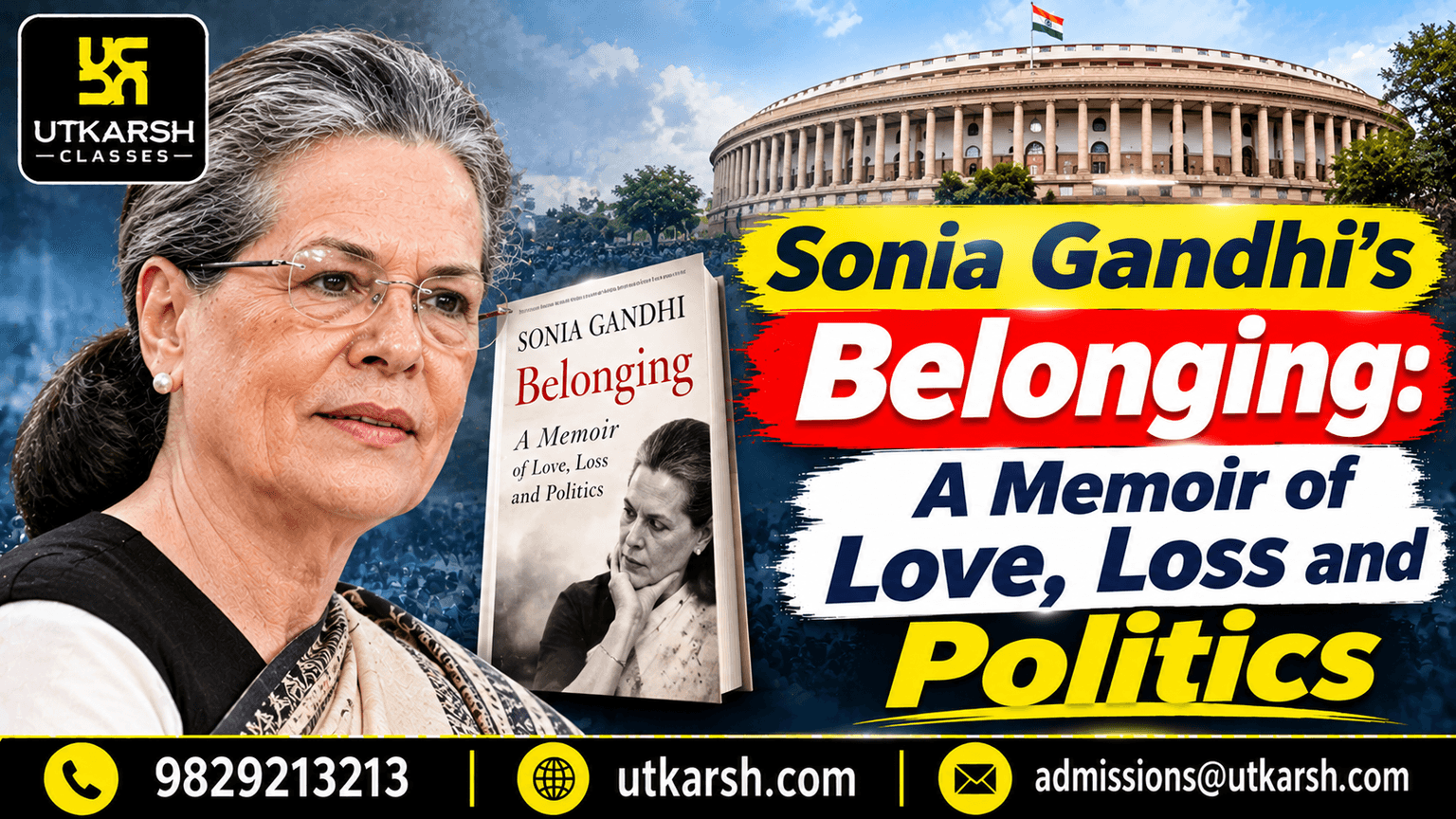
Sonia Gandhi has guarded her privacy for decades. Yet, she stands as one of modern India’s most influential political leaders. Her 544-page memoir, Belonging: A Journey of Love, gives readers a rare window into her private life. It also traces the turbulent history of the Nehru–Gandhi family across pivotal moments in Indian politics.
In this personal account, Sonia places family, love, and grief at the center of her story. She treats politics as a backdrop—a "kind of framework"—while sharing her perspective on the 1975 Emergency, the 1984 anti-Sikh riots, and the Bofors scandal. While political critics may contest her interpretations, the book captures how major national crises affected her household.
Sonia begins her story in northern Italy, recalling her childhood in the village of Sangano and the nearby town of Orbassano near Turin. Her parents raised her with strong values of discipline, simplicity, and duty.
Her life changed completely after she met and married Rajiv Gandhi. She candidly describes adapting to Indian customs, raising her children, and navigating life beside Prime Minister Indira Gandhi. Sonia portrays Indira as a complex figure—a commanding political leader who was deeply protective and affectionate toward her family, yet often demanding and unpredictable.
The memoir sheds light on private family conversations during the Emergency of 1975. Sonia highlights sharp disagreements between Rajiv Gandhi and his younger brother, Sanjay Gandhi, over reports of administrative excesses.
However, the narrative stays focused on household dynamics rather than conducting a deep political audit of leadership accountability during that era.
Sonia recounts the trauma that followed Indira Gandhi’s assassination in October 1984. Amid acute fear for Rajiv and their children, she witnessed Sikh families fleeing mob violence and seeking shelter.
She condemns the riots as "barbaric" and admits that sections of the administration failed to stop the attacks, with some officials allegedly encouraging the violence. At the same time, Sonia firmly rejects accusations that Rajiv Gandhi authorized violence against innocent citizens.
Turning to the late 1980s, Sonia describes the emotional toll of the Bofors controversy on Rajiv Gandhi. She notes his push for a Swedish investigation, the creation of a Joint Parliamentary Committee, and the Delhi High Court’s 2004 ruling that quashed charges against him.
The memoir’s most poignant chapter recounts Rajiv Gandhi’s assassination in 1991. Sonia recalls the devastating moment her daughter, Priyanka, broke the news of his death. She also questions persistent security lapses, citing prior intelligence warnings regarding the LTTE threat alongside findings from the Verma and Jain commissions.
Initially, Sonia avoided active politics after Rajiv’s death. She eventually stepped forward to lead a struggling Congress party, guiding its coalition to victory in the 2004 Lok Sabha elections.
Despite winning the mandate, Sonia declined the Prime Minister’s post and nominated Dr. Manmohan Singh. She reveals that her children, Rahul and Priyanka, strongly opposed her taking the office because they feared for her physical safety after losing both Indira and Rajiv to assassination. She also recounts a 2010 conversation with veteran leader Pranab Mukherjee, who suggested the party needed a leadership change—a remark Sonia interpreted as his own ambition to become Prime Minister.
In the closing chapters, Sonia reflects on the Congress party’s electoral setbacks, the rise of the Modi government, Rahul Gandhi’s Bharat Jodo Yatra, and the formation of the INDIA bloc. She notes that her interactions with Prime Minister Narendra Modi have remained formal and brief, while reaffirming her firm ideological opposition to the Rashtriya Swayamsevak Sangh (RSS).
Enriched with rare family photographs—many taken by Rajiv Gandhi himself—Belonging succeeds as an intimate human portrait of duty and endurance, even as it leaves broader historical debates open for future historians.
|
Book Parameter |
Key Details |
|
Book Title |
Belonging: A Journey of Love |
|
Author |
Sonia Gandhi |
|
Length |
544 pages |
|
Core Themes |
Family life, marriage to Rajiv Gandhi, personal grief, and Indian political milestones |
|
Key Events Covered |
1975 Emergency, 1984 anti-Sikh violence, Bofors controversy, 1991 assassination, 2004 elections |
|
Notable Features |
Personal anecdotes and rare photographs captured by Rajiv Gandhi |
लेखक के बारे में

Girish Kumar
Current Affairs Content Writer
Girish Kumar is a current affairs content writer at Utkarsh Classes, with a decade of experience covering diverse contemporary issues. He develops high-quality study material for various competitive examinations, including UPSC, PSC, Bank PO etc.

नवीनतम करेंट अफेयर्स
लोकप्रिय टैग
Frequently asked questions

अपने नज़दीकी उत्कर्ष क्लासेज के ऑफलाइन सेंटर पर आज ही विजिट करें।