सीखने के लिए तैयार हैं?
अपने शैक्षणिक लक्ष्यों को प्राप्त करने की दिशा में पहला कदम उठाएँ। चाहे आप परीक्षा की तैयारी कर रहे हों या अपने ज्ञान का विस्तार कर रहे हों, शुरुआत बस एक क्लिक दूर है। आज ही हमसे जुड़ें और अपनी पूरी क्षमता को अनलॉक करें।
Utkarsh Classes
Admission office
Above Arora Namkeen
Jalori Gate circle,
Jodhpur (Raj.), 342005
support@utkarsh.com
+91-9116691119, +91-9829213213
आरंभ करें


सीखने के साधन
Teaching Exams
Rajasthan Govt Exams
Central Govt Exams
Civil Services Exams
Nursing Exams
School Tuitions
Other State Govt Exams
Agriculture Exams
College Entrance Exams
Miscellaneous Exams

© 2026 उत्कर्ष क्लासेज एंड एडुटेक प्राइवेट लिमिटेड सभी अधिकार सुरक्षित
होम

National Current Affairs
Place in News
Delhi Overtakes Lahore as World’s Most Polluted City: AQI Hits 334 “Hazardous”
Add as a preferred source on Google
Delhi has become the most polluted city in the world, taking the spot from Lahore in Pakistan. Thick smog has cut visibility across the capital, where about 20 million people live. Air quality is now in the hazardous range.
Updated: 13 Nov 2026
2 Min Read
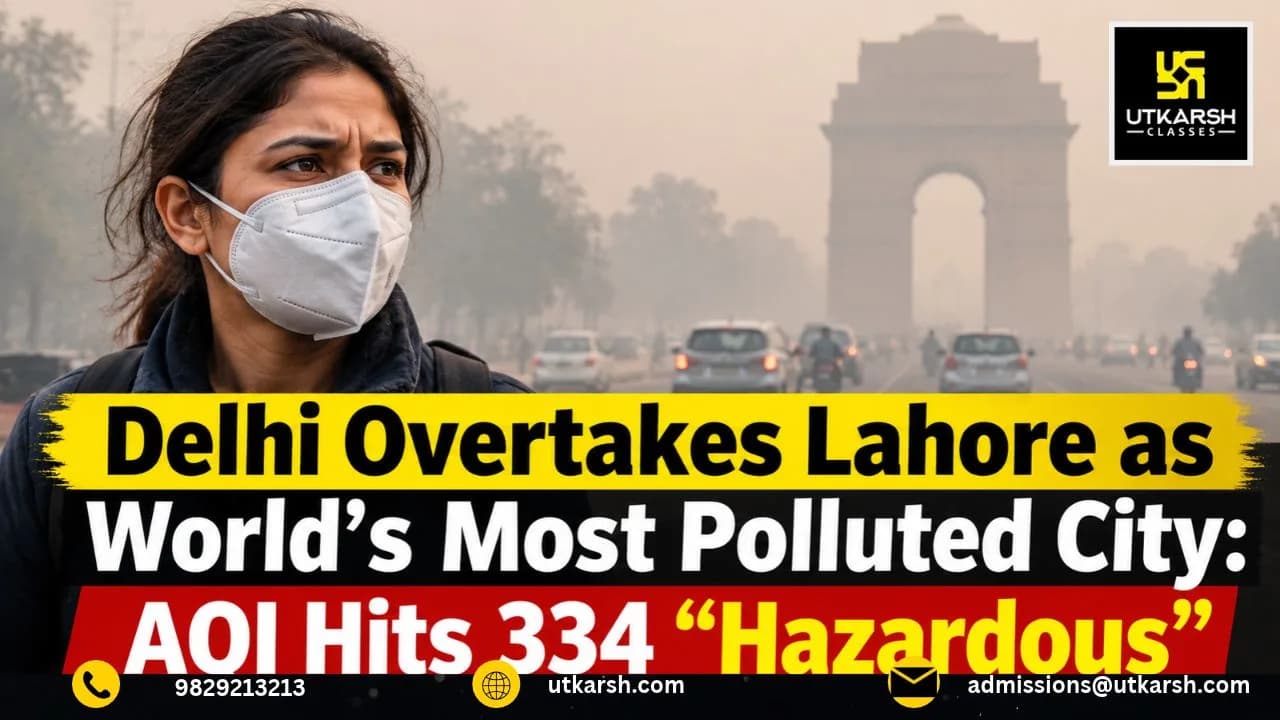
On Friday, 13 November 2026, Delhi moved to the top of the world’s most polluted cities list, ahead of Lahore. Smog covered the city and made it hard to see far, which is a worry for the millions living there.
IQAir, a Swiss air monitoring group, measured Delhi’s Air Quality Index (AQI) at 334, which is in the hazardous category. For comparison, an AQI of up to 50 is considered good, with little or no risk to health.
India’s Central Pollution Control Board (CPCB) recorded a higher AQI of 403 at 9 am and rated it severe. The numbers differ because the Swiss and Indian systems use different scales and methods to calculate and classify pollution.
CPCB readings have climbed steadily since Diwali on Sunday, 8 November. On Friday, 33 of Delhi’s 58 monitoring stations showed severe air, and several readings were above 450.
The steady rise in pollution after Diwali is the main reason Delhi moved ahead. The reference report points to firecrackers and fine particles as the key factors.
The Supreme Court had allowed only approved “green” firecrackers on Diwali, and only within fixed time windows. Even so, the AQI kept rising in the days after the festival.
The Centre for Science and Environment (CSE), a Delhi research group, studied PM2.5, which are fine particles small enough to enter the lungs. In the week before Diwali, PM2.5 averaged 236 micrograms per cubic metre of air. That is nearly double the 120 recorded in the same week of 2025. This shows pollution was already high before the festival began.
लेखक के बारे में

Hardika Shekhawat
Current Affairs Content Writer
Hardika is a current affairs content writer at Utkarsh Classes with 3 years of experience in academic content writing. She creates clear, exam-ready current affairs articles for UPSC, SSC, RAS, Banking, Railway and State PCS aspirants.

नवीनतम करेंट अफेयर्स
Frequently asked questions

अपने नज़दीकी उत्कर्ष क्लासेज के ऑफलाइन सेंटर पर आज ही विजिट करें।