सीखने के लिए तैयार हैं?
अपने शैक्षणिक लक्ष्यों को प्राप्त करने की दिशा में पहला कदम उठाएँ। चाहे आप परीक्षा की तैयारी कर रहे हों या अपने ज्ञान का विस्तार कर रहे हों, शुरुआत बस एक क्लिक दूर है। आज ही हमसे जुड़ें और अपनी पूरी क्षमता को अनलॉक करें।
Utkarsh Classes
Admission office
Above Arora Namkeen
Jalori Gate circle,
Jodhpur (Raj.), 342005
support@utkarsh.com
+91-9116691119, +91-9829213213
आरंभ करें


सीखने के साधन
Teaching Exams
Rajasthan Govt Exams
Central Govt Exams
Civil Services Exams
Nursing Exams
School Tuitions
Other State Govt Exams
Agriculture Exams
College Entrance Exams
Miscellaneous Exams
UC Skills

© 2026 उत्कर्ष क्लासेज एंड एडुटेक प्राइवेट लिमिटेड सभी अधिकार सुरक्षित
Add as a preferred source on Google
Updated: 15 Oct 2026
3 Min Read
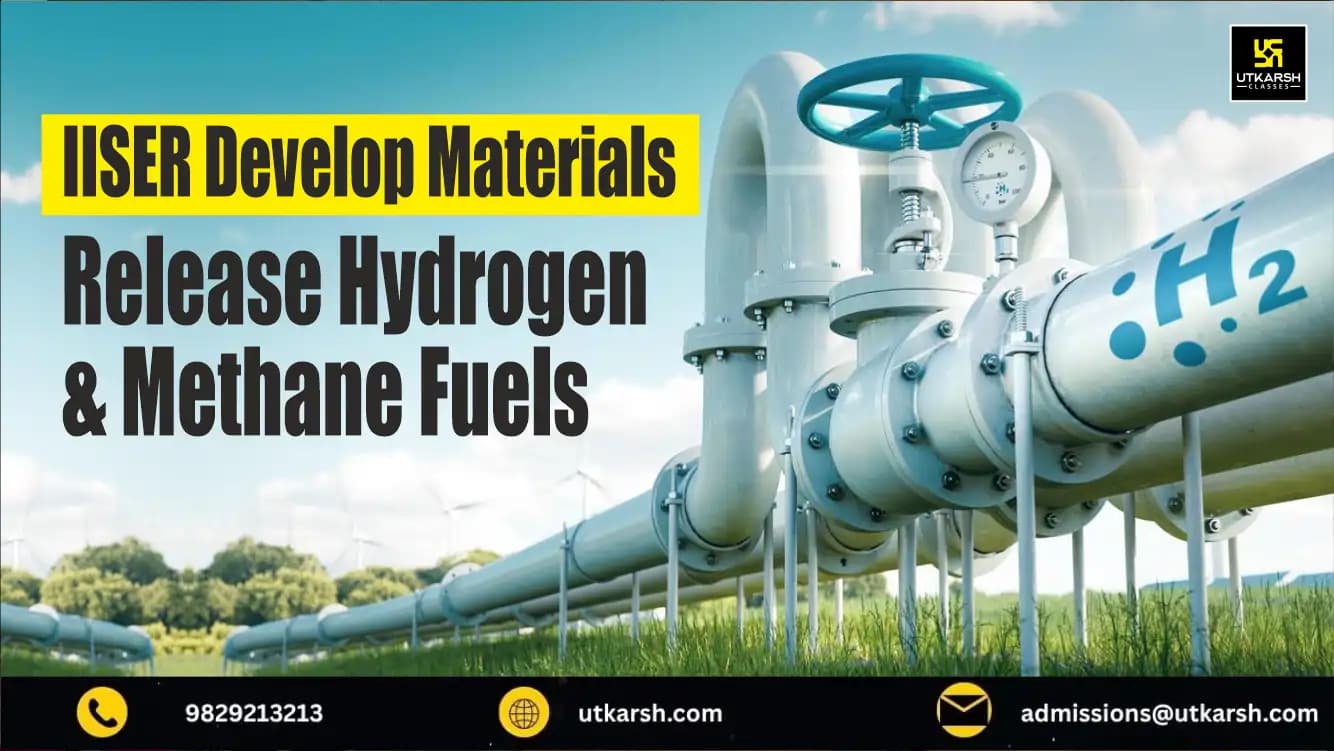
Researchers at the Indian Institute of Science Education and Research (IISER), Thiruvananthapuram, have developed a chemical compound that releases two fuel gases hydrogen and methane, when heated. The discovery could support the development of new methods to store and transport fuel gases more efficiently.
The research findings appeared in the journal Science Advances on October 7. The research team explored how organometallic compounds could serve as molecular platforms for storing and releasing fuel gases under controlled conditions.
The researchers developed a compound called magnesium hydridomethylzincate, which contains magnesium, zinc, hydrogen and carbon. The team examined how the compound releases gases under different heating conditions.
When the researchers heated the compound in a solution at 100°C, it released hydrogen. However, when they heated its crystals without a solvent at temperatures between 80°C and 110°C, the compound released both hydrogen and methane.
The team also observed that methane emerged before hydrogen. This sequence indicated that successive chemical reactions triggered the release of the two gases. Further analysis showed that each unit of the compound's paired molecular structure could produce two molecules of hydrogen and two molecules of methane.
Chemistry professor and study lead Ajay Venugopal highlighted the broader potential of organometallic compounds for storing and releasing fuel gases through controlled chemical processes.
Hydrogen has attracted global attention as a potential clean fuel because its combustion does not directly emit carbon dioxide. However, its very low density makes storage and transportation difficult. These challenges often require expensive technologies.
Scientists have explored blending hydrogen with methane as an intermediate solution. Hydrogen burns faster than methane, while methane can help reduce the risk of flame flashback into burners and certain dangerous combustion events.
Researchers have also developed methods to store hydrogen and methane as compressed gases or in solid materials that release individual gases under specific conditions.
The IISER study adds to this research by demonstrating how a single solid compound can release both gases under suitable heating conditions.
Magnesium hydridomethylzincate remains solid at room temperature. This property could offer an alternative to transporting hydrogen and methane in compressed-gas form. The relatively low temperatures required to release the gases also make the compound worthy of further investigation.
However, the researchers have identified important limitations. The compound reacts sensitively to moisture, which could complicate its handling, storage and practical use. The team also has not established whether the compound can regain its gas-storage capacity after releasing its gaseous contents.
Professor Venugopal noted that the researchers have yet to demonstrate reversibility in their system. Nevertheless, the study provides a starting point for investigating molecular compounds that use main-group elements to absorb and release fuel gases reversibly.
The discovery advances scientific understanding of solid-state fuel storage and controlled gas release. Further research must establish the compound's stability, reusability, storage capacity and practical performance before scientists can assess its commercial potential.
If researchers overcome these challenges, such compounds could contribute to future technologies for handling hydrogen and methane more conveniently and safely.
लेखक के बारे में

Girish Kumar
This content is prepared by the Utkarsh Classes team to present accurate, updated, and exam-relevant current affairs in a simple and reliable format.
नवीनतम करेंट अफेयर्स
Frequently asked questions

अपने नज़दीकी उत्कर्ष क्लासेज के ऑफलाइन सेंटर पर आज ही विजिट करें।

Download Last 5 Years PYQs in a Single Click
FREE PYQs exam ke level aur question pattern ko samajhne ka best tareeka