सीखने के लिए तैयार हैं?
अपने शैक्षणिक लक्ष्यों को प्राप्त करने की दिशा में पहला कदम उठाएँ। चाहे आप परीक्षा की तैयारी कर रहे हों या अपने ज्ञान का विस्तार कर रहे हों, शुरुआत बस एक क्लिक दूर है। आज ही हमसे जुड़ें और अपनी पूरी क्षमता को अनलॉक करें।
Utkarsh Classes
Admission office
Above Arora Namkeen
Jalori Gate circle,
Jodhpur (Raj.), 342005
support@utkarsh.com
+91-9116691119, +91-9829213213
आरंभ करें


सीखने के साधन
Teaching Exams
Rajasthan Govt Exams
Central Govt Exams
Civil Services Exams
Nursing Exams
School Tuitions
Other State Govt Exams
Agriculture Exams
College Entrance Exams
Miscellaneous Exams

© 2026 उत्कर्ष क्लासेज एंड एडुटेक प्राइवेट लिमिटेड सभी अधिकार सुरक्षित
होम

International Current Affairs
Science and Technology
NASA's Voyager 1 Reaches One Light-Day From Earth on Nov 18
Add as a preferred source on Google
Updated: 20 Nov 2026
5 Min Read
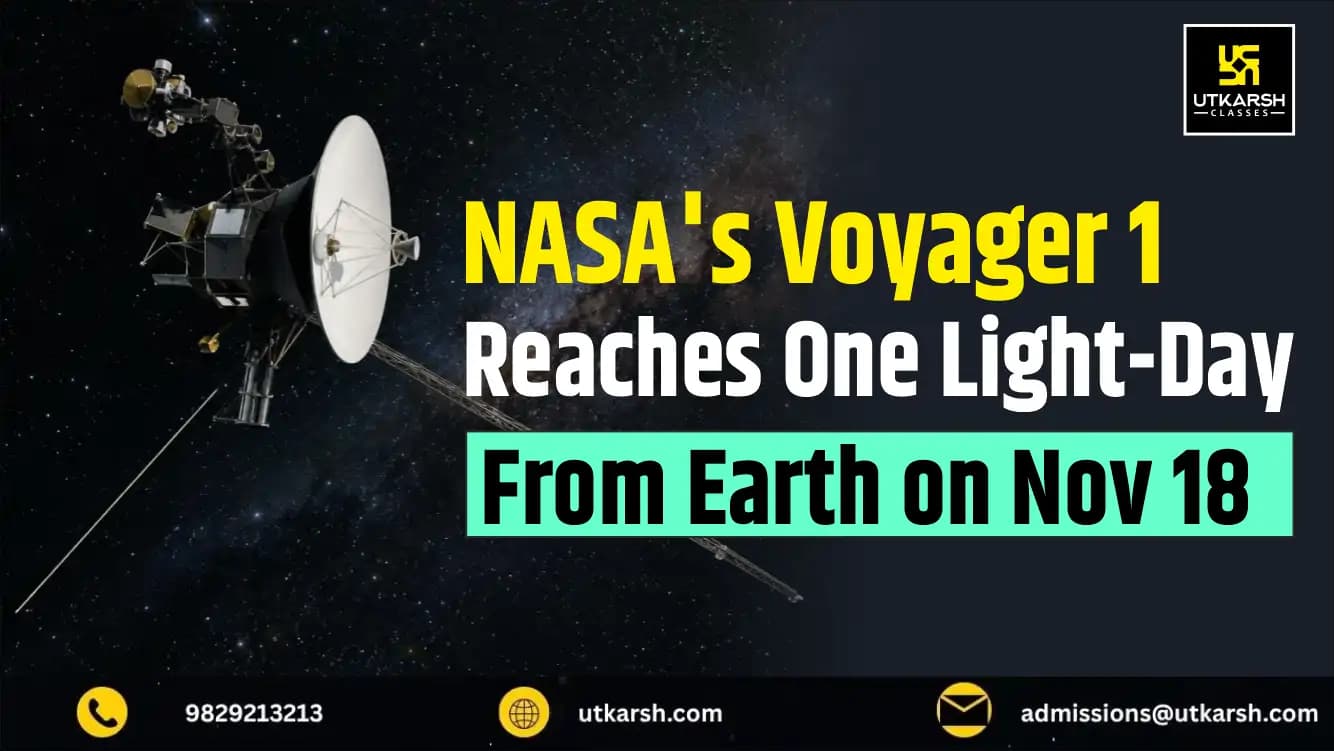
NASA’s Voyager 1 spacecraft has achieved a monumental milestone in human space exploration. On November 18, 2026, the legendary probe reached a distance of one light-day from Earth after more than 49 years of continuous flight.
As the farthest human-made object in existence, Voyager 1 has traveled so far into deep space that its radio signals now take 24 hours to reach our planet. Flight controllers at NASA’s Jet Propulsion Laboratory (JPL) in Southern California confirmed the achievement, celebrating the endurance of a mission that continues to expand humanity's cosmic reach.
|
Mission Parameter |
Official Details |
|
Spacecraft |
NASA’s Voyager 1 |
|
Milestone Timestamp |
November 18, 2026, at 2:16 a.m. PST (5:16 a.m. EST) |
|
Exact One Light-Day Distance |
~16.1 billion miles (25.9 billion kilometres) |
|
Signal Travel Time |
24 hours one-way (48 hours round-trip command cycle) |
|
Launch Year & Duration |
Launched in 1977 (over 49 years in active operation) |
|
Cruising Velocity |
Approximately 38,000 mph (61,155 km/h) |
|
Interstellar Entry |
Crossed the heliosphere in 2012 (Voyager 2 followed in 2018) |
|
Power System |
Radioisotope Thermoelectric Generator (RTG) — loses ~4 watts/year |
A light-day measures the exact distance that light travels through a vacuum in 24 hours. Moving at roughly 186,000 miles (299,000 kilometres) per second, light covers approximately 16.1 billion miles (25.9 billion kilometres) in a single day.
Voyager 1 crossed this threshold at 2:16 a.m. PST (5:16 a.m. EST) on November 18, 2026. Its radio transmission traveled at light speed for a full day before JPL engineers captured it on November 19.
Voyager 1 achieved this historic distance while navigating an active technical challenge. Since November 14, 2026, the spacecraft has stopped transmitting its regular stream of science and engineering telemetry.
However, Voyager 1 continues to beam a steady carrier signal toward Earth. Using this baseline radio tone alongside precision orbital trajectory calculations, JPL engineers verified the exact moment the probe crossed the one-light-day mark. Meanwhile, specialists are actively diagnosing the onboard anomaly to restore full data transmission.
NASA launched Voyager 1 and its twin, Voyager 2, in 1977 to take advantage of a rare geometric alignment of the outer planets that occurs once every 175 years.
In 2012, Voyager 1 became the first human-made probe to enter interstellar space—the vast expanse between stars. It achieved this by crossing the outer edge of the heliosphere, a giant magnetic bubble inflated by the Sun’s solar wind that shields our Solar System from harmful galactic cosmic radiation.
Following a different trajectory, Voyager 2 crossed into interstellar space in 2018. Today, both spacecraft sample particles and magnetic fields beyond the Sun’s protective bubble.
Before Voyager, astronomers lacked direct in-situ measurements of interstellar space. Data returned by both probes revealed a surprising discovery: the Sun’s magnetic influence extends significantly farther into interstellar space than theoretical models predicted.
Voyager project scientist Linda Spilker emphasized that keeping the probes operational allows researchers to map where solar influence truly ends and undisturbed interstellar medium begins.
Because sunlight at interstellar distances is far too weak for solar panels, Voyager 1 relies on a Radioisotope Thermoelectric Generator (RTG). Functioning like a nuclear battery, the RTG converts heat from decaying plutonium-238 into electricity.
As the plutonium decays, each Voyager spacecraft loses roughly 4 watts of electrical power every year. To keep science instruments running, engineers carefully manage the power budget. Earlier in 2026, flight controllers executed a delicate maneuver—switching off three legacy onboard devices and activating three lower-power backup systems. NASA expects these energy-saving steps to keep Voyager 1’s science instruments operating through its 50th launch anniversary in 2027.
Hurtling through space at 38,000 mph (61,155 km/h), Voyager 1 operates on 1970s-era hardware. Over nearly five decades, JPL engineers have creatively resolved clogged thruster lines, degrading sensors, and onboard computer glitches from billions of kilometres away.
Communicating with the probe requires NASA’s Deep Space Network (DSN)—three giant radio antenna complexes positioned around the globe. While engineers listen to Voyager 1 daily and send commands weekly, every instruction now takes 24 hours to reach the probe and another 24 hours for a confirmation signal to return—creating a 48-hour round-trip communication loop.
Mounted to the side of both Voyager probes is the Golden Record, a 12-inch gold-plated copper phonograph disc curated under the leadership of astronomer Carl Sagan.
Containing encoded images, natural Earth sounds, music from diverse world cultures, and spoken greetings in dozens of languages, the Golden Record serves as a cosmic time capsule—carrying humanity's story to any advanced civilization that might encounter Voyager millions of years from now.
As Caltech President Ray Jayawardhana noted, the Voyager mission stands as a triumph of human ingenuity and multi-generational dedication. Reaching one light-day from Earth proves that visionary scientific investment can overcome extreme distances, dwindling power, and aging hardware—inspiring future generations to explore the farthest frontiers of our universe.
लेखक के बारे में

Girish Kumar
Current Affairs Content Writer
Girish Kumar is a current affairs content writer at Utkarsh Classes, with a decade of experience covering diverse contemporary issues. He develops high-quality study material for various competitive examinations, including UPSC, PSC, Bank PO etc.

नवीनतम करेंट अफेयर्स
Frequently asked questions

अपने नज़दीकी उत्कर्ष क्लासेज के ऑफलाइन सेंटर पर आज ही विजिट करें।