सीखने के लिए तैयार हैं?
अपने शैक्षणिक लक्ष्यों को प्राप्त करने की दिशा में पहला कदम उठाएँ। चाहे आप परीक्षा की तैयारी कर रहे हों या अपने ज्ञान का विस्तार कर रहे हों, शुरुआत बस एक क्लिक दूर है। आज ही हमसे जुड़ें और अपनी पूरी क्षमता को अनलॉक करें।
Utkarsh Classes
Admission office
Above Arora Namkeen
Jalori Gate circle,
Jodhpur (Raj.), 342005
support@utkarsh.com
+91-9116691119, +91-9829213213
आरंभ करें


सीखने के साधन
Teaching Exams
Rajasthan Govt Exams
Central Govt Exams
Civil Services Exams
Nursing Exams
School Tuitions
Other State Govt Exams
Agriculture Exams
College Entrance Exams
Miscellaneous Exams

© 2026 उत्कर्ष क्लासेज एंड एडुटेक प्राइवेट लिमिटेड सभी अधिकार सुरक्षित
Add as a preferred source on Google
Donald Trump, Xi Jinping, and Vladimir Putin issue a four-point Declaration Towards Peace, focusing on energy supplies, nuclear risks, and UN reforms.
Updated: 20 Nov 2026
4 Min Read
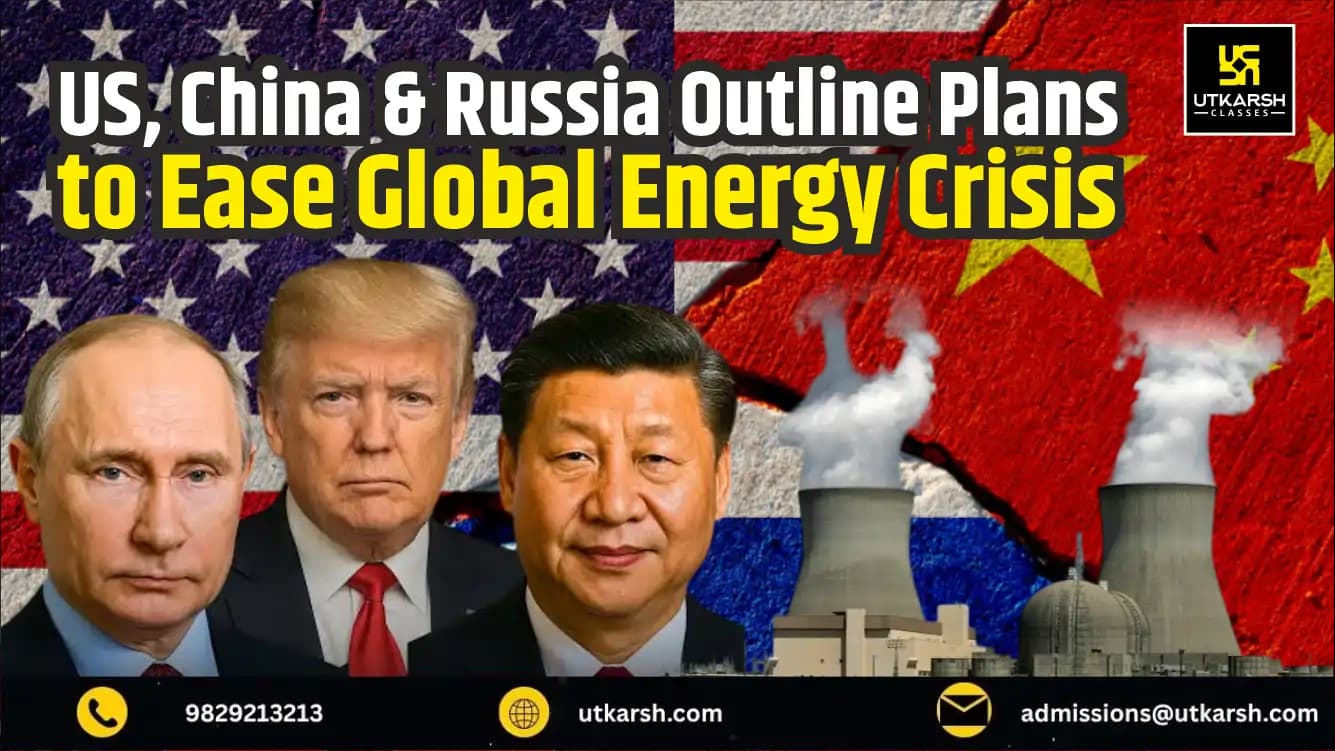
Presidents of the United States, China, and Russia concluded an unprecedented trilateral summit with a joint declaration on pressing global challenges. Meeting on the sidelines of the Asia-Pacific Economic Cooperation (APEC) summit at Kylin Villa in Shenzhen, China, Donald Trump, Xi Jinping, and Vladimir Putin issued a four-point agreement titled “Declaration Towards Peace.”
Through this landmark document, the three leaders outlined plans to boost the production and supply of refined petroleum products to ease the global energy crisis. They also called for United Nations (UN) reforms, committed to dialogue on nuclear risk reduction, and warned against jurisdictional overreach by the International Criminal Court (ICC).
|
Particulars |
Official Details |
|
Participating Leaders |
US President Donald Trump, Chinese President Xi Jinping, and Russian President Vladimir Putin |
|
Venue & Occasion |
Kylin Villa, Shenzhen, China (on the sidelines of the APEC Summit) |
|
Outcome Document |
Four-point “Declaration Towards Peace” |
|
Energy Focus |
Increasing production and supply of refined petroleum products |
|
Security Focus |
Dialogue on nuclear risk reduction and nuclear non-proliferation |
|
Institutional & Legal Focus |
Calling for UN reforms and opposing jurisdictional abuse by the ICC |
The joint declaration establishes a shared diplomatic agenda across four critical areas:
Stabilizing global energy markets stood at the center of the Shenzhen talks. Trump, Xi, and Putin agreed on the need to expand the production and supply of refined petroleum products.
Refined fuels power global transportation, industrial manufacturing, and electricity generation. Supply bottlenecks quickly trigger inflation and disrupt economic activity worldwide. By prioritizing higher output and smoother supply chains, the three major powers aim to relieve pressure on global consumers—though the declaration did not specify exact production quotas or delivery timelines.
The three Presidents jointly called for structural reforms within the United Nations. As the premier forum for international diplomacy, peace, and security, the UN faces growing calls to adapt to shifting geopolitical dynamics.
While the declaration places UN reform high on the trilateral agenda, the leaders did not outline specific institutional proposals or name targeted UN organs for restructuring.
Strategic stability formed another major pillar of the summit. The three leaders committed to ongoing dialogue aimed at lowering nuclear risks and preventing the proliferation of nuclear weapons.
Direct communication between Washington, Beijing, and Moscow helps reduce the danger of miscalculation or accidental escalation. Reaffirming non-proliferation commitments also signals a shared interest in stopping nuclear weapons from spreading to additional states or non-state actors.
The declaration also addressed international legal institutions. The three Presidents stated that the International Criminal Court (ICC) and comparable judicial bodies must not abuse their jurisdiction.
While the announcement did not cite any specific legal proceedings, the joint statement underscores shared concerns among the three nations regarding how international courts exercise authority over sovereign states.
Bringing together the leaders of the United States, China, and Russia carries profound geopolitical weight. Direct engagement allows the world's foremost military and economic powers to manage friction and identify practical areas of cooperation.
Ultimately, the long-term impact of the “Declaration Towards Peace” will depend on whether Washington, Beijing, and Moscow back their joint commitments with concrete policy actions in energy markets and international diplomacy.
लेखक के बारे में

Girish Kumar
Current Affairs Content Writer
Girish Kumar is a current affairs content writer at Utkarsh Classes, with a decade of experience covering diverse contemporary issues. He develops high-quality study material for various competitive examinations, including UPSC, PSC, Bank PO etc.

नवीनतम करेंट अफेयर्स
Frequently asked questions

अपने नज़दीकी उत्कर्ष क्लासेज के ऑफलाइन सेंटर पर आज ही विजिट करें।