Ready to learn?
Take the first step toward achieving your educational goals. Whether you’re preparing for exams or expanding your knowledge, getting started is just a click away. Join us today and unlock your full potential
832, utkarsh bhawan, near mandap restaurant, 9th chopasani road, jodhpur rajasthan - 342003
support@utkarsh.com
+91-9116691119, +91-9829213213
Support
Get Started


Learning Resources
Rajasthan Govt Exams
Central Govt Exams
Civil Services Exams
Nursing Exams
School Tuitions
Other State Govt Exams
Agriculture Exams
College Entrance Exams
Miscellaneous Exams

© 2026 Utkarsh Classes & Edutech Pvt. Ltd. All Rights Reserved
Add as a preferred source on Google
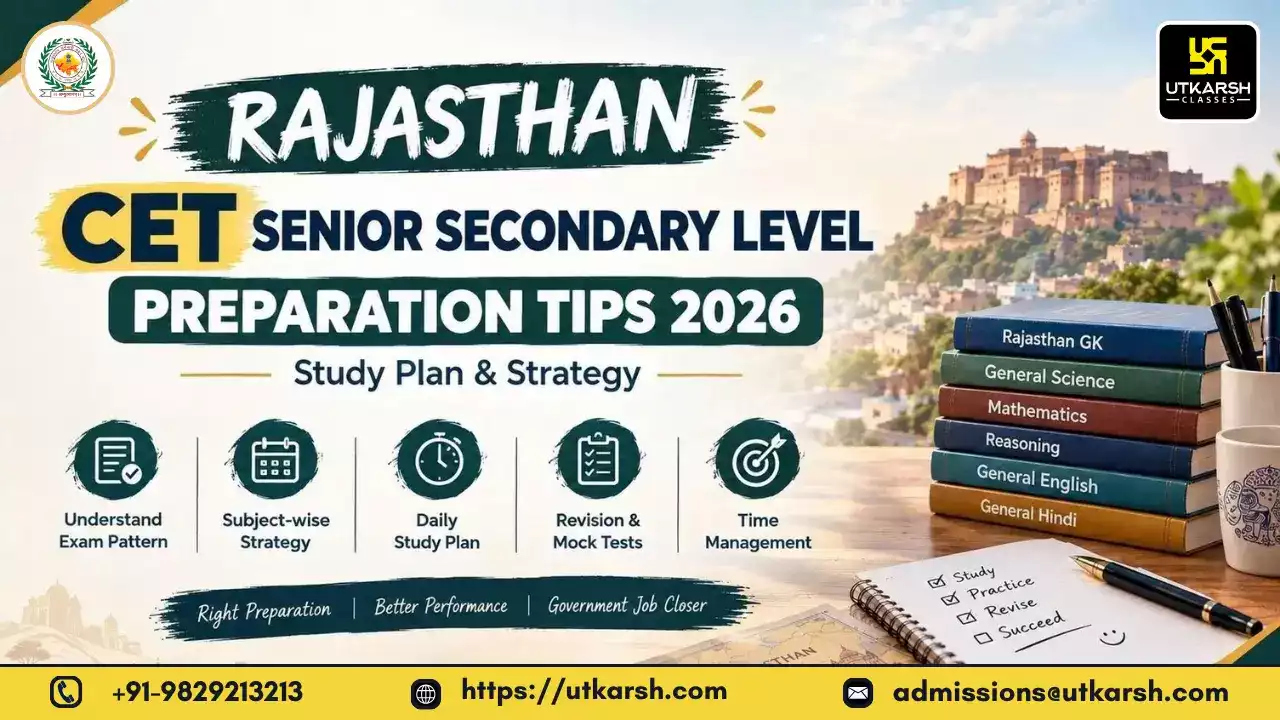
The Rajasthan CET Senior Secondary Level Exam is conducted for candidates seeking eligibility for various Rajasthan government posts. The exam covers a wide range of subjects, including Rajasthan General Knowledge, General Science, Mathematics, Reasoning, General Hindi, General English, Computer Knowledge and Current Affairs. Since the syllabus is broad, candidates need a proper study plan to cover all subjects and revise them effectively.
The CET score is used for different recruitment opportunities, including posts such as Rajasthan Police Constable, Junior Assistant, Clerk Grade-II and Hostel Superintendent. Candidates who qualify the CET can use their score for relevant recruitments announced during the validity period, as the CET score remains valid for three years.
However, studying for long hours without a clear plan may not be enough to perform well in the examination. Candidates should know which subjects need regular revision, which topics require more question practice and how to manage time during the paper. This article covers Rajasthan CET Preparation Tips 2026, including subject-wise preparation strategies, a daily study plan, revision techniques, mock-test analysis and exam-hall time management tips suggested by Utkarsh Classes mentors.
Before creating a study plan, candidates should first understand the exam pattern. The Rajasthan Staff Selection Board (RSSB) conducts the Senior Secondary CET in offline OMR mode. Knowing the number of questions, marking scheme, subject distribution, and exam duration helps candidates manage their time properly and avoid unnecessary mistakes due to negative marking.
The structural overview of the Rajasthan CET (10+2) examination pattern is summarized below:
|
Rajasthan CET (10+2) Level 2026 |
|
|
Exam Name |
Rajasthan CET Senior Secondary Level 2026 |
|
Level |
Senior Secondary / 10+2 |
|
Total Questions |
120 Questions |
|
Maximum Marks |
240 Marks |
|
Exam Duration |
150 Minutes (2 Hours 30 Minutes) |
|
Question Type |
Objective Type Multiple Choice Questions (MCQs) |
|
Exam Mode |
Offline, OMR-based |
|
Negative Marking |
1/3 Mark for Each Wrong Answer |
|
Minimum Qualifying Marks |
40% (Category-wise relaxations apply as per government rules) |
|
Score Validity |
3 Years |
The Rajasthan Staff Selection Board does not fix rigid sectional cutoffs or mandatory question quotas for individual subjects in its exam pattern. The examination features a single integrated question paper where questions from different subjects appear together. However, based on previous exam shifts and paper analysis, candidates can prioritize their preparation using these broad weightage trends:
|
Subject / Section |
Indicative Weightage Trend |
Preparation Priority |
|
Rajasthan History, Art, Culture, Literature & Heritage |
~20% – 25% |
Core Foundation (High Weightage) |
|
Geography of Rajasthan & India |
~15% – 18% |
Core Foundation (Map-Based) |
|
Everyday Science & Public Health (First Aid, CPR, Health Acts) |
~10% – 12% |
High-Scoring / Conceptual |
|
Basic Mathematics (Numerical Ability & Mensuration) |
~8% – 10% |
Daily Problem Solving |
|
Logical Reasoning & Mental Ability |
~8% – 10% |
High Accuracy / Practice-Based |
|
General Hindi |
~8% – 10% |
Quick Scoring / Grammar Rules |
|
Rajasthan Polity & Administrative System |
~8% – 10% |
Factual & Constitutional |
|
General English |
~6% – 8% |
Grammar & Vocabulary |
|
Computer Knowledge (MS Office, Memory, IT Basics) |
~6% – 8% |
Quick Scoring / High ROI |
|
Rajasthan Economy & Government Welfare Schemes |
~6% – 8% |
Factual & Scheme Updates |
|
Current Affairs (Rajasthan, National & Global Events) |
~6% – 8% |
Daily Regular Tracking |
NOTE: The subject-wise weightage shown above is indicative and based on past trends and mentor evaluation to help students plan their revision. The board reserves the right to vary the exact number of questions across sections.
The Rajasthan Staff Selection Board enforces a strict 5-option OMR evaluation system across its offline recruitment exams to curb malpractices and maintain total transparency. Candidates must follow these guidelines carefully during the examination:
Deep dive into the 40% criteria, new topics like CPR and public health, and book lists through this video → CET 2026 Syllabus, Exam Pattern & Strategy
The first mistake many candidates make is starting preparation without looking at the complete syllabus. They begin with whichever book or video they find online first and continue studying without checking whether all the required topics are being covered. This can result in some subjects receiving too much attention while other important sections remain untouched. To start an effective preparation, students must follow these tips:
All subjects do not require the same preparation approach. Utkarsh mentors suggest dividing the syllabus based on the type of effort each subject needs.
Each subject needs a slightly different preparation approach. Factual subjects require repeated revision, while Mathematics and Reasoning improve mainly through regular question practice. Candidates should therefore plan their preparation according to the nature of each subject instead of following the same method for every section.
Prepare Rajasthan History in a sequence so that major events are easier to connect and remember. Give special attention to ancient sites and civilisations, major dynasties and rulers, important battles, the freedom movement, Prajamandal movements, peasant and tribal movements, and the integration of Rajasthan. Important personalities should also be revised regularly.
Making short timelines can make revision easier. Note the leader, place, period and major development together for important movements and events. This will help you revise an entire topic quickly instead of reading the complete chapter repeatedly.
Rajasthan Art and Culture includes many similar-looking facts, so connecting each fact with its region or tradition can make preparation easier. Cover folk dances, folk songs, musical instruments, folk deities, fairs and festivals, paintings, handicrafts, forts, architecture, costumes, ornaments, languages, dialects and literature.
While studying a folk dance or fair, remember its associated region and significance along with the name. Keep micro notes for facts that you frequently confuse and revise them regularly.
Use maps wherever possible while preparing Rajasthan Geography. Start with the physical divisions of the state: Aravalli Range, desert region, rivers, drainage system, lakes, climate, soil, vegetation and wildlife. Then move to minerals, agriculture, irrigation, population, tribes and industries.
Instead of memorising separate lists of rivers, dams, minerals or wildlife locations, try to understand their geographical distribution. This makes closely related locations easier to distinguish in objective questions.
Start preparing for this subject with the basic features of the Indian Constitution and then focus on Rajasthan's administrative structure. Cover Fundamental Rights, Fundamental Duties, Directive Principles, the President, Governor, Parliament, State Legislature, Judiciary, constitutional bodies, Panchayati Raj and local administration.
Once the basic concepts are clear, practise MCQs regularly. This is particularly useful for questions that ask candidates to distinguish between similar constitutional provisions, institutions or functions.
Study Rajasthan Economy by connecting basic economic concepts with the state's major sectors. Agriculture, irrigation, minerals, industries, tourism, animal husbandry and handicrafts should be prepared along with important state-level developments.
Government schemes also need regular revision. Make short notes covering their purpose, beneficiaries and major features instead of trying to memorise every detail. Rajasthan Budget and other important economic developments should be covered through Current Affairs.
Focus on basic scientific concepts and their applications in everyday life rather than spending excessive time on advanced topics. Cover Physics, Chemistry, Biology, human health, nutrition, diseases, environment, plants, animals and everyday scientific phenomena.
Science preparation should combine concept reading with MCQ practice. After completing a topic, solve related questions and revisit the concept if the same type of mistake occurs repeatedly. Important developments in Science and Technology can be prepared along with Current Affairs.
Mathematics requires regular practice, so candidates should not postpone numerical preparation until the final weeks. Start with Number System, Simplification, LCM and HCF, Percentage, Average, Ratio and Proportion, and then move to Profit and Loss, Simple and Compound Interest, Time and Work, Time, Speed and Distance, Mensuration and data-based questions.
Maintain a formula notebook for quick revision, but do not limit preparation to reading formulas. Understand the method and immediately practise questions based on it. Utkarsh mentors recommend regular practice of calculation-heavy topics so that familiar questions can be solved without spending unnecessary time during the examination.
Reasoning improves with regular question practice. First understand the method for each question type and then solve enough questions to become familiar with the pattern. Focus on Analogy, Classification, Number and Alphabet Series, Coding-Decoding, Blood Relations, Direction Sense, Ranking, Clock and Calendar, Venn Diagrams and Logical or Analytical Reasoning.
When you make a mistake, identify where your approach went wrong instead of simply noting the correct answer. An error notebook can help you track repeated mistakes and revise the methods that need more attention.
Prepare Hindi through a combination of grammar, vocabulary and question practice. Important areas include संधि, समास, उपसर्ग, प्रत्यय, पर्यायवाची, विलोम, शब्द शुद्धि, वाक्य शुद्धि, मुहावरे and लोकोक्तियाँ.
After studying a grammar rule, practise MCQs based on it. This will help you understand how the rule is applied in examination questions and identify the areas where you need further revision.
Regular short study sessions can make English preparation manageable. Focus on grammar, vocabulary and comprehension, including Parts of Speech, Tenses, Articles, Prepositions, Subject-Verb Agreement, Active and Passive Voice, Direct and Indirect Speech, Synonyms, Antonyms, Error Detection and Sentence Correction.
Maintain a small vocabulary list for difficult words and revise it regularly. For grammar, give more attention to the rules you frequently get wrong rather than repeatedly revising topics you already understand.
Computer Knowledge can be prepared effectively by covering the basic concepts and then practising objective questions. Focus on computer fundamentals, hardware and software, input and output devices, operating systems, MS Word, MS Excel, PowerPoint, Internet, networking basics, memory and storage, and common computer terminology.
Keep important abbreviations, keyboard shortcuts, storage units and terminology in short notes for quick revision before mock tests and the final examination.
Current Affairs should be studied throughout the preparation rather than being left for the final few weeks. Give special attention to Rajasthan-specific developments along with important national and international events.
Cover government schemes, appointments, awards, sports, important reports, Science and Technology, books and authors, important days and major government initiatives. A monthly revision cycle can make this section easier to manage. Prepare short notes and revise them regularly instead of repeatedly reading the entire material.
Candidates should also pay attention to newly added practical and public-health topics mentioned in the syllabus:
A daily study plan should be practical and easy to follow consistently. Making a 12-hour timetable has little value if it becomes difficult to maintain after a few days. The focus should be on creating a routine that gives regular time to every important part of the syllabus.
|
Study Session |
Time Slot |
Suggested Subject Focus |
|
First Session |
Morning (2.5 Hours) |
Rajasthan History / Art & Culture / Geography |
|
Second Session |
Late Morning (2 Hours) |
Mathematics / Reasoning (Problem-solving) |
|
Third Session |
Afternoon (1.5 Hours) |
Polity / Economy / General Science |
|
Fourth Session |
Late Afternoon (1.5 Hours) |
Hindi / English / Computer Knowledge |
|
Daily Revision |
Evening (1 Hour) |
Current Affairs + Quick Review of the Day's Notes |
|
Final Session |
Night (1 Hour) |
Objective MCQ Practice / Error Log Analysis |
Keep the syllabus in front of you while following the timetable and mark topics as you complete them. This will help you track your progress and identify the areas that need another round of revision.
The final 30 days before the exam should focus on revision, practice and consolidation instead of collecting new study material.
Avoid making major changes to your study material during the final days. Use this period to strengthen the topics you have already prepared.
A structured revision framework ensures that you do not forget older topics while moving ahead with the syllabus. Simply re-reading textbooks is not enough; candidates must combine spaced recall, micro-notes, previous year questions, and full-length mock tests to consolidate their preparation.
Keep the syllabus in front of you while following the timetable and mark topics as you complete them. This will help you track your progress and identify the areas that need another round of revision.
Candidates do not need lengthy notes for every topic. Instead, prepare short micro notes containing facts, formulas and concepts that require repeated revision. These notes will become especially useful during the final weeks:
Keep these notes concise and update them during revision. By the final week, they should provide a quick source for revising important information without having to go through multiple books or PDFs.
Previous year papers should be used to understand the examination as well as to strengthen preparation. They can show how different topics are converted into questions and which areas need more practice.
Mock tests are most useful when candidates analyse their performance after every test. Simply attempting a paper, checking the score and moving on to the next test does not show where the actual problem lies.
After each mock, check the questions you answered incorrectly as well as those you answered by guessing. A guessed answer may be correct, but if the concept is not clear, a similar question can become an error in the actual examination. Also note the questions that took more time than expected.
Your mock-test analysis should answer three basic questions:
Use these findings to plan the next week's revision and practice. This makes every mock test part of your preparation rather than just a measure of your score.
To get guidance on practicing full-length mock tests and performance evaluation, watch this video → CET 2026 Free Mock Tests Overview
Candidates can practise through the Free CET 10+2 Online Open Mock Tests available on the Utkarsh App:
Treat these tests like actual examinations. Sit with the prescribed 150-minute time limit, avoid checking answers while attempting the paper and complete the test in one sitting.
Candidates get 150 minutes to complete the Rajasthan CET paper, so having a time-management strategy can help them use the available time effectively. Utkarsh mentors suggest dividing the paper into different stages instead of attempting questions randomly.
This is a practical approach rather than a compulsory sequence. Candidates should adjust the order according to their strengths and the strategy that works for them during mock tests.
One useful time-management technique suggested by Utkarsh mentors is the 30-Second Rule:
If you spend around 30 seconds reading a question and still do not have a clear idea of how to approach it, move ahead immediately and return to it later.
This rule is especially important in Mathematics and Reasoning, where an intricate seating arrangement or compound interest problem can easily swallow 5 minutes. Remember: every question carries 2 marks. Wasting time on one difficult question costs you the chance to attempt 5 easy General Knowledge questions waiting near the end of the test.
To get tips on avoiding time traps, negative marking calculations, and the 150-minute plan, watch this video → CET 10+2 Exam 2026: Time Management & Question Traps
The 40% minimum qualifying requirement should not be taken as a reason to attempt questions through random guessing. Since 1/3 marks (0.66 marks) are deducted for an incorrect answer, unnecessary attempts can drag your score below the qualifying line.
The focus should always be on increasing the number of accurate, confident attempts rather than maximizing attempts blindly.
The Rajasthan CET Senior Secondary Level examination is conducted in offline OMR mode, so candidates should include OMR practice in their full-length mock tests.
Students must avoid doing these mistakes during their CET exam preparation:
Rajasthan CET Senior Secondary Level preparation requires consistency rather than a complicated study routine. Candidates should divide the syllabus properly, revise factual subjects regularly and give enough time to Mathematics and Reasoning practice.
Current Affairs should remain part of the daily routine, while mock tests and previous year questions should be used to identify and correct weak areas. Candidates should also practise completing the paper within 150 minutes and develop a careful approach towards negative marking and OMR marking.
The most important part of preparation is to learn from mistakes. Instead of repeatedly covering new material, focus on revising the syllabus, improving accuracy and strengthening the topics that continue to cause difficulty. A consistent study routine combined with regular revision and practice can make the Rajasthan CET syllabus much easier to manage.
About the author

Sakshi
Content Writer
Sakshi Dawar is a professional content writer with 5+ years of experience in creating SEO-friendly and engaging content. With a background across Digital Marketing, EdTech, and Law, she focuses on delivering clear, well-structured content that drives value for readers. At Utkarsh Classes, she applies this expertise to create accurate, learner-focused content for competitive exam aspirants, combining creativity with strategy to make information both impactful and easy to understand.

RSMSSB CET Important Updates
Frequently asked questions