सीखने के लिए तैयार हैं?
अपने शैक्षणिक लक्ष्यों को प्राप्त करने की दिशा में पहला कदम उठाएँ। चाहे आप परीक्षा की तैयारी कर रहे हों या अपने ज्ञान का विस्तार कर रहे हों, शुरुआत बस एक क्लिक दूर है। आज ही हमसे जुड़ें और अपनी पूरी क्षमता को अनलॉक करें।
Utkarsh Classes
Admission office
Above Arora Namkeen
Jalori Gate circle,
Jodhpur (Raj.), 342005
support@utkarsh.com
+91-9116691119, +91-9829213213
आरंभ करें


सीखने के साधन
Teaching Exams
Rajasthan Govt Exams
Central Govt Exams
Civil Services Exams
Nursing Exams
School Tuitions
Other State Govt Exams
Agriculture Exams
College Entrance Exams
Miscellaneous Exams

© 2026 उत्कर्ष क्लासेज एंड एडुटेक प्राइवेट लिमिटेड सभी अधिकार सुरक्षित
Add as a preferred source on Google
Explore India's solar energy growth, installed capacity, government schemes, solar parks, domestic manufacturing and global renewable energy partnerships.
Updated: 17 Nov 2026
6 Min Read
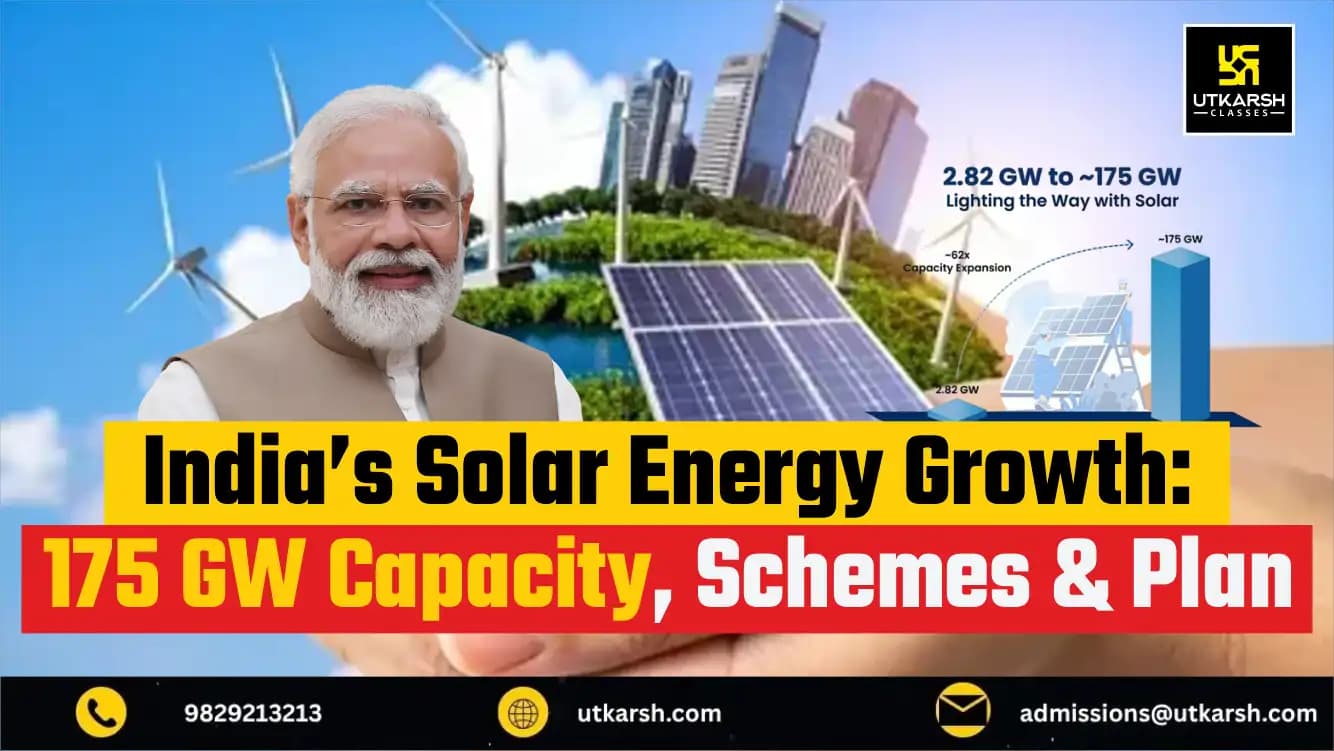
India’s solar energy sector has entered a transformative phase of expansion. Over the past twelve years, solar power has evolved from a niche alternative into the backbone of the nation’s clean energy transition. Strong policy frameworks, domestic factory investments, and mass citizen participation have propelled this growth.
Between 2014 and October 31, 2026, India’s installed solar capacity surged from 2.82 GW to approximately 175 GW—an extraordinary 62-fold increase. Today, solar electricity directly reinforces India's energy security, powers industrial expansion, and drives progress toward national climate commitments. These milestones took center stage at the Bharat Renewable Energy Summit & Expo (BRESE) 2026, hosted in New Delhi from November 2 to 5, 2026.
Recent government data highlights the speed and scale of India’s clean power expansion across generation and manufacturing:
|
Metric / Achievement |
Recorded Milestone |
Reference Date |
|
Total Installed Solar Capacity |
~175 GW (62x growth since 2014) |
October 31, 2026 |
|
Annual Capacity Addition (FY26) |
44.61 GW added in a single fiscal year |
FY 2025–26 |
|
Solar Module Manufacturing |
192 GW domestic manufacturing capacity |
June 2026 |
|
Total Non-Fossil Fuel Capacity |
308.03 GW nationwide |
September 30, 2026 |
|
Peak Electricity Demand Share |
Met 51.5% of India’s national power demand |
July 29, 2025 |
|
Global Annual Additions (2025) |
Added 37 GW, surpassing the United States |
Calendar Year 2025 |
From November 2 to 5, 2026, Bharat Mandapam in New Delhi hosted the Bharat Renewable Energy Summit & Expo (BRESE) 2026 under the theme “Invest. Innovate. Inspire.”
The summit convened policymakers, investors, researchers, and industry executives from more than 130 countries. Running alongside the 9th International Solar Alliance (ISA) Assembly and the 4th International Conference on Green Hydrogen, the exhibition featured over 400 organizations and 13 Partner States showcasing regional clean energy investment opportunities. Organizers also honored the winners of the Bharat Renewable Energy Hackathon 2026, which crowdsourced practical engineering solutions to ten real-world renewable energy challenges.
India’s solar boom rests on structured, long-term policy foundations:
To help developers build gigawatt-scale projects rapidly without land-acquisition delays, the government launched the Solar Parks Scheme with an initial 20 GW goal, later doubling it to 40 GW in 2017. By October 2026, authorities had approved 56 solar parks with a combined sanctioned capacity of 39,461 MW.
To transmit clean electricity from resource-rich states to major industrial load centers, the Green Energy Corridor Programme had enabled the grid evacuation of 24,567.8 MW by February 2026. Ongoing transmission projects across ten states will expand evacuation capacity to roughly 44 GW.
Recognizing land constraints, the Union Government approved the Pradhan Mantri Surya Sarovar Yojana (PM-SSY) on July 31, 2026. Backed by an outlay of ₹5,070 crore from FY 2026–27 to FY 2030–31, this scheme deploys 5,000 MW of floating solar photovoltaic projects paired with battery energy storage systems across reservoirs and industrial ponds.
Every project incorporates at least two hours of energy storage—totaling 10,000 MWh—to help state utilities manage evening peak demand and stabilize grid frequency. According to the National Institute of Solar Energy (NISE), India’s inland water bodies hold an estimated 102.18 GWp of untapped floating solar potential.
To eliminate reliance on imported equipment and secure clean-energy supply chains, New Delhi has aggressively scaled up domestic manufacturing:
Beyond massive utility installations, India has democratized clean power through two grassroots schemes:
India actively shares its clean-energy expertise with developing nations worldwide:
With 175 GW of installed solar capacity and 308.03 GW of total non-fossil fuel power already online, India stands firmly on track to achieve its 500 GW non-fossil fuel target by 2030. Continued investments in battery storage, floating solar, domestic cell manufacturing, and rooftop adoption will anchor India's journey toward energy independence and its 2070 net-zero emissions goal.
लेखक के बारे में

Girish Kumar
Current Affairs Content Writer
Girish Kumar is a current affairs content writer at Utkarsh Classes, with a decade of experience covering diverse contemporary issues. He develops high-quality study material for various competitive examinations, including UPSC, PSC, Bank PO etc.

नवीनतम करेंट अफेयर्स
Frequently asked questions

अपने नज़दीकी उत्कर्ष क्लासेज के ऑफलाइन सेंटर पर आज ही विजिट करें।