Ready to learn?
Take the first step toward achieving your educational goals. Whether you’re preparing for exams or expanding your knowledge, getting started is just a click away. Join us today and unlock your full potential
832, utkarsh bhawan, near mandap restaurant, 9th chopasani road, jodhpur rajasthan - 342003
support@utkarsh.com
+91-9116691119, +91-9829213213
Support
Get Started


Learning Resources
Rajasthan Govt Exams
Central Govt Exams
Civil Services Exams
Nursing Exams
School Tuitions
Other State Govt Exams
Agriculture Exams
College Entrance Exams
Miscellaneous Exams

© 2026 Utkarsh Classes & Edutech Pvt. Ltd. All Rights Reserved
Home

National Current Affairs
Important Day
Mahatma Gandhi Jayanti 2 October: Theme, History, and Celebration
Add as a preferred source on Google
Updated: 23 Sep 2026
4 Min Read
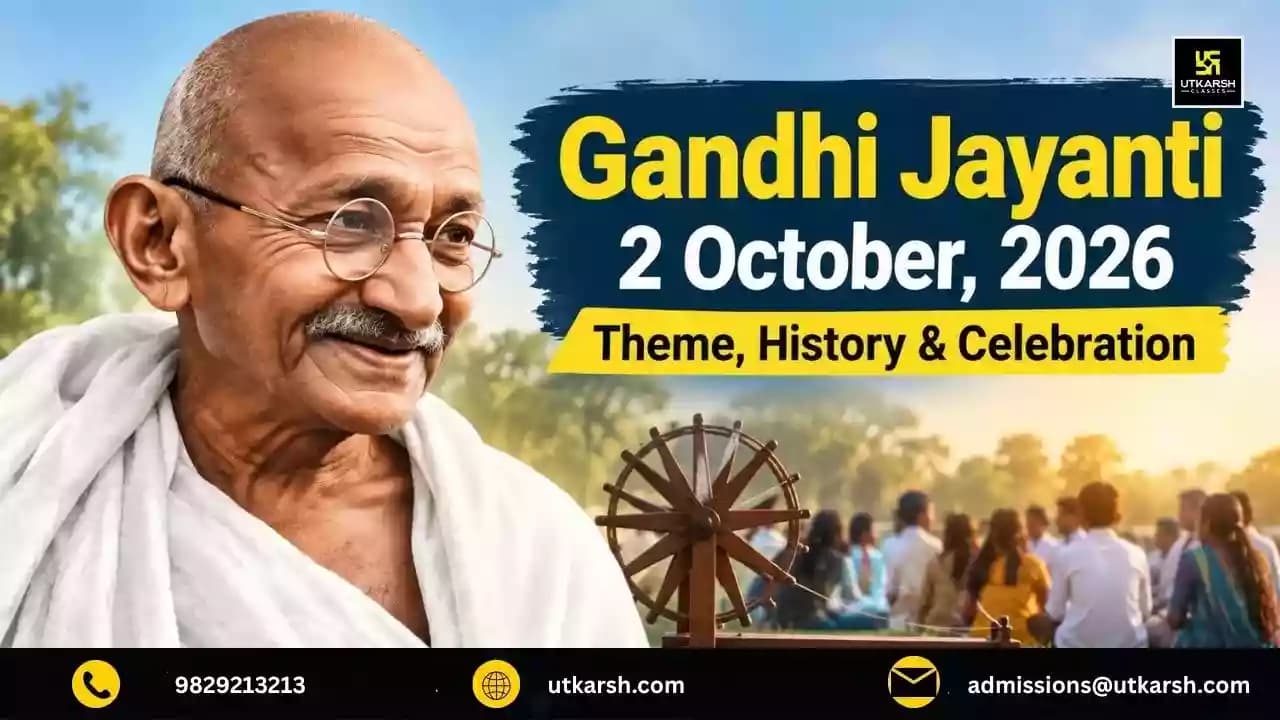
Gandhi Jayanti, observed every year on October 2, marks the birth anniversary of Mahatma Gandhi, the father of the nation. In 2026, the day will commemorate his 156th birth anniversary. Beyond being a national holiday in India, it holds global significance as the International Day of Non-Violence, honouring Gandhi's lifelong commitment to peace and non-violent resistance.
Gandhi Jayanti is observed on October 2 every year, without fail, since it marks the exact birth date of Mohandas Karamchand Gandhi. It is one of only three national holidays in India alongside Independence Day and Republic Day and is marked by government offices, schools, banks, and most businesses remaining closed across the country.
The day serves as a reminder of the values Gandhi stood for: truth, non-violence, simplicity, and self-reliance. His philosophy of passive resistance and his unshakeable belief in Ahimsa remain deeply relevant in a world still grappling with conflict. Gandhi Jayanti also honours his central role in India's freedom struggle, where he managed to weaken an oppressive colonial regime without resorting to armed conflict. His message of tolerance and peace continues to inspire movements for social justice worldwide, making the day one of reflection rather than celebration in the conventional sense.
Each year, the President, Prime Minister, and other senior leaders gather at Raj Ghat in Delhi , Gandhi's cremation memorial, to lay floral tributes and observe a moment of silence at the black marble platform inscribed with his final words.
Communities across the country hold prayer gatherings featuring Gandhi's two favorite devotional songs, "Raghupati Raghava Raja Ram" and "Vaishnav Jan To." These gatherings echo the interfaith evening prayer meetings Gandhi himself used to conduct during his lifetime.
Cleanliness drives form a major part of the day's observances. Under the Swachh Bharat Mission 2026, citizens take part in shramdaan voluntary clean-up work in streets, schools, and public spaces, reflecting Gandhi's belief that cleanliness and self-reliance are closely linked.
Tree plantation drives are also organised on this day as part of the Ek Ped Maa Ke Naam initiative, encouraging citizens to plant trees in honour of their mothers while promoting environmental responsibility, a value in line with Gandhi's emphasis on sustainable living.
As part of the day's observance, the sale of alcohol is banned nationwide on October 2 every year, a practice often referred to as a "dry day," in keeping with Gandhi's own advocacy for abstinence and temperance.
Mahatma Gandhi was born on October 2, 1869, in Porbandar, Gujarat, into a family of modest nobility. After studying law in London, he moved to South Africa, where he first practised civil disobedience against racial discrimination and developed his philosophy of Satyagraha, or peaceful resistance. Returning to India, he became a central figure in the Indian National Congress, leading landmark movements such as the Non-Cooperation Movement, the Salt March, and the Quit India Movement. His approach mobilised millions of Indians and significantly weakened British control. Gandhi was assassinated on January 30, 1948, by Nathuram Godse, but his teachings continue to shape movements for justice and peace around the world.
In recognition of Gandhi's universal message of peace and tolerance, the United Nations declared in 2007 that October 2 would be observed globally as the International Day of Non-Violence, cementing his legacy well beyond India's borders.
October 2 also marks the birth anniversary of Lal Bahadur Shastri, India's second Prime Minister, born in Mughalsarai, Uttar Pradesh, in 1904. In 2026, his 122nd birth anniversary falls on the same day as Gandhi Jayanti. Shastri is remembered for his integrity, simplicity, and his famous slogan "Jai Jawan, Jai Kisan." On this day, leaders and citizens pay tributes at Vijay Ghat in New Delhi, while schools and institutions across India organise debates, speeches, and cultural programmes celebrating both leaders' contributions to the nation
About the author

Utkarsh Classes
Company
This content is prepared by the Utkarsh Classes team to present accurate, updated, and exam-relevant current affairs in a simple and reliable format.


Latest Current Affairs
Frequently asked questions


Still have questions?
Can't find the answer you're looking for? Please contact our friendly team.
Visit Utkarsh Classes Offline Centre Near You.

Download Last 5 Years PYQs in a Single Click
FREE PYQs exam ke level aur question pattern ko samajhne ka best tareeka