सीखने के लिए तैयार हैं?
अपने शैक्षणिक लक्ष्यों को प्राप्त करने की दिशा में पहला कदम उठाएँ। चाहे आप परीक्षा की तैयारी कर रहे हों या अपने ज्ञान का विस्तार कर रहे हों, शुरुआत बस एक क्लिक दूर है। आज ही हमसे जुड़ें और अपनी पूरी क्षमता को अनलॉक करें।
Utkarsh Classes
Admission office
Above Arora Namkeen
Jalori Gate circle,
Jodhpur (Raj.), 342005
support@utkarsh.com
+91-9116691119, +91-9829213213
आरंभ करें


सीखने के साधन
Teaching Exams
Rajasthan Govt Exams
Central Govt Exams
Civil Services Exams
Nursing Exams
School Tuitions
Other State Govt Exams
Agriculture Exams
College Entrance Exams
Miscellaneous Exams
UC Skills

© 2026 उत्कर्ष क्लासेज एंड एडुटेक प्राइवेट लिमिटेड सभी अधिकार सुरक्षित
होम

State Current Affairs
State news
Bihar Becomes India’s First State to Introduce Comprehensive Silt Management Policy 2026
Add as a preferred source on Google
Updated: 04 Nov 2026
4 Min Read
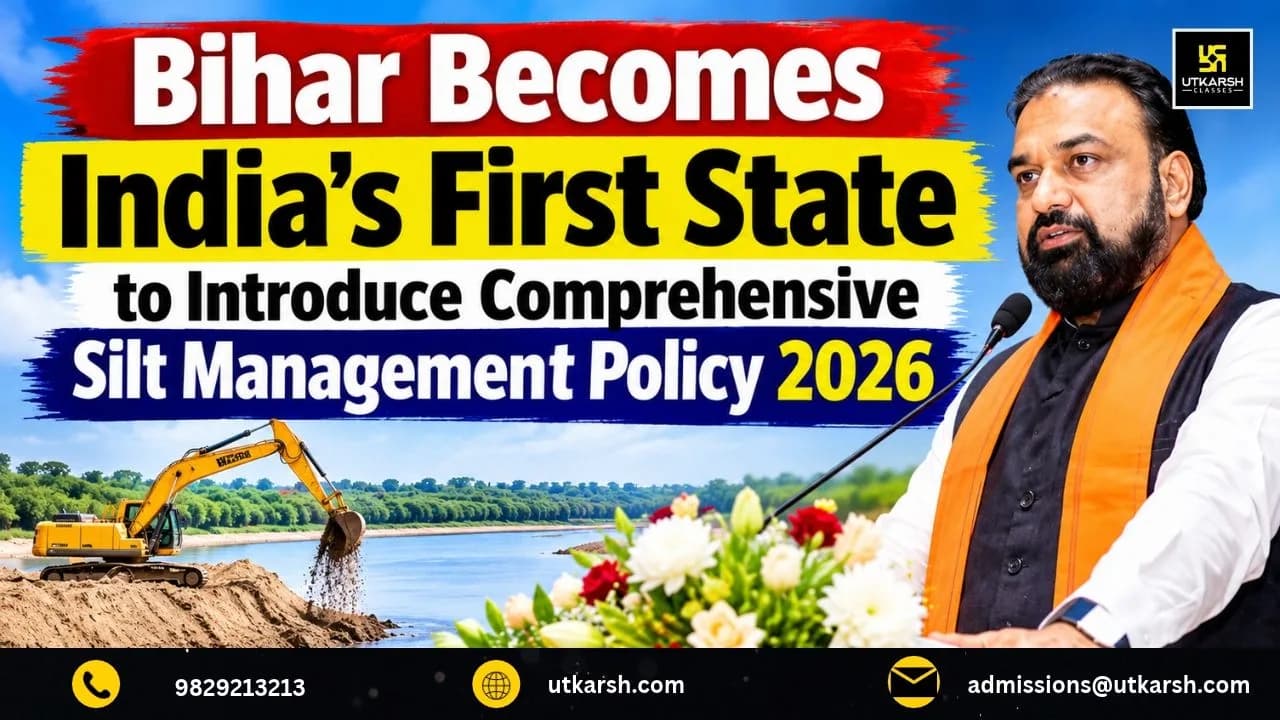
On 3 November 2026, Chief Minister Samrat Choudhary announced that Bihar is the first Indian state to bring in a complete policy for managing silt. The policy targets river health and flood control, and it also finds a use for the removed silt.
Here are some of the key facts about Bihar’s New Silt Management Policy 2026:
Its official name is the Bihar Water Source Restoration and Silt Management Policy, 2026. Silt is a fine, soil-like material that rivers carry along and drop once the current slows. Silt management means measuring how much has piled up, removing it, transporting it and finding a safe use for it. The policy treats all of this as one connected process.
Here are some major objectives of Bihar’s Silt Management Policy 2026
Bihar has teamed up with NHAI, which works under the Ministry of Road Transport and Highways (MoRTH). Desilting will begin only after technical checks, with environmental safeguards in place.
The Nadi Sanjeevani initiative aims at cleaning rivers and building highways. Usable silt taken out of rivers will serve as filling material for national highway works, so one task helps both.
Bihar sits in the Ganga basin, and many rivers from the Himalayas in Nepal flow through it. In the monsoon they bring huge amounts of sediment. When this settles, riverbeds become shallow and water has less room to flow. The result is:
Policy help in flood control - Removing silt from the most affected spots lets rivers carry water more freely. This can reduce waterlogging and ease pressure at selected locations during the monsoon.
Improve water supply - Desilting brings back the storage capacity of rivers, canals and reservoirs. This helps keep water available for irrigation and daily use.
Protect farming land - Silt removed from rivers can be used as filling material instead of digging up farmland. This keeps fertile topsoil on the field.
Help road and highway construction - Suitable silt becomes a ready source of filling material for roads and national highway projects, so builders do not have to look for earth elsewhere.
Make construction cheaper - Yes, it can. Reusing silt that has already been removed reduces the need to buy or excavate fresh material, which can lower project costs.
Benefit for the environment - Silt is removed and used in a planned way with environmental safeguards, instead of being dumped or dug out without control.
Improve governance - The policy needs the state government and NHAI to work together, which builds better coordination between the two on river restoration and infrastructure.
लेखक के बारे में

Hardika Shekhawat
Current Affairs Content Writer
Hardika is a current affairs content writer at Utkarsh Classes with 3 years of experience in academic content writing. She creates clear, exam-ready current affairs articles for UPSC, SSC, RAS, Banking, Railway and State PCS aspirants.

नवीनतम करेंट अफेयर्स
लोकप्रिय टैग
Economy
State news
Death
Person in News
Place in News
Himachal Pradesh
Uttrakhand
Art and Culture
Government Scheme
Science
Supreme Court
Tribe
Energy
Environment
Agriculture
Award and Honour
Uttar Pradesh
Supreme Court
Important Day
Transport
Science and Technology
Summit and Conference
Bill and Act
Haryana
Madhya Pradesh
Election
Industry
Infrastructure
Tourism
Government Initiative
Frequently asked questions

अपने नज़दीकी उत्कर्ष क्लासेज के ऑफलाइन सेंटर पर आज ही विजिट करें।