सीखने के लिए तैयार हैं?
अपने शैक्षणिक लक्ष्यों को प्राप्त करने की दिशा में पहला कदम उठाएँ। चाहे आप परीक्षा की तैयारी कर रहे हों या अपने ज्ञान का विस्तार कर रहे हों, शुरुआत बस एक क्लिक दूर है। आज ही हमसे जुड़ें और अपनी पूरी क्षमता को अनलॉक करें।
Utkarsh Classes
Admission office
Above Arora Namkeen
Jalori Gate circle,
Jodhpur (Raj.), 342005
support@utkarsh.com
+91-9116691119, +91-9829213213
आरंभ करें


सीखने के साधन
Teaching Exams
Rajasthan Govt Exams
Central Govt Exams
Civil Services Exams
Nursing Exams
School Tuitions
Other State Govt Exams
Agriculture Exams
College Entrance Exams
Miscellaneous Exams

© 2026 उत्कर्ष क्लासेज एंड एडुटेक प्राइवेट लिमिटेड सभी अधिकार सुरक्षित
होम

National Current Affairs
Science and Technology
Indian Polar Stations Pioneer New Solar Event Detection Method
Add as a preferred source on Google
Scientists at IIG Mumbai use gamma-ray detectors at Maitri (Antarctica) and Ny-Ålesund (Arctic) to detect Ground-Level Enhancement GLE #77, expanding space-weather coverage.
Updated: 26 Nov 2026
3 Min Read
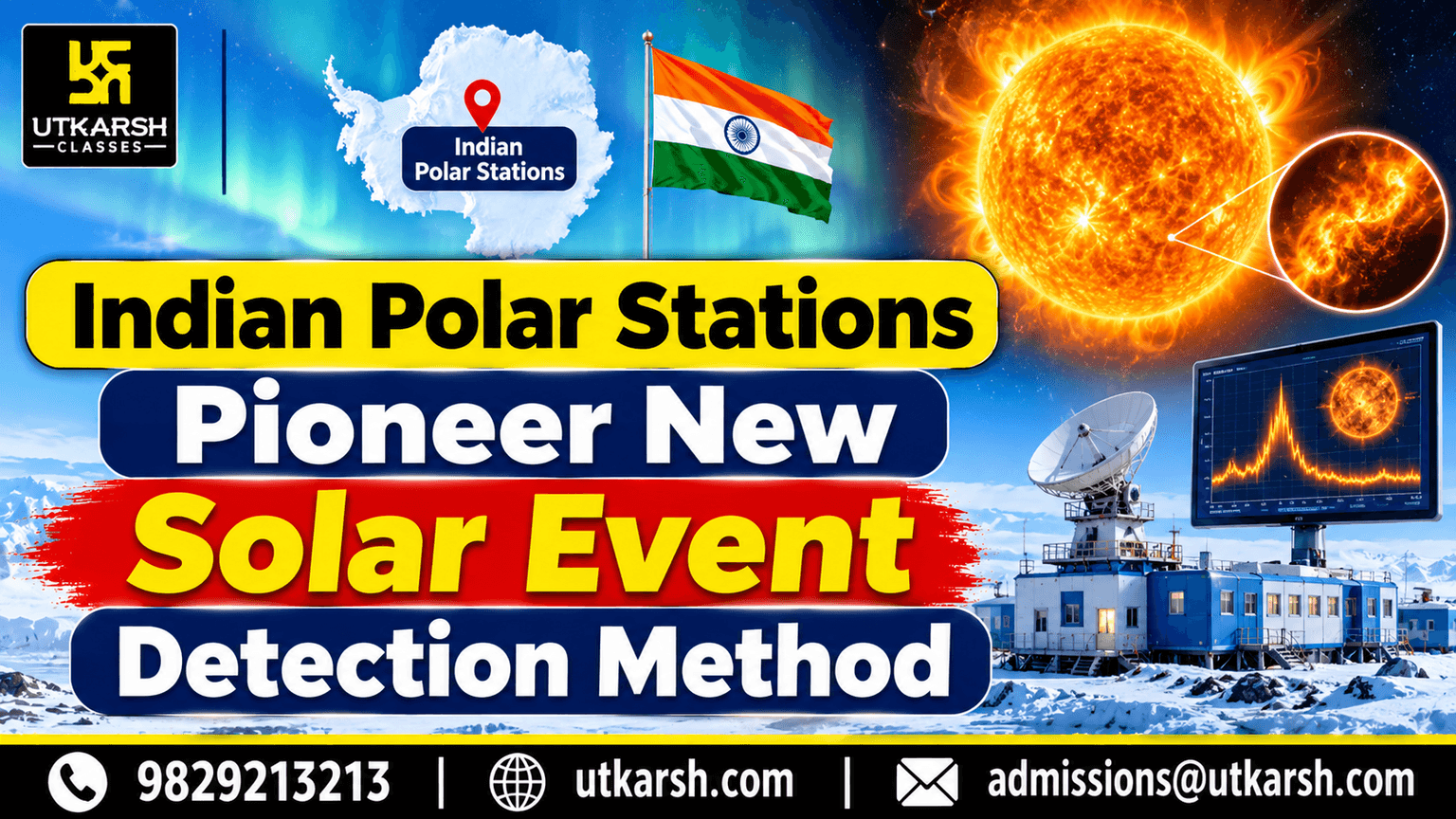
Indian scientists have pioneered a cost-effective method to detect rare, extreme solar particle events from Earth’s polar regions. Using specialized gamma-ray detectors installed at India’s research stations in the Arctic (Ny-Ålesund) and Antarctica (Maitri), researchers successfully captured signatures of a Ground-Level Enhancement (GLE).
This breakthrough by the Indian Institute of Geomagnetism (IIG), Mumbai—an autonomous institute under the Department of Science and Technology (DST)—expands global space-weather monitoring capabilities. Published in the prestigious Astrophysical Journal Letters, the study proves that compact ground-based gamma-ray detectors can effectively complement traditional neutron monitors.
Ground-Level Enhancements (GLEs) represent the most extreme manifestation of Solar Energetic Particle (SEP) events. They occur when powerful solar eruptions—such as intense X-class solar flares and fast Coronal Mass Ejections (CMEs)—accelerate protons to ultra-high energies.
These energetic particles travel rapidly through interplanetary space and penetrate Earth’s atmosphere. Upon colliding with atmospheric molecules, they trigger cascades of secondary hadronic, mesonic, and electromagnetic particles that reach ground level. Tracking GLEs helps scientists understand the Sun–Earth connection and assess radiation risks to satellites, aviation routes, and power grids.
For the first time, IIG scientists detected GLE signatures simultaneously from both hemispheres during the major solar storm of November 11, 2025, officially designated GLE #77. Triggered by an intense X-class solar flare and a fast CME, GLE #77 registered clearly on Sodium Iodide Thallium-activated — NaI(Tl) — scintillation detectors deployed by IIG at Maitri and Ny-Ålesund.
|
Research Parameter |
Study Details & Findings |
|
Lead Institution |
Indian Institute of Geomagnetism (IIG), Mumbai (DST) |
|
Research Team |
Prof. G. Vichare, Ms. P. Thakur, Mr. C. Selvaraj (IIG), and Prof. N. Gopalswamy (NASA) |
|
Polar Observation Sites |
Maitri Station (Antarctica) & Ny-Ålesund Station (Arctic) |
|
Instrument Used |
Compact NaI(Tl) scintillation gamma-ray detectors |
|
Solar Event Analysed |
GLE #77 (November 11, 2025), linked to an X-class solar flare and fast CME |
|
Publication Journal |
Astrophysical Journal Letters |
To confirm that the recorded signals originated from GLE #77, the research team—comprising Prof. G. Vichare, Ms. P. Thakur, and Mr. C. Selvaraj from IIG alongside Prof. N. Gopalswamy from NASA—conducted a systematic analysis across multiple energy ranges.
Comparing the gamma-ray count rates against pre-event baselines, traditional neutron monitor networks, and GOES satellite particle data revealed striking hemispherical differences:
Traditionally, scientists rely on large, expensive neutron-monitor installations to detect Ground-Level Enhancements. In contrast, NaI(Tl) gamma-ray detectors are compact, affordable, and easier to deploy in remote locations.
Deploying a wider global network of these cost-effective gamma-ray detectors at strategic latitudes will dramatically expand the geographic coverage of ground-based space-weather observations. Through its active polar observatories at Maitri and Ny-Ålesund, India continues to strengthen international scientific efforts to forecast and mitigate extreme space-weather hazards.
लेखक के बारे में

Girish Kumar
Current Affairs Content Writer
Girish Kumar is a current affairs content writer at Utkarsh Classes, with a decade of experience covering diverse contemporary issues. He develops high-quality study material for various competitive examinations, including UPSC, PSC, Bank PO etc.

नवीनतम करेंट अफेयर्स
Frequently asked questions

अपने नज़दीकी उत्कर्ष क्लासेज के ऑफलाइन सेंटर पर आज ही विजिट करें।