सीखने के लिए तैयार हैं?
अपने शैक्षणिक लक्ष्यों को प्राप्त करने की दिशा में पहला कदम उठाएँ। चाहे आप परीक्षा की तैयारी कर रहे हों या अपने ज्ञान का विस्तार कर रहे हों, शुरुआत बस एक क्लिक दूर है। आज ही हमसे जुड़ें और अपनी पूरी क्षमता को अनलॉक करें।
Utkarsh Classes
Admission office
Above Arora Namkeen
Jalori Gate circle,
Jodhpur (Raj.), 342005
support@utkarsh.com
+91-9116691119, +91-9829213213
आरंभ करें


सीखने के साधन
Teaching Exams
Rajasthan Govt Exams
Central Govt Exams
Civil Services Exams
Nursing Exams
School Tuitions
Other State Govt Exams
Agriculture Exams
College Entrance Exams
Miscellaneous Exams

© 2026 उत्कर्ष क्लासेज एंड एडुटेक प्राइवेट लिमिटेड सभी अधिकार सुरक्षित
होम

National Current Affairs
Art and Culture
Gudiyam Vavaal Cave in Tiruvallur Shows Human Intervention
Add as a preferred source on Google
Updated: 18 Nov 2026
3 Min Read
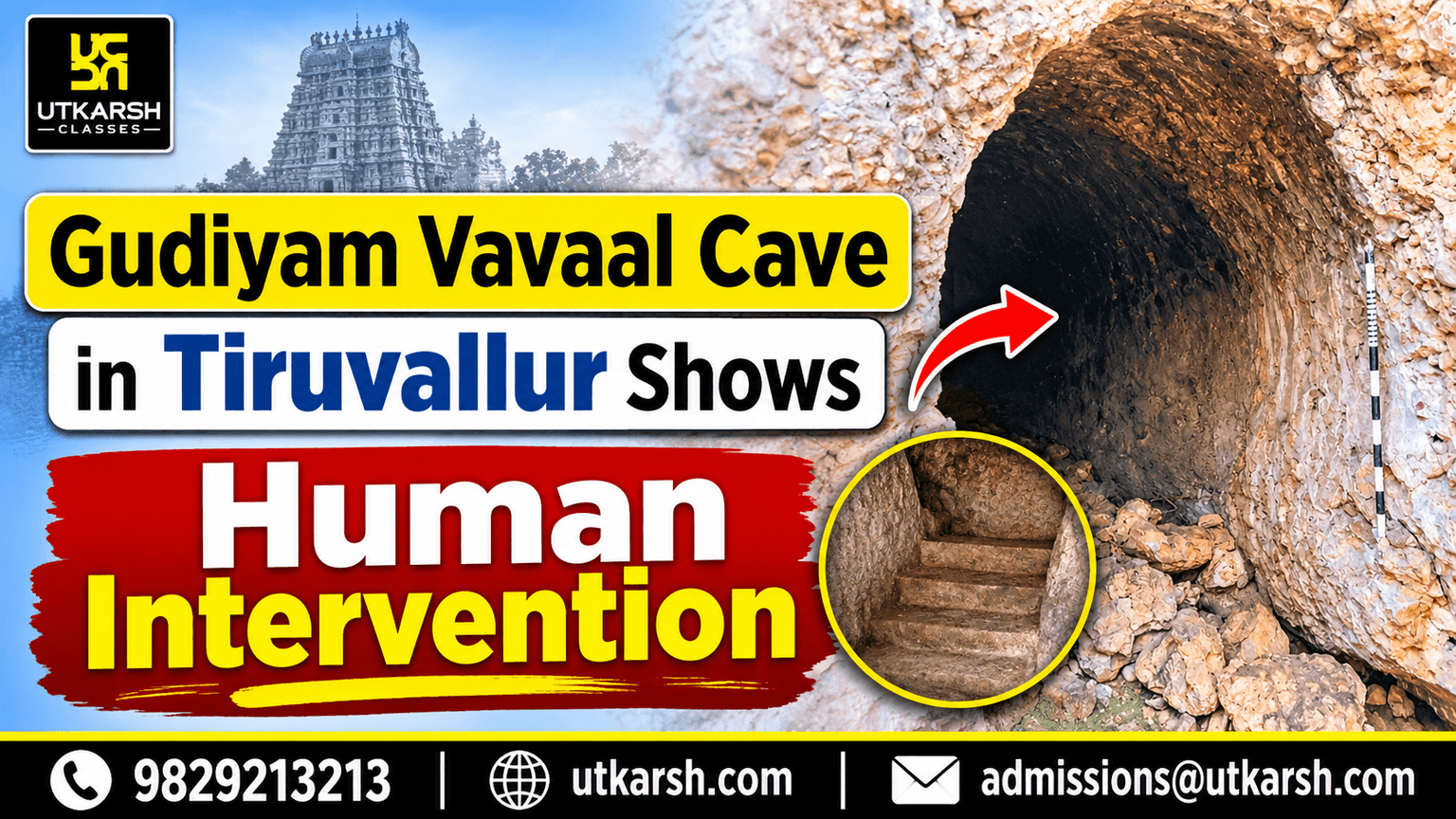
Archaeologists have uncovered compelling evidence of deliberate human carving inside a tunnel-like cavern at the Gudiyam Caves in Tamil Nadu’s Tiruvallur district. Locally known as Vavaal Cave (Bat Cave), this rock structure stands apart from the surrounding natural caverns due to its refined geometry, levelled floor, and smooth interior walls.
Alongside this unusual structure, researchers recorded prehistoric stone tools, multi-colored rock paintings, cup-shaped rock depressions, and historical inscriptions. Together, these discoveries shed new light on how Stone Age communities shaped and inhabited this ancient landscape.
|
Particulars |
Official Survey Details |
|
Site Name |
Vavaal Cave (Bat Cave), Gudiyam Caves complex |
|
Location |
Tiruvallur district, Tamil Nadu |
|
Cave Dimensions |
11.87 metres long; entrance 3.22 metres high and 2.22 metres wide |
|
Key Physical Evidence |
Planned tunnel shape, levelled interior, smooth walls, zero natural mineral deposits |
|
Associated Artifacts |
Stone tools, flakes, stone-tool cores, rock paintings, rock cupules, and inscriptions |
|
Sites Surveyed |
40 sites surveyed; 18 locations show prehistoric cave habitation |
|
Research Partners |
Yaakkai Charitable Trust & Tamil Nadu Forest Department (MoU signed June 2026) |
Measuring 11.87 metres in length with an entrance 3.22 metres high and 2.22 metres wide, Vavaal Cave lacks the rough rock-fall debris and mineral deposits typically found inside natural caverns. Instead, its straight alignment and smoothed interior surfaces point toward intentional cutting.
Kumaravel Ramasamy, secretary of the Yaakkai Charitable Trust, noted that the cave’s deliberate engineering distinguishes it from standard geological formations. Geologist Dr. P. Kumaraguru, former Director of the Geological Survey of India, and B. Gowtham, Head of the Department of Geology at Government Arts College, Coimbatore, also inspected the site. Dr. Kumaraguru confirmed that while the broader Gudiyam cave network formed naturally, Vavaal Cave exhibits clear signs of human modification within a region rich in Stone Age activity.
The survey team documented ancient rock paintings across three key locations: Kuralchavadu Sunai cave, Pasumaadu Parai, and Kannithoppu caves. Artists painted these geometric motifs, ancient symbols, and human figures using three natural pigments: red ochre, white, and black.
At Kuralchavadu Sunai cave, researchers recorded a prominent painting high on the upper wall, 7.08 metres above ground level. According to Dr. Kumaraguru, these artworks closely mirror prehistoric paintings found at other ancient sites across Tamil Nadu, pointing to shared cultural traditions among early inhabitants.
Researchers also identified rock cupules—small, circular, cup-shaped hollows carved into rock surfaces—at five separate locations. Along the path to Pasumaadu Parai cave near a natural spring, the team counted a cluster of 18 cupules of varying sizes. While archaeologists elsewhere link cupules to early counting systems, star or terrain mapping, or ritual practices, their exact function at Gudiyam requires further study.
In addition, the team recovered stone tools, flakes, and partly broken stone-tool cores, confirming active toolmaking. Out of 40 sites surveyed, researchers documented prehistoric cave habitation at 18 locations.
This systematic survey operates under a June 2026 Memorandum of Understanding (MoU) signed between the State Forest Research and Education Institute, the Dharmapuri Forest Nursery Division, and the Yaakkai Charitable Trust. Lead researchers Kumaravel Ramasamy and Sudhakar Nalliyappan use modern digital archiving and scientific mapping to preserve every artifact and inscription for future scholarship.
लेखक के बारे में

Girish Kumar
Current Affairs Content Writer
Girish Kumar is a current affairs content writer at Utkarsh Classes, with a decade of experience covering diverse contemporary issues. He develops high-quality study material for various competitive examinations, including UPSC, PSC, Bank PO etc.

नवीनतम करेंट अफेयर्स
Frequently asked questions

अपने नज़दीकी उत्कर्ष क्लासेज के ऑफलाइन सेंटर पर आज ही विजिट करें।