सीखने के लिए तैयार हैं?
अपने शैक्षणिक लक्ष्यों को प्राप्त करने की दिशा में पहला कदम उठाएँ। चाहे आप परीक्षा की तैयारी कर रहे हों या अपने ज्ञान का विस्तार कर रहे हों, शुरुआत बस एक क्लिक दूर है। आज ही हमसे जुड़ें और अपनी पूरी क्षमता को अनलॉक करें।
Utkarsh Classes
Admission office
Above Arora Namkeen
Jalori Gate circle,
Jodhpur (Raj.), 342005
support@utkarsh.com
+91-9116691119, +91-9829213213
आरंभ करें


सीखने के साधन
Teaching Exams
Rajasthan Govt Exams
Central Govt Exams
Civil Services Exams
Nursing Exams
School Tuitions
Other State Govt Exams
Agriculture Exams
College Entrance Exams
Miscellaneous Exams
UC Skills

© 2026 उत्कर्ष क्लासेज एंड एडुटेक प्राइवेट लिमिटेड सभी अधिकार सुरक्षित
होम

National Current Affairs
Bill and Act
New UPI MDR Framework Explained: What to Know About P2P Transfers and Standard P2M
Add as a preferred source on Google
Updated: 16 Sep 2026
3 Min Read
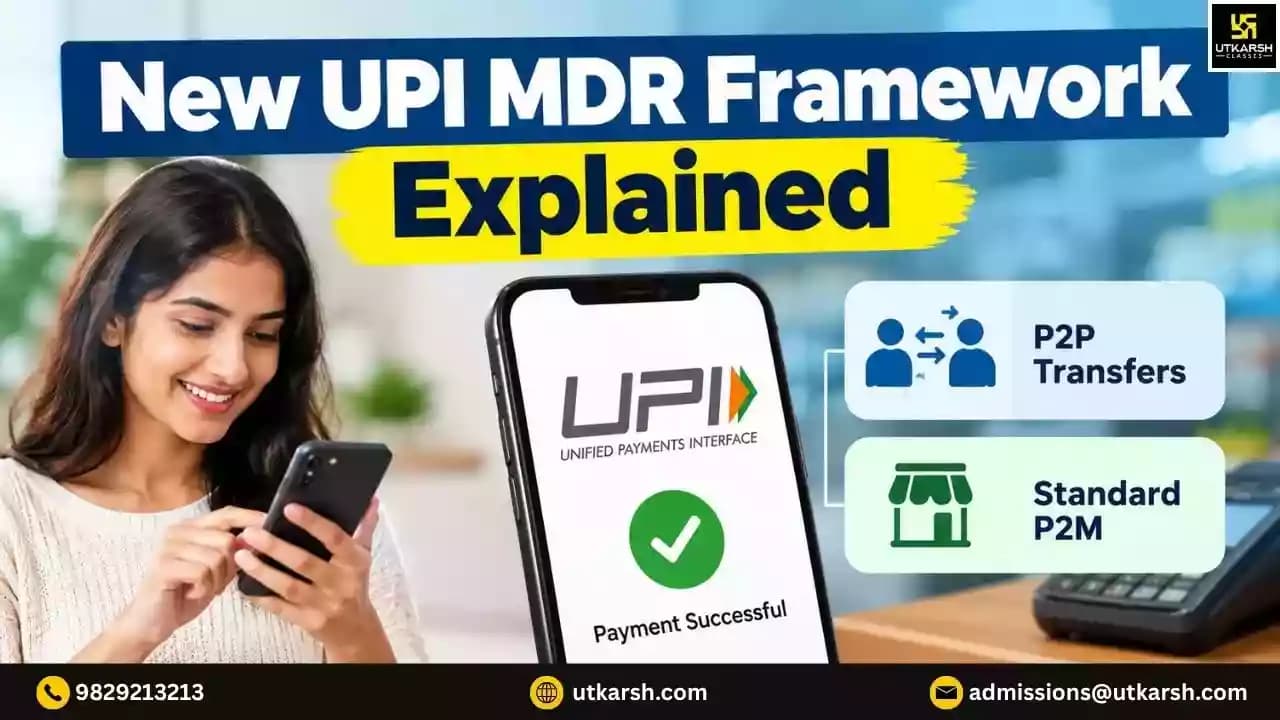
The government has clarified that the new UPI framework won't mean any charge for people using UPI. This clarification came on 15th September, 2026, after confusion spread about whether individuals would now have to pay for making UPI payments. Payments between two individuals will stay completely free, no matter the amount transferred, and payments to merchants up to ₹2,000 will also remain free. From October 15, merchants accepting UPI payments above ₹2,000 will pay a fee under the new rules, but this cost falls on the merchant, not the customer.
Under the new framework, a Merchant Discount Rate (MDR) of 0.4% will apply to merchant payments that cross ₹2,000. This isn't a government tax or an NPCI charge; it gets shared among banks, payment service providers, and UPI app companies, helping fund the infrastructure that keeps UPI running and expanding across the country.
Nothing changes for person-to-person transfers. Whether you're sending ₹100 to a friend or ₹50,000 to a family member, it stays completely free. This category alone makes up the bulk of UPI's transaction value, so most people won't feel this reform at all.
Buying vegetables, paying for a haircut, and grabbing a coffee if the bill is ₹2,000 or under—the payment goes through without any extra charge. Since most day-to-day purchases fall well within this range, this is where the framework has the least impact.
Once a merchant payment crosses ₹2,000, the 0.4% MDR applies, effective from October 15. There's a ceiling too: for transactions of ₹75,000 or more, the charge is capped at ₹300. And crucially, this cost sits with the merchant, not the person paying.
Sectors like railways, telecom, insurance, fuel, and agricultural inputs get special treatment. Instead of a percentage-based fee, payments above ₹2,000 here attract a flat ₹5 charge, giving businesses in these thin-margin, essential areas cost predictability.
Mutual fund and stock market payments carry a much smaller MDR of just 0.02%, capped at ₹300, so the framework doesn't discourage retail investors from using UPI for market-related payments.
Banks have been directed to make sure merchants don't shift this cost onto buyers. UPI providers are also barred from adding their own platform fees on top.
There's no quota system here; individuals can keep making free UPI transactions as often as they like, with no monthly ceiling.
About 96% of all merchant payments either fall under ₹2,000 or qualify under the small-merchant exemption, meaning the new fee touches only a small fraction of transactions overall.
A share of the MDR collected — 5% — will go into a dedicated fund to help small merchants and street vendors adopt and continue using UPI.
Not for most people. Individuals and the vast majority of merchant payments remain completely free. The charge applies narrowly, to bigger merchant transactions only, starting October 15, 2026.
लेखक के बारे में

Hardika Shekhawat
Current Affairs Content Writer
Hardika is a current affairs content writer at Utkarsh Classes with 3 years of experience in academic content writing. She creates clear, exam-ready current affairs articles for UPSC, SSC, RAS, Banking, Railway and State PCS aspirants.

नवीनतम करेंट अफेयर्स
Frequently asked questions

अपने नज़दीकी उत्कर्ष क्लासेज के ऑफलाइन सेंटर पर आज ही विजिट करें।

Vijayadashami Offer Is LIVE!
Get 25% EXTRA OFF on All Online Courses. Use Code WEB25 to Unlock Your Festive Discount!