Ready to learn?
Take the first step toward achieving your educational goals. Whether you’re preparing for exams or expanding your knowledge, getting started is just a click away. Join us today and unlock your full potential
832, utkarsh bhawan, near mandap restaurant, 9th chopasani road, jodhpur rajasthan - 342003
support@utkarsh.com
+91-9116691119, +91-9829213213
Support
Get Started


Learning Resources
Rajasthan Govt Exams
Central Govt Exams
Civil Services Exams
Nursing Exams
School Tuitions
Other State Govt Exams
Agriculture Exams
College Entrance Exams
Miscellaneous Exams

© 2026 Utkarsh Classes & Edutech Pvt. Ltd. All Rights Reserved
Add as a preferred source on Google

Confused about how to start your RRB Group D Exam Preparation? Don’t worry, many students preparing for the Railway exams feel the same way. The most challenges they face are, the syllabus is vast, time is short to cover all subjects, and it’s hard to balance preparation for the RRB Group D written exam and physical test. In this preparation blog, we are sharing clear step-by-step Railway Group D Exam Preparation Tips for every subject, with daily and weekly goals, PET tips, and last-minute tricks to improve your score in the Group D Exam.
Starting your RRB Group D preparation early gives you more time to understand concepts and improve your fitness for the PET. The Railway Recruitment Board (RRB) conducts the Group D exam in a Computer-Based Test (CBT) format, which covers subjects like Maths, Reasoning, General Science, and General Awareness. After that, there is a Physical Efficiency Test (PET) and a document verification stage.
Start your RRB Group D exam preparation today by following the tips, and stay consistent because steady practice and a clear plan can help you reach your goal faster.
Before getting started with the RRB Group D Preparation Tips, it’s important to understand the Railway Group D Exam Pattern and the topics it covers. The RRB Group D (also known as the Railway Level 1 Exam) CBT covers four subjects: General Science, Mathematics, General Intelligence & Reasoning, and General Awareness & Current Affairs.
CBT (Computer-Based Test) follows this structure:
Section-wise division of marks:
After RRB Group D CBT, candidates who clear the cut-off will be shortlisted to appear for the PET (qualifying), then document verification and medical exam.
Download RRB Group D Exam Pattern & Syllabus PDF
Check the complete information on PET and Physical Standards given in the RRB Group D Notification.
If you’re starting your RRB Group D preparation, follow these 7-day beginner tips to:
RRB Group D Preparation needs a smart timetable in which each subject of the exam gets proper time to study. Since the CBT includes four main subjects, following subject-wise tips helps improve your score and clear the RRB Group D cut-off. The subject-wise RRB Group D preparation tips below will help you manage your time better and prepare more effectively for the exam.
Maths can become one of the most scoring subjects of the RRB Group D exam if you prepare with a clear plan. Start by revising basic arithmetic topics like tables, fractions, ratios, averages, percentages, and simplification to build a strong base. Once your basics are clear, practice slightly tougher topics using easy tricks and faster calculation methods to save time in the exam.
Here are the important topics and practice tips for Railway Group D Mathematics:
|
Important Maths topics to cover |
|
|
Number System, BODMAS |
Geometry basics (Triangles, Circles, Perimeters) and Trigonometry |
|
Time & Work, Pipes & Cisterns, Speed & Distance |
Percentages, Ratio & Proportion, Profit & Loss, Simple Interest (SI) and Compound Interest (CI) |
|
Algebra |
Data Interpretation and Charts |
Preparation Tips: Start your preparation by learning basic concepts and shortcut tricks, like conversion of percent-to-fraction and ratios. Regularly practice word problems and revise all formulas daily. Focus more on geometry theorems, logic-based problems, and Data Interpretation (DI) questions. Along with this, attempt at least two full-length mock tests per week and maintain a mistakes log book to track your improvement.
Additional Tips: Learn 10–15 arithmetic shortcuts (e.g., quick percentage methods, divisibility rules). Use PYQs to identify frequently repeated topics.
The reasoning section in the RRB Group D exam tests your logical thinking and problem-solving skills. Begin your preparation with basic topics and simple logic-based questions before moving on to puzzles and arrangements, which are slightly more difficult and take more time to solve.
Here are the important topics and practice tips for Railway Group D Reasoning:
|
Important Reasoning topics to cover |
|
|
Series (number/letter) |
Seating Arrangement |
|
Coding-Decoding |
Puzzles |
|
Directions |
Blood Relations |
|
Syllogism, Venn Diagram |
Analogies, Classification |
Preparation Tips: Focus on pattern-based questions and improve your observation skills. Practice making family trees for blood relation questions and solving direction and distance-based questions step by step. Learn to use elimination methods in puzzles and arrangement questions. Try solving 30 to 50 reasoning questions daily within a set time and note down useful tricks in your notebook.
Additional Tip: For improving speed in solving reasoning questions, regular practice is important. Note down the types of puzzles or questions you find difficult and practice them every week to improve your accuracy and speed.
General Science questions in the RRB Group D exam are mostly based on Class 8th to 10th level topics. Focus on simple explanations, important terms, and everyday examples of Physics, Chemistry, and Biology while preparing.
Here are the important topics and practice tips for Railway Group D General Science:
|
Important General Science topics to cover |
|
Physics: Motion, Light, Force, Work and Energy, Electricity & Magnetism, Gravitation, Units and Measurements |
|
Chemistry: Elements, Compounds, Acids, Bases & Salts, Metals & Non-metals, Chemical Reactions |
|
Biology: Human Body Systems, Life Processes, Common Diseases, Ecology, and Food Chain |
|
Science & Technology |
Preparation Tips: Revise all basic concepts of science and solve conceptual MCQs to understand the topics clearly. Learn important formulas from the periodic table, chemical reactions and commonly used scientific terms. Use diagrams and flow charts to study and revise short notes, PYQs, and fact charts regularly. Also, stay updated with recent news and developments in Science & Technology.
Additional Tip: General Science questions in the RRB Group D exam are fact-based. Read the question in your question paper carefully and choose the most accurate answer.
The General Awareness section of the RRB Group D exam tests candidates’ knowledge of current affairs and static GK topics. Regular revision and the habit of making short one-liner notes of important topics and facts can help in quick revision and make it easier to score well in this subject.
Here are the important topics for Railway Group D General Awareness:
|
Important General Awareness topics to cover |
|||
|
Static GK |
|
General Knowledge |
|
|
National and International Current Affairs |
|||
Preparation Tips: To prepare well for the General Awareness section, spend about 25 to 30 minutes daily reading current affairs while also revising Static GK, History, and Geography. Along with this, attempt one RRB Group D General Knowledge test every week to check your progress. Make a small revision chart for current affairs, government schemes, and railway updates, noting important dates and events for quick revision. You can also keep a separate notebook for railway-related facts, such as zones, projects, and recent train launches, to make your revision easier.
The Physical Efficiency Test (PET) in the Railway Group D Recruitment is a qualifying stage, so regular practice and consistency are very important.
The RRB Group D PET pattern:
Here is how you can plan for the RRB Group D Physical Test:
Note: Always warm up, stretch after workouts, and take rest days in between practice sessions to help your body recover.
Doing RRB Group D preparation with a full-time job requires regular study rather than studying randomly for long hours. Focus on daily studying and understanding of concepts with smart weekend revision and practice sessions.
A suggested flexible Study Schedule to manage your private job and RRB Group D Preparation easily is given below:
Tip: Keep a mistakes notebook to track repeated mistakes and confusing concepts. Revise it regularly and reattempt the quiz or practice tests on those topics. Even with limited time, focused effort can bring steady improvement.
In the last month before the RRB Group D exam, candidates should focus on revision, accuracy, and fitness. At this stage, it’s important to revise smartly, practice regularly, and maintain your energy for both CBT and PET.
These 30-day RRB Group D Preparation Tips will guide you:
By following these 30-day RRB Group D Revision Tips, you can strengthen your preparation, improve accuracy, and enter the exam hall confident for CBT.
The last few hours before the RRB Group D exam and the way you handle yourself during the exam can have a big impact on your performance. Along with quick revision, following the right Railway Group D Exam Day Tips will help you stay calm and focused.
By following these RRB Group D Preparation tips, you can stay confident, attempt the paper with a clear mind, and improve your chances of scoring well in the Group D exam.
Prepare for the RRB Group D exam with Utkarsh Classes’ Railway Group D Online Courses, designed to cover the complete syllabus in a systematic and exam-focused manner. Learn from an experienced teacher through interactive video sessions, topic-wise Daily Practice Papers (DPPs), and study notes that help you build a strong foundation for the Group D exam.
Enroll in Utkarsh Classes’ Online Courses today and access other free study resources to improve your RRB Group D Preparation!
About the author

Sakshi
Content Writer
Sakshi Dawar is a professional content writer with 5+ years of experience in creating SEO-friendly and engaging content. With a background across Digital Marketing, EdTech, and Law, she focuses on delivering clear, well-structured content that drives value for readers. At Utkarsh Classes, she applies this expertise to create accurate, learner-focused content for competitive exam aspirants, combining creativity with strategy to make information both impactful and easy to understand.

RRB Group D Important Updates
RRB Group D Physical Exam Date 2026: Zone-wise Schedule & Admit Card
Read More
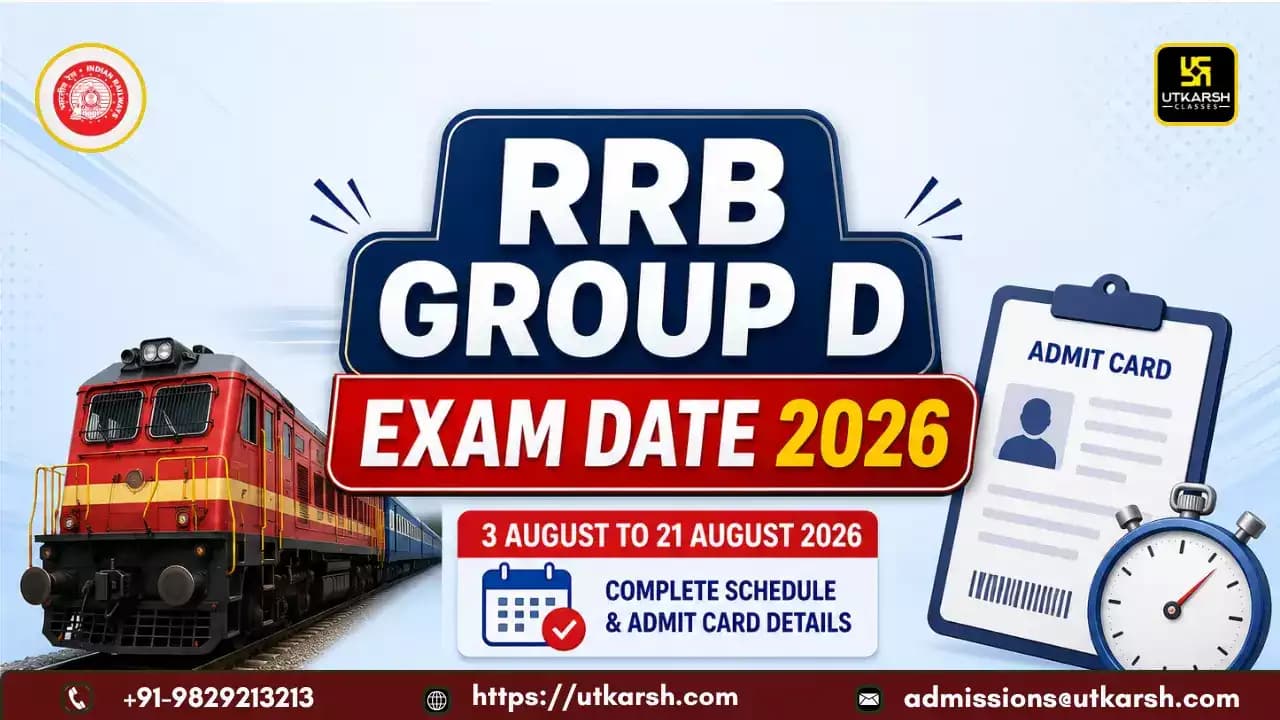
RRB Group D Exam Date 2026: Check Exam Pattern & Admit Card Details
Read More

RRB Group D 2024 Revised Exam Date OUT: Check Official CBT Schedule Here
Read More

RRB Group D Vacancies 2024 (Announced): Apply For 32438 Posts
Read More
Related Exams
Frequently asked questions