Ready to learn?
Take the first step toward achieving your educational goals. Whether you’re preparing for exams or expanding your knowledge, getting started is just a click away. Join us today and unlock your full potential
Utkarsh Classes
Admission office
Above Arora Namkeen
Jalori Gate circle,
Jodhpur (Raj.), 342005
support@utkarsh.com
+91-9116691119, +91-9829213213
Support
Get Started


Learning Resources
Rajasthan Govt Exams
Central Govt Exams
Civil Services Exams
Nursing Exams
School Tuitions
Other State Govt Exams
Agriculture Exams
College Entrance Exams
Miscellaneous Exams

© 2026 Utkarsh Classes & Edutech Pvt. Ltd. All Rights Reserved
Home

International Current Affairs
Report
India Ranks 3rd in Asia Power Index 2026, Ahead of Japan & Russia
Add as a preferred source on Google
Updated: 24 Nov 2026
7 Min Read
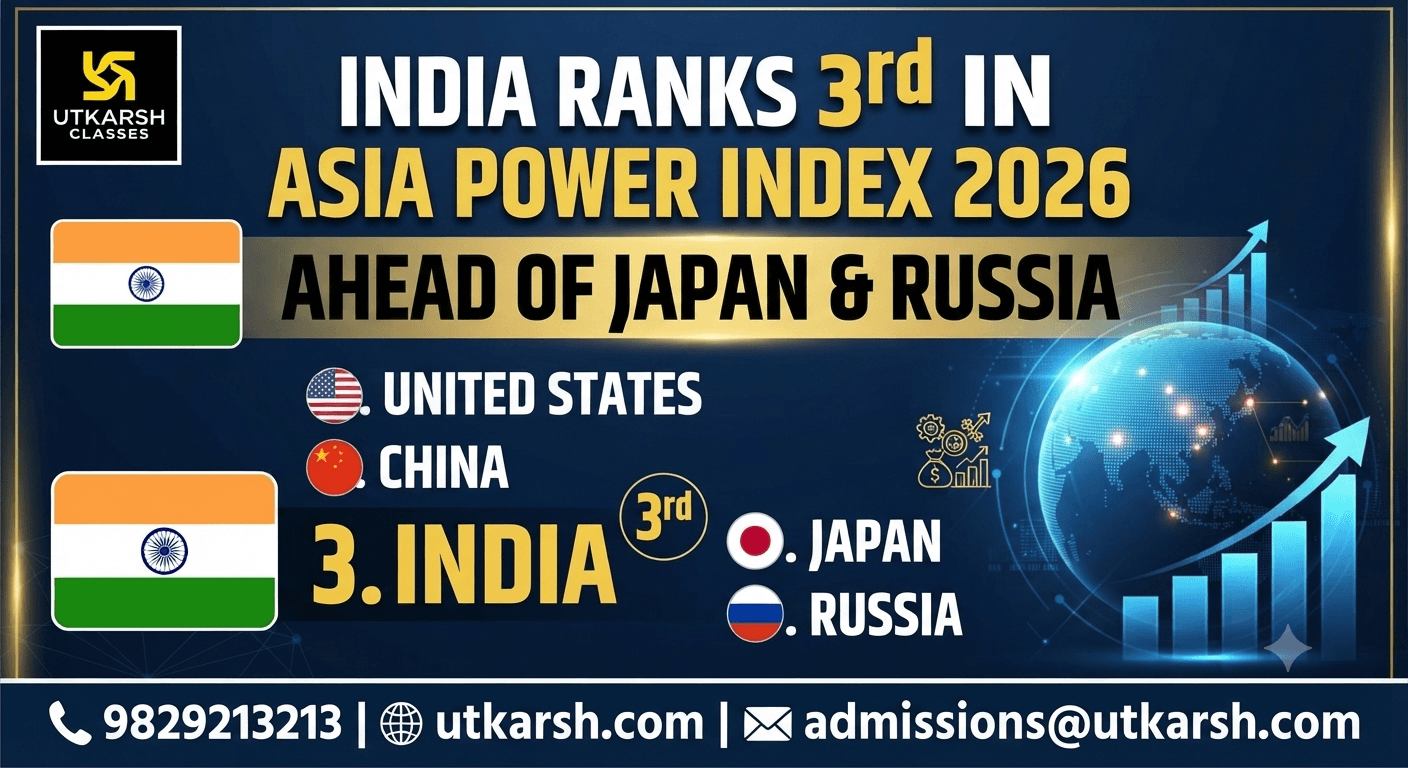
India has strengthened its position as the third-most powerful country in Asia. The Australian think tank Lowy Institute released the 2026 Asia Power Index on November 23, 2026. India secured 40.5 points in the latest rankings. It stands behind only the United States and China.
India has also recorded its highest overall score since the index began in 2018. The country has maintained its position ahead of Japan and Russia. Moreover, the gap between India and China has narrowed to its smallest level since 2018.
The report also recognised Prime Minister Narendra Modi's growing regional influence. It ranked him as the second-most effective regional leader after Chinese President Xi Jinping.
However, China still holds a significant advantage over India. Its overall power score remains much higher. India must strengthen its economic, military and diplomatic capabilities to challenge China's position.
The 2026 Asia Power Index ranks 27 countries and territories based on their ability to influence regional and global developments.
The United States retained the top position, while China secured second place. India ranked third with 40.5 points.
|
Rank |
Country |
Overall Score |
|
1 |
United States |
78.9 |
|
2 |
China |
73.6 |
|
3 |
India |
40.5 |
|
4 |
Japan |
38.6 |
|
5 |
Russia |
32.2 |
The Lowy Institute considers countries with scores of 40 or above as major powers. India has therefore joined the United States and China in this category.
Japan narrowly missed this classification with 38.6 points.
The Lowy Institute evaluates national power through 131 indicators. It groups these indicators into eight major measures.
These measures examine a country's resources and its ability to convert those resources into regional influence.
The index divides the eight measures into two broad categories.
1. Resource Measures
These measures examine the resources available to a country.
2. Influence Measures
These measures examine how effectively a country uses its resources to influence others.
Economic and military capabilities carry the highest weight, with 17.5% each. Economic relationships account for 15%. Each of the remaining five measures carries a weight of 10%.
India improved its overall score by 0.5 points in 2026. This improvement reflects gradual progress across several areas.
The gap between India and China has reached its narrowest level since the index started in 2018. However, China still enjoys a substantial advantage.
According to the report, China's comprehensive power remains around 80% higher than India's.
The report also highlights the changing balance between the United States and China. Their overall scores differ by only 5.3 points. The Lowy Institute links much of this change to setbacks in Washington rather than a sudden rise in Beijing's power.
India, meanwhile, continues to strengthen its regional position through gradual improvements in economic relationships, defence partnerships and cultural influence.
India's third-place position places it ahead of two major Asian powers. However, Japan and Russia retain important advantages.
Japan secured fourth place with 38.6 points. It trails India by only 1.9 points. However, Japan uses its resources more effectively than India. It recorded a Power Yield of +10.9, the highest in the index. This score shows that Japan converts its economic and other resources into influence more effectively than the index expects.
Russia ranked fifth with 32.2 points. India leads Russia by 8.3 points. However, Russia remains ahead of India in military capability. Russia scored 55.8 points, while India secured 48.5 points in this category. Russia's overall position has suffered due to weaker performance across other areas and the economic and military costs of its war in Ukraine. Its Power Yield stands at -6.6, reflecting these challenges.
India recorded important improvements in defence cooperation, economic relationships and cultural influence.
India's Defence Networks score increased by 2.1 points to 18.6. This improvement helped India move up two positions to ninth place.
The report links this progress to India's growing regional defence engagement and BrahMos missile sales to Southeast Asian countries.
However, defence networks remain India's weakest measure. India needs stronger defence partnerships to improve its regional influence.
India improved its position by two places to seventh in Economic Relationships. It secured 19.9 points in this category. India was also among only five countries whose scores did not decline in this measure. Stable regional trade and investment relationships supported this improvement.
Cultural Influence recorded India's biggest improvement. Its score increased by 2.3 points to 43.8. India improved its performance in cultural projection, information flows and people-to-people exchanges. These developments show that cultural connections also play an important role in building international influence.
Diplomatic Influence remains India's strongest measure, with 70.3 points. However, India recorded a slight decline in this category. The report ranked Prime Minister Narendra Modi as the second-most effective regional leader after Xi Jinping. He improved his position by three places. However, the report noted weaker perceptions of his global leadership and strategic ambition. It partly linked this change to India's lower profile during the Gulf conflict.
India's Economic Capability score declined by 0.7 points to 26.4. However, India retained third place in this category.
These factors affected India's relative economic position in the index.
However, the decline does not mean that India's domestic economy has lost its growth momentum. India continues to remain one of the world's fastest-growing major economies. Strong domestic demand and services activity support its economic growth. The IMF's October 2026 World Economic Outlook projected India's growth at 7% in FY27. The World Bank and the Reserve Bank of India projected growth at 7.1%. India also improved its Future Resources score by 1.2 points to 56.2. It retained third place in this category. This measure considers future economic and defence resources, demographic trends and labour-force potential.
Power Yield measures the difference between a country's expected power and its actual comprehensive power. It shows how effectively a country converts its available resources into international influence.
|
Country |
Power Yield |
|
Japan |
+10.9 |
|
China |
+0.2 |
|
India |
-3.3 |
|
Russia |
-6.6 |
India's Power Yield improved, and the gap narrowed for the first time since 2023. However, its negative score shows that India still needs to use its resources more effectively. Japan provides a strong example of converting resources into influence. China performs close to its expected level, while Russia faces significant challenges.
The Lowy Institute's 2026 Asia Power Index highlights India's growing position in the Asian power structure. India has moved ahead of Japan and Russia and strengthened its position as a major power.
Its progress in defence networks, economic relationships and cultural influence supports this rise. Its strong future resources also offer significant opportunities.
However, China remains far ahead of India in comprehensive power. India must improve its economic capabilities, strengthen defence partnerships and use its diplomatic influence more effectively.
India's next challenge is not simply to acquire more resources. It must convert its growing economic, military and demographic strength into greater regional and global influence.
About the author

Girish Kumar
Current Affairs Content Writer
Girish Kumar is a current affairs content writer at Utkarsh Classes, with a decade of experience covering diverse contemporary issues. He develops high-quality study material for various competitive examinations, including UPSC, PSC, Bank PO etc.

Latest Current Affairs
Frequently asked questions

Visit Utkarsh Classes Offline Centre Near You.