Ready to learn?
Take the first step toward achieving your educational goals. Whether you’re preparing for exams or expanding your knowledge, getting started is just a click away. Join us today and unlock your full potential
Utkarsh Classes
Admission office
Above Arora Namkeen
Jalori Gate circle,
Jodhpur (Raj.), 342005
support@utkarsh.com
+91-9116691119, +91-9829213213
Support
Get Started


Learning Resources
Rajasthan Govt Exams
Central Govt Exams
Civil Services Exams
Nursing Exams
School Tuitions
Other State Govt Exams
Agriculture Exams
College Entrance Exams
Miscellaneous Exams

© 2026 Utkarsh Classes & Edutech Pvt. Ltd. All Rights Reserved
Home

National Current Affairs
Banking and Finance
RBI Raises Repo Rate by 25 Basis Points to 5.50% After 3 Years
Add as a preferred source on Google
Updated: 07 Oct 2026
4 Min Read
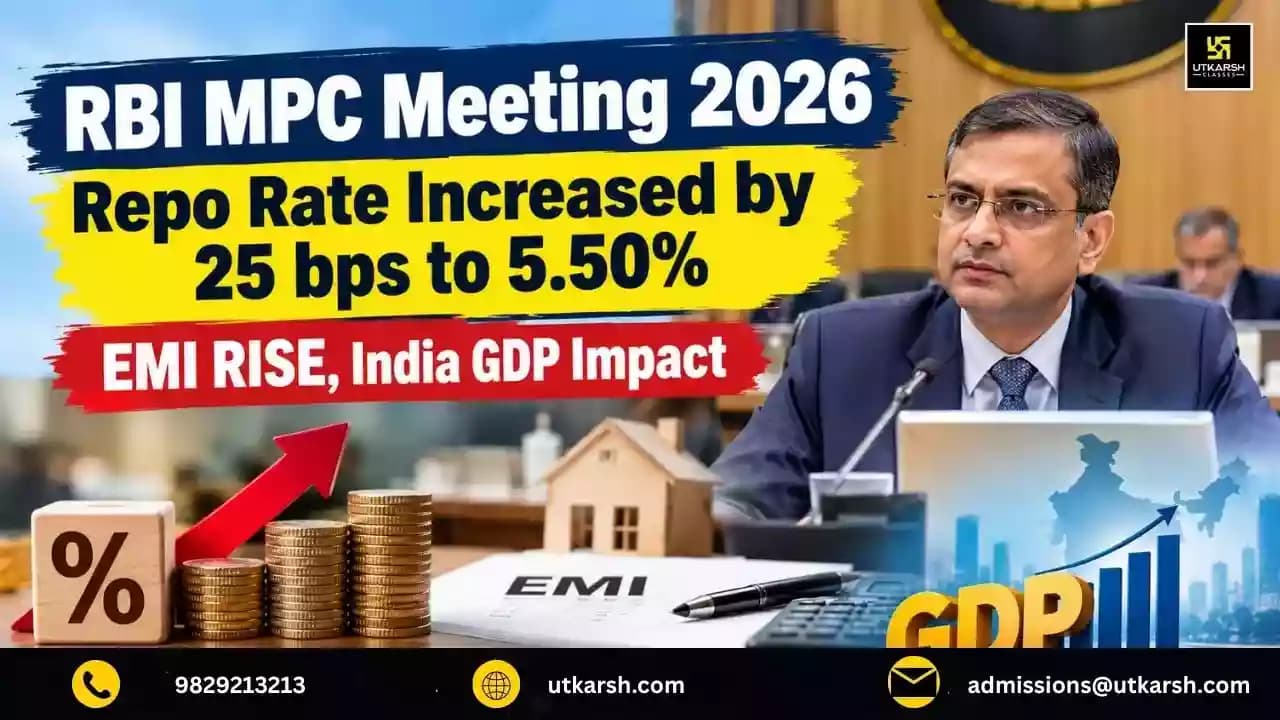
The Reserve Bank of India (RBI) raised the repo rate by 25 basis points (0.25%) to 5.50% on 7 October 2026. It is the first hike in over three years. The repo rate is the rate at which the RBI lends short-term money to banks. Governor Sanjay Malhotra announced the decision after the Monetary Policy Committee (MPC) meeting.
The RBI raised the rate to bring inflation under control. Higher borrowing costs reduce spending, and lower spending slows price rises. The main pressures were:
All six MPC members voted for the hike. The Governor said the economy is strong, but inflation is now a bigger worry than last year.
Banks link floating-rate loans, such as home and car loans, to the repo rate. When the repo rate goes up, banks raise their lending rates, so borrowers pay a higher EMI or a longer tenure. On a ₹50 lakh, 20-year home loan, a 0.25% rise adds roughly ₹800 a month (an approximate figure). Fixed-rate loans stay the same until renewed. Fixed deposit rates may also go up slowly, which benefits savers.
A stance tells us which way the RBI is likely to move on rates. Under the earlier neutral stance, it could raise or cut rates. Under calibrated tightening, rate cuts are unlikely in the near term. "Tightening" means making money costlier to fight inflation. "Calibrated" means doing it carefully, in small steps, not through sudden big hikes. The next move could be another hike or a pause, depending on inflation and growth.
Costlier loans can slow spending and investment, which can pull down growth. However, the RBI believes the economy can handle it. Growth was a strong 7.8% in April–June, and the RBI now expects 7.1% for the year, up 40 bps from the earlier forecast. Its own quarterly estimates dip slightly, from 7.2% in Q2 to 6.8% in Q4.
Core inflation is now seen at 4.4%, up from 4.3%
|
Period |
CBI Inflation |
|
FY 2026-27 |
5.20% |
|
Q2 FY27 |
4.90% |
|
Q3 FY27 |
6.00% |
|
Q4 FY27 |
5.70% |
|
Q1 FY 2027-28 |
5.60% |
The repo rate is the interest rate at which the RBI gives short-term loans to banks. When the RBI raises it, banks have to pay more to borrow money, so their own cost of funds goes up.
Banks usually pass this extra cost on to customers. As a result, interest rates on floating-rate loans, such as home loans and car loans, may rise, and borrowers may have to pay a higher EMI.
Costlier loans also make people and businesses spend and borrow less. When demand in the economy cools down, price rises slow, which helps the RBI bring inflation under control.
The Monetary Policy Committee (MPC) is the body that decides India's benchmark policy interest rate. Its job is to keep prices stable while supporting economic growth.
The October 2026 meeting was chaired by RBI Governor Sanjay Malhotra. The other members present were:
About the author

Utkarsh Classes
Company
This content is prepared by the Utkarsh Classes team to present accurate, updated, and exam-relevant current affairs in a simple and reliable format.


Latest Current Affairs
Frequently asked questions


Download Last 5 Years PYQs in a Single Click
FREE PYQs exam ke level aur question pattern ko samajhne ka best tareeka

Still have questions?
Can't find the answer you're looking for? Please contact our friendly team.
Visit Utkarsh Classes Offline Centre Near You.