Ready to learn?
Take the first step toward achieving your educational goals. Whether you’re preparing for exams or expanding your knowledge, getting started is just a click away. Join us today and unlock your full potential
Utkarsh Classes
Admission office
Above Arora Namkeen
Jalori Gate circle,
Jodhpur (Raj.), 342005
support@utkarsh.com
+91-9116691119, +91-9829213213
Support
Get Started


Learning Resources
Rajasthan Govt Exams
Central Govt Exams
Civil Services Exams
Nursing Exams
School Tuitions
Other State Govt Exams
Agriculture Exams
College Entrance Exams
Miscellaneous Exams

© 2026 Utkarsh Classes & Edutech Pvt. Ltd. All Rights Reserved
Home

International Current Affairs
Award and Honour
Scientists Henri Kagan and Kenso Soai won the 2026 Nobel Prize in Chemistry
Add as a preferred source on Google
Updated: 07 Oct 2026
3 Min Read
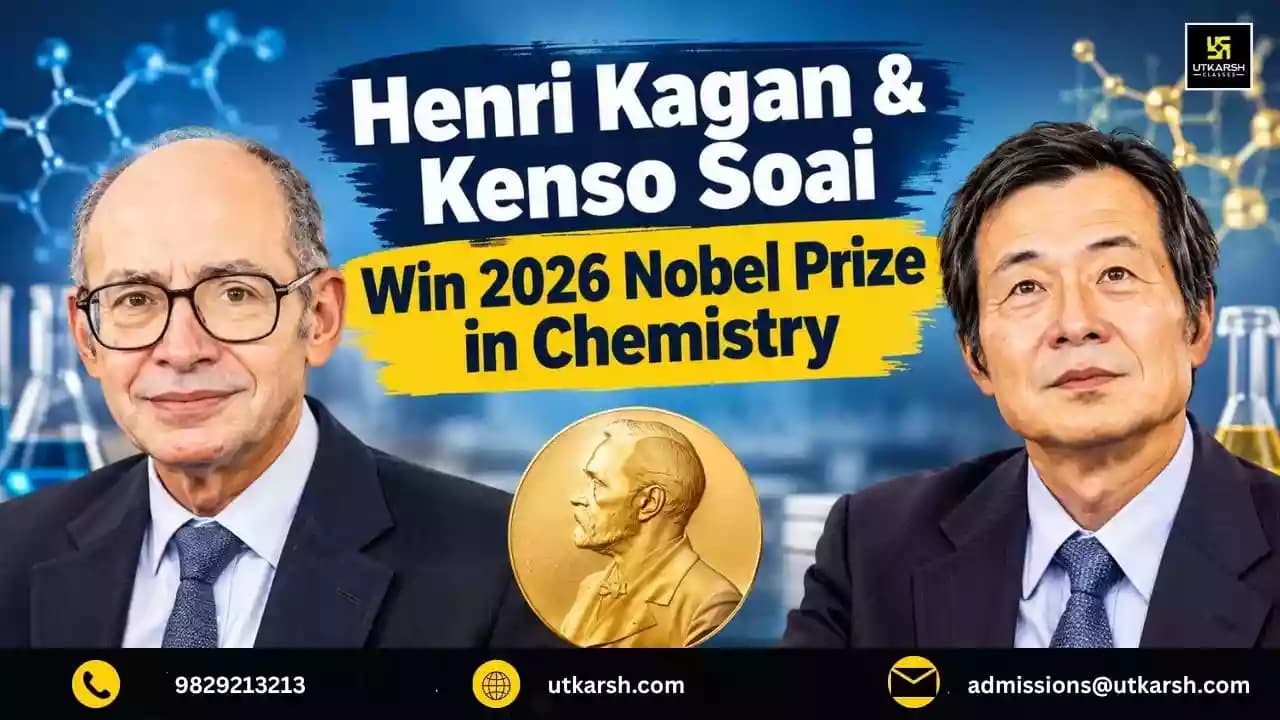
The Royal Swedish Academy of Sciences has awarded the 2026 Nobel Prize in Chemistry to Henri B. Kagan and Kenso Soai on 7th October, 2026. The prize recognises their discovery of non-linear effects and autocatalysis in asymmetric organic synthesis.
|
Laureate |
Affiliation |
Country/Origin |
Discovery |
|
Henri B. Kagan |
Université Paris-Sud |
France |
Discovery of non-linear effects in asymmetric synthesis |
|
Kenso Soai |
Tokyo University of Science |
Japan |
Discovery of asymmetric autocatalysis (the Soai reaction) |
Many molecules exist in two mirror-image forms, like left and right hands. These forms can behave very differently inside the body. Living things use only one "hand", so chemists need to make just the required form.
Kagan found a way to control reactions so that one mirror image forms in much greater amounts than was thought possible. This helps in making medicines, flavours, scents and new materials. Soai designed the first reaction in which only one mirror image forms. Before this, only life itself had done so. This is known as the Soai reaction.
It is a branch of chemistry that makes molecules with one particular 3D arrangement (an enantiomer) in preference to its mirror image. This matters because the two forms can act differently in living systems, so controlling this "handedness" is vital in medicine.
Normally, a change in the catalyst gives a matching change in the product. In non-linear effects, this is not so. A small change in the mix of catalyst forms can cause a much bigger change in the handedness of the product. Kagan's work established and explained this idea.
In autocatalysis, a product of a reaction also acts as a catalyst for the same reaction. The more product forms, the faster the reaction goes, so the process feeds itself.
Here, a product with one handedness helps make more molecules of the same handedness. In Soai's reaction, a tiny starting preference is amplified step by step. It shows how one molecular handedness can come to dominate.
About the author

Utkarsh Classes
Company
This content is prepared by the Utkarsh Classes team to present accurate, updated, and exam-relevant current affairs in a simple and reliable format.


Latest Current Affairs
Frequently asked questions


Still have questions?
Can't find the answer you're looking for? Please contact our friendly team.
Visit Utkarsh Classes Offline Centre Near You.

Download Last 5 Years PYQs in a Single Click
FREE PYQs exam ke level aur question pattern ko samajhne ka best tareeka