Ready to learn?
Take the first step toward achieving your educational goals. Whether you’re preparing for exams or expanding your knowledge, getting started is just a click away. Join us today and unlock your full potential
Utkarsh Classes
Admission office
Above Arora Namkeen
Jalori Gate circle,
Jodhpur (Raj.), 342005
support@utkarsh.com
+91-9116691119, +91-9829213213
Support
Get Started


Learning Resources
Rajasthan Govt Exams
Central Govt Exams
Civil Services Exams
Nursing Exams
School Tuitions
Other State Govt Exams
Agriculture Exams
College Entrance Exams
Miscellaneous Exams

© 2026 Utkarsh Classes & Edutech Pvt. Ltd. All Rights Reserved
Home

International Current Affairs
Agreements and MoU
India and Bangladesh Face Ganga Water Treaty Expiry in 2026
Add as a preferred source on Google
Updated: 21 Nov 2026
5 Min Read
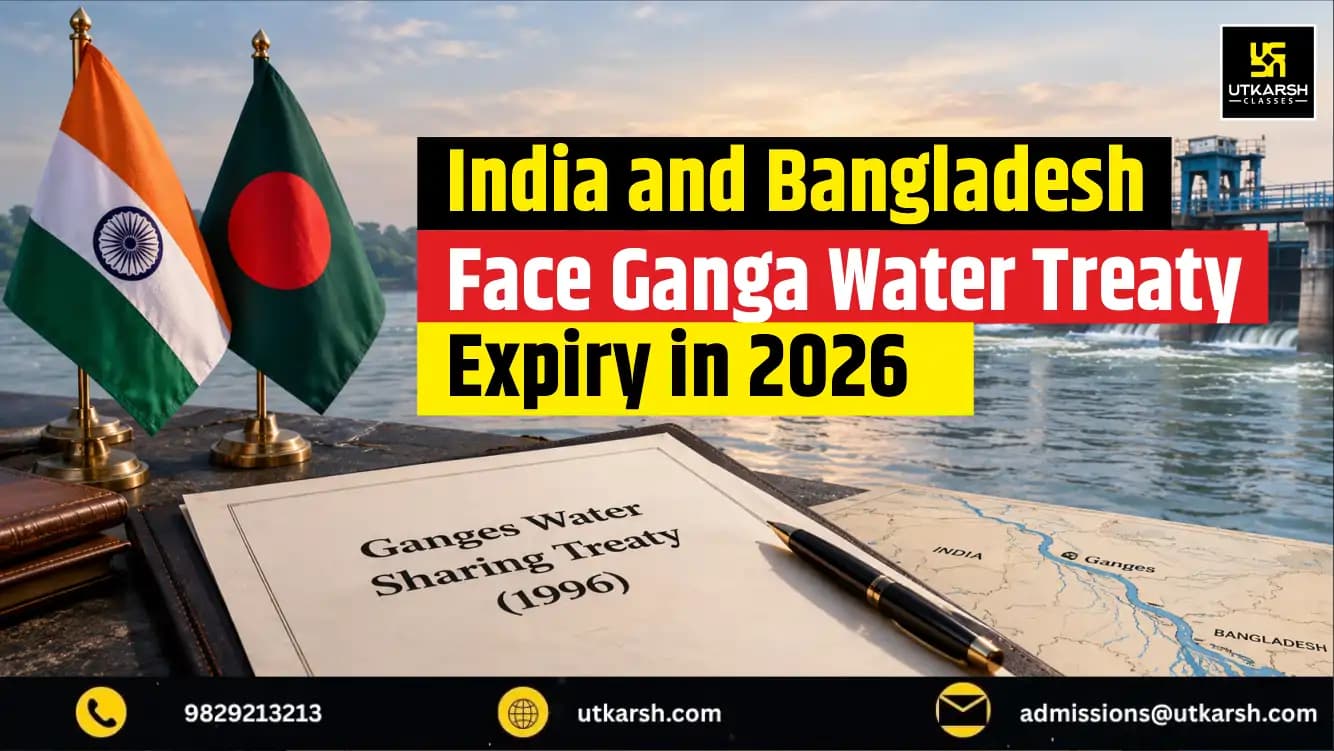
India and Bangladesh face a pressing diplomatic challenge as the 1996 Ganga Water Treaty nears its December 12, 2026, expiry date. Neither neighbour has started formal negotiations to renew the landmark pact. Both nations must act swiftly to prevent a sudden vacuum in their cross-border water-sharing framework.
For nearly three decades, this treaty has governed the distribution of Ganga waters at the Farakka Barrage. It has anchored bilateral resource management and regional stability. Today, strained diplomatic ties and prolonged procedural delays threaten its continuity.
Officials familiar with the developments warn that administrative channels alone cannot bridge this gap. Top political leaders in New Delhi and Dhaka must intervene immediately to resolve the deadlock before the deadline arrives.
On November 17, 2026, Bangladesh Water Resources Minister Shahiduddin Chowdhury Anee wrote to his Indian counterpart, C.R. Patil. Sent through official diplomatic channels, the letter formally requested talks to renew the Treaty on Sharing of the Ganga Waters at Farakka.
Dhaka informed New Delhi that it has already assembled a high-level technical committee for the negotiations. Minister Anee urged India to share the composition of its own negotiating team. Bangladesh stated that it has completed its groundwork and hopes formal talks will begin well before December 12.
Despite Dhaka's outreach, formal renewal negotiations have not yet commenced. Diplomats are actively exploring an interim extension of the current pact. This temporary measure would preserve existing water-sharing formulas while both nations hammer out a modernized treaty. However, top political leadership in both capitals must sign off on any stopgap arrangement.
Drafting a new water-sharing agreement involves complex environmental, demographic, and diplomatic variables. Negotiators must overcome three primary obstacles:
1. Climate Change and Shifting River Flows
Climate change directly alters the hydrology of the Ganga basin. Erratic monsoon rainfall, rising temperatures, and accelerated glacial melt impact seasonal water availability. A renewed treaty must incorporate flexible, science-based mechanisms to adapt to these changing river conditions.
2. Surging Water Demand and Population Growth
Rapid population growth across the Ganga basin has sharply increased water consumption. Agriculture, expanding industries, and urban households in both countries rely heavily on this river system. India and Bangladesh must balance competing domestic needs through rigorous technical planning.
3. Severe Time Constraints
The treaty expires on December 12, 2026, leaving just weeks to finalize a complex international pact. Experts doubt that both nations can resolve intricate technical and political disputes within this narrow window. Consequently, an interim extension appears to be the most practical safeguard against immediate disruption.
India and Bangladesh had originally agreed to launch technical renewal discussions in June 2024. Prime Minister Narendra Modi announced this commitment during former Bangladesh Prime Minister Sheikh Hasina’s final official visit to New Delhi.
However, political upheavals in Dhaka stalled the process. Sources note that Bangladesh’s interim administration failed to advance technical talks for nearly two years.
Indian sources also pointed out that New Delhi extended two formal invitations to Bangladesh Prime Minister Tarique Rahman to visit India in 2026. Such a high-level summit could have unlocked political consensus on the water treaty.
Furthermore, New Delhi wants a comprehensive dialogue covering all pending bilateral matters. India seeks progress on:
Indian officials emphasize that bilateral engagement must address these interconnected issues holistically rather than isolating water sharing.
An Indian technical delegation is visiting Bangladesh from November 21 to 23, 2026. The team is attending one of the three mandatory annual meetings of the Joint Committee established under the 1996 treaty.
However, extending or renewing the treaty is not on the official agenda. While delegates will review current dry-season water flows and operational data, this technical session cannot substitute for formal renewal negotiations. Political leaders must authorize a separate mandate to extend the pact.
India and Bangladesh share 54 transboundary rivers that sustain millions of livelihoods. Following years of disputes over dry-season flows at Farakka, then-Indian Prime Minister H.D. Deve Gowda and Bangladesh Prime Minister Sheikh Hasina signed the 30-year Ganga Water Treaty in December 1996.
Beyond the Ganga, the unresolved Teesta River dispute continues to test bilateral water diplomacy. Despite years of negotiations, both nations have yet to finalize a water-sharing agreement for the Teesta. Together, the Ganga and Teesta issues underscore the urgent need for sustained, transparent river diplomacy.
The Ganga Water Treaty remains a cornerstone of India-Bangladesh cooperation. Allowing the pact to lapse without a replacement would create severe uncertainty for farmers, ecosystems, and downstream communities. Over the next three weeks, New Delhi and Dhaka must decide whether to approve a short-term extension or fast-track a new agreement to safeguard their shared lifeline.
About the author

Girish Kumar
Current Affairs Content Writer
Girish Kumar is a current affairs content writer at Utkarsh Classes, with a decade of experience covering diverse contemporary issues. He develops high-quality study material for various competitive examinations, including UPSC, PSC, Bank PO etc.

Latest Current Affairs
Frequently asked questions

Visit Utkarsh Classes Offline Centre Near You.