Ready to learn?
Take the first step toward achieving your educational goals. Whether you’re preparing for exams or expanding your knowledge, getting started is just a click away. Join us today and unlock your full potential
Utkarsh Classes
Admission office
Above Arora Namkeen
Jalori Gate circle,
Jodhpur (Raj.), 342005
support@utkarsh.com
+91-9116691119, +91-9829213213
Support
Get Started


Learning Resources
Rajasthan Govt Exams
Central Govt Exams
Civil Services Exams
Nursing Exams
School Tuitions
Other State Govt Exams
Agriculture Exams
College Entrance Exams
Miscellaneous Exams

© 2026 Utkarsh Classes & Edutech Pvt. Ltd. All Rights Reserved
Add as a preferred source on Google
Updated: 17 Sep 2026
2 Min Read
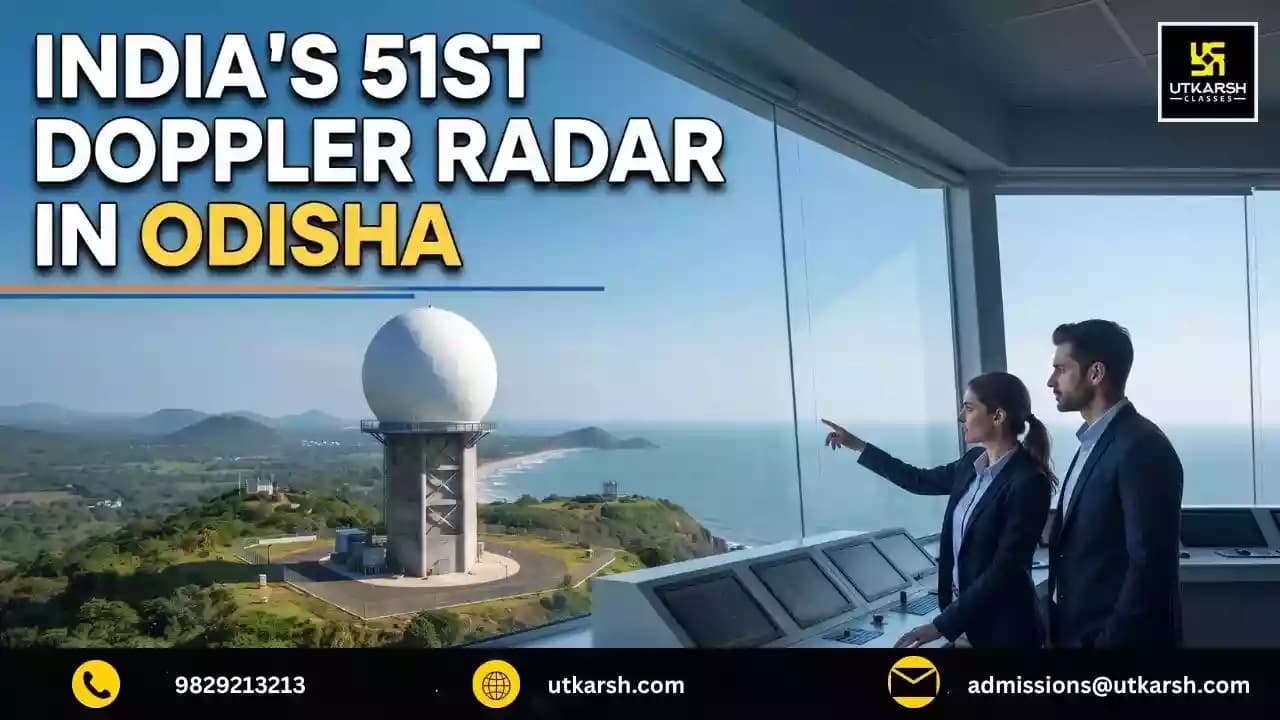
Union Minister of State (Independent Charge) for Earth Sciences, Dr. Jitendra Singh, virtually inaugurated India's 51st Doppler Weather Radar at Sambalpur, Odisha, in the presence of Chief Minister Mohan Charan Majhi on 16th September 2026. The new facility strengthens weather observation and early warning capabilities across Western Odisha and neighbouring regions.
Dr. Singh pointed out just how far India's radar infrastructure has come, from a mere 14 Doppler Weather Radars in 2014 to 51 today. That's a more than threefold jump in about a decade, reflecting a sustained government push to build stronger tools for tracking extreme weather events like thunderstorms and heavy rainfall.
The expansion isn't stopping here. Under Mission Mausam, roughly 40 additional radars are in the pipeline, which would eventually take India's total count to around 81. Odisha itself will see more additions soon, with radars planned for Balasore, Puri, and Bhubaneswar.
With Sambalpur now operational, Odisha has three Doppler Weather Radars in total, joining the ones already running at Gopalpur and Paradip. The Sambalpur unit fills a key observational gap, feeding better meteorological data not just to Western Odisha but also to parts of Southern Jharkhand, Northern Chhattisgarh, North Andhra Pradesh, and West Bengal.
India's growing radar network isn't just a domestic asset anymore. As IMD marks its 150th anniversary, the department is now offering cyclone, flash-flood, and general weather forecasting support to 13 neighboring countries, a move Dr. Singh linked to India's "Neighbour First" and "Vishwa Bandhu Bharat" approach to regional cooperation.
Radars alone aren't the whole story. The government is simultaneously rolling out automatic weather stations, rain gauges, radiosonde stations, and microwave radiometers across districts and even schools. The goal is a layered observation system that delivers hyper-local, actionable forecasts critical for agriculture, disaster management, and energy sectors that depend heavily on accurate weather information.
About the author

Hardika Shekhawat
Blogger
Blogger
Latest Current Affairs
Frequently asked questions

Visit Utkarsh Classes Offline Centre Near You.

Download Last 5 Years PYQs in a Single Click
FREE PYQs exam ke level aur question pattern ko samajhne ka best tareeka