Ready to learn?
Take the first step toward achieving your educational goals. Whether you’re preparing for exams or expanding your knowledge, getting started is just a click away. Join us today and unlock your full potential
Utkarsh Classes
Admission office
Above Arora Namkeen
Jalori Gate circle,
Jodhpur (Raj.), 342005
support@utkarsh.com
+91-9116691119, +91-9829213213
Support
Get Started


Learning Resources
Rajasthan Govt Exams
Central Govt Exams
Civil Services Exams
Nursing Exams
School Tuitions
Other State Govt Exams
Agriculture Exams
College Entrance Exams
Miscellaneous Exams

© 2026 Utkarsh Classes & Edutech Pvt. Ltd. All Rights Reserved
Add as a preferred source on Google
Updated: 31 Aug 2026
3 Min Read
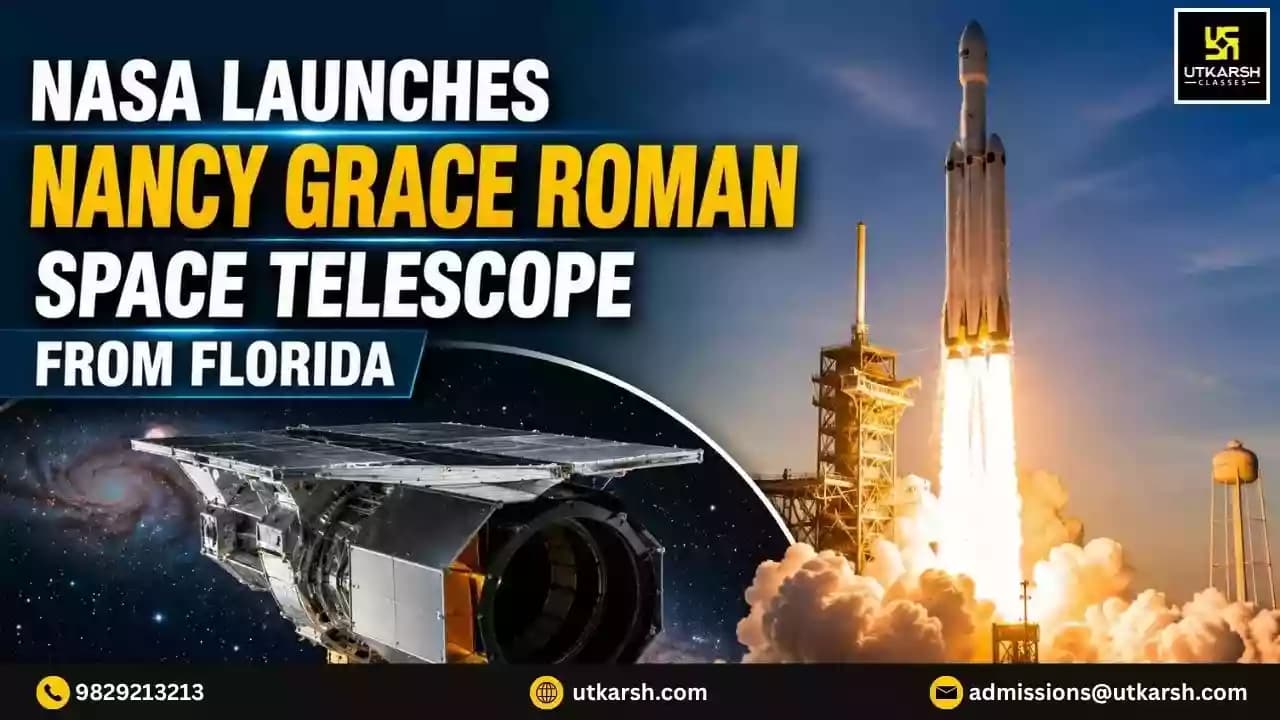
NASA has successfully launched the Nancy Grace Roman Space Telescope, marking a major step forward in the study of dark matter, dark energy, and planets beyond our solar system. The telescope lifted off from the Kennedy Space Center in Florida aboard a SpaceX Falcon Heavy rocket on 30th August, 2026, beginning a mission expected to reshape how scientists view the universe.
The telescope is named after Nancy Grace Roman, who served as NASA's first chief astronomer in the 1960s and was also the agency's first female executive. She had earlier played a key role in building support for the Hubble Space Telescope and later identified dark energy as one of Hubble's most fascinating discoveries, the very mystery her namesake telescope will now help investigate. Roman's Wide Field Instrument gives it a field of view at least 100 times larger than Hubble's, allowing scientists to capture much more of the sky in a single observation. NASA plans five years of primary scientific operations, with hopes the telescope could remain functional for up to a decade.
What Will NASA's New Roman Telescope Discover?
Roman's biggest scientific target is the search for exoplanets, with NASA expecting its surveys to uncover close to 100,000 new planets beyond our solar system. This data will help scientists study whether distant worlds could potentially support life. Beyond exoplanets, Roman will also probe dark matter and dark energy, two mysterious forces believed to make up around 95% of the universe. By observing galaxies across vast distances, the telescope will help researchers build detailed cosmic maps showing how the universe has evolved over time, alongside studying black holes and mapping billions of galaxies.
About the author

Hardika Shekhawat
Current Affairs Content Writer
Hardika is a current affairs content writer at Utkarsh Classes with 3 years of experience in academic content writing. She creates clear, exam-ready current affairs articles for UPSC, SSC, RAS, Banking, Railway and State PCS aspirants.

Latest Current Affairs
Frequently asked questions

Visit Utkarsh Classes Offline Centre Near You.

Download All Exam PYQ PDFS Free!!!
Previous 5+ year Questions Papers se karen damdar practice