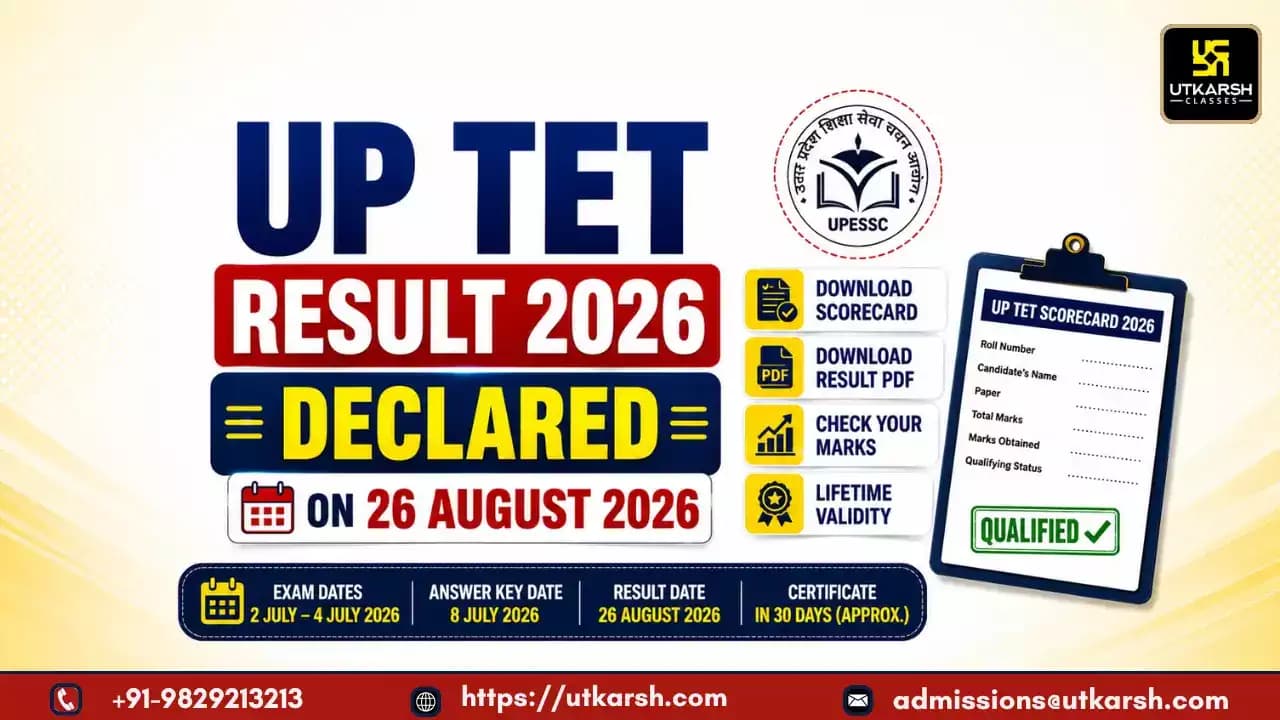
UP TET Exam Date 2026 has been announced by the Uttar Pradesh Education Service Selection Commission (UPESSC) through the UP TET Notification 2026. UP TET Exam 2026 will take place on 2, 3 and 4 July 2026. Those who are going to appear in the Uttar Pradesh Teacher Eligibility Test (UPTET) Exam 2026 should check the UP TET Syllabus 2026 carefully before starting their UP TET Exam Preparation 2026.
If you are the one who is going to appear in the UP TET Exam in the near future, then Utkarsh Classes is your one-stop solution, as we are providing you with the UP TET Syllabus 2026 PDF for both Paper 1 and 2, along with the detailed UP TET Exam Pattern 2026. You can kickstart your UP TET Exam Preparation journey 2026 by getting the subject-wise UP TET Syllabus here.
What Is UP TET Exam 2026?
The Uttar Pradesh Teacher Eligibility Test (UPTET) is a state-level qualifying examination conducted to assess whether candidates are qualified to become teachers in government schools across Uttar Pradesh. It is mandatory for individuals who wish to teach at the Primary level (Classes 1 to 5) or Upper Primary level (Classes 6 to 8).
The exam is divided into two papers i.e. Paper 1 is for candidates aiming to teach Classes 1 to 5, while Paper 2 is for those who want to teach Classes 6 to 8. Applicants can appear for either one or both papers, depending on their teaching preference and eligibility. Qualifying for UPTET is an essential step, after which candidates must complete further recruitment processes, such as document verification, as specified by the respective authorities.
UP TET Selection Process 2026
According to the UP TET 2026 Notification, the UP TET Selection Process 2026 includes objective-type written examinations for both Primary and Upper Primary teaching levels. Candidates who aspire to become teachers for Classes 1 to 8 in government schools of Uttar Pradesh are required to appear in the UP TET. Based on their eligibility and preference, candidates can choose to appear for Paper 1, Paper 2, or both.
UP TET Paper I (Primary Level) Exam 2026
UP TET Primary Level Exam 2026 Paper is meant for candidates who want to teach Classes 1 to 5. It includes subjects such as Child Development and Pedagogy, Language I, Language II, Mathematics, and Environmental Studies. The exam is designed to evaluate a candidate’s basic teaching skills and understanding of primary-level concepts.
UP TET Paper II (Upper Primary Level) Exam 2026
Candidates aiming to teach Classes 6 to 8 must appear for the UP TET Upper Primary Level Exam 2026. It covers Child Development and Pedagogy, two language papers, and subject-specific sections like Mathematics & Science or Social Studies. This paper focuses more on subject knowledge along with teaching aptitude.
UP TET Paper 1 & 2 (Primary & Upper Primary Level) Exam 2026
Candidates who wish to be eligible for teaching across Classes 1 to 8 are required to appear for both UP TET Paper I and UP TET Paper II. Qualifying for both exams allows them to apply for both Primary and Upper Primary teaching positions.
Note: To receive the UPTET eligibility certificate, candidates must achieve the minimum qualifying marks as prescribed for each paper.
UPTET Notification 2026: Key Highlights
UPTET 2026 is your gateway to completing your dream of becoming a Primary Level and Upper Primary Level teachers. You are advised to check this table for a quick overview of the UPTET 2026:-
|
UP TET Exam Updates 2026
|
|
Exam Conducting Organization
|
Uttar Pradesh Education Service Selection Commission (UPESSC)
|
|
Exam Name
|
Uttar Pradesh Teacher Eligibility Test (UPTET) 2026
|
|
Exam Level
|
State-Level Teaching Eligibility Test
|
|
Paper Levels
|
- Paper 1 (Class 1 to 5)
- Paper 2 (Class 6 to 8)
|
|
UP TET Exam City Slip 2026 Release Date
|
22 June 2026
|
|
UP TET Admit Card 2026 Release Date
|
30 June 2026
|
|
UP TET Exam Date 2026
|
02, 03, and 04 July 2026
|
|
Exam Mode
|
Offline (OMR-based)
|
|
Job Location
|
Uttar Pradesh
|
|
Purpose of Exam
|
To determine eligibility for Primary & Upper Primary Teacher posts
|
|
Validity
|
Lifetime
|
|
Exam Nature
|
Qualifying in nature
|
|
UP TET Notification 2026
|
UPTET Exam Pattern 2026
UP TET Exam Pattern 2026 must be checked by those who are going to appear in the exam. Understanding the UP TET Exam Pattern is crucial for candidates preparing for the recruitment exam, as it provides clarity on the structure of the test and helps in planning a focused and effective preparation strategy.
Know the basic structure of the UP TET Exam, including no of questions, marks, duration, and subjects on which questions will be asked to begin your preparation according to the exam needs:-
UPTET Exam Pattern for Paper 1 (Primary Level)
Candidates who qualify for Primary level teaching through UPTET become eligible to work in government schools run by the Uttar Pradesh State Government, local body schools recognized by the state or Basic Education Board, government-aided institutions, and schools affiliated with recognized national boards that have a valid NOC from the Uttar Pradesh Government. Have a look at the UP TET Primary Exam Pattern here:-
- There will be 150 multiple-choice questions of 150 marks.
- Candidates will be given 1 mark for each right answer, and there is no negative marking.
- To complete the exam, 150 minutes will be allotted.
- Candidates must secure the prescribed minimum qualifying marks to pass the exam i.e. General category candidates need at least 60% (90 out of 150), while candidates from reserved categories (SC/ST/OBC/EWS/PwD, etc.) must obtain a minimum of 55% (82 out of 150).
|
UPTET Paper 1 Exam 2026 Pattern
|
|
Subject
|
No. of Questions
|
Marks
|
Exam Duration
|
|
Child Development & Pedagogy
|
30
|
30
|
150 Minutes
|
|
Language I (Hindi)
|
30
|
30
|
|
Language II (English/Urdu/Sanskrit)
|
30
|
30
|
|
Mathematics
|
30
|
30
|
|
Environmental Studies
|
30
|
30
|
|
Total
|
150
|
150
|
UPTET Exam Pattern for Paper 2 (Upper Primary Level)
Candidates who qualify for the Upper Primary level become eligible to teach in schools run by the Uttar Pradesh State Government, institutions managed by local bodies and recognized by the state, Basic Education Board, or Secondary Education Board, government-aided schools, and institutions affiliated with recognized national boards that have valid approval from the Uttar Pradesh Government. Check the complete UPTET Upper Primary Exam Pattern 2026:-
- The exam will consist of 150 multiple-choice questions carrying a total of 150 marks.
- Each correct answer will be awarded 1 mark, and there will be no negative marking.
- Candidates will be given 150 minutes to complete the exam.
- To qualify, General category candidates must score at least 60% (90 out of 150), while reserved category candidates (SC/ST/OBC/EWS/PwD, etc.) need to secure a minimum of 55% (82 out of 150).
|
UP TET Paper 2 Exam Pattern 2026
|
|
Subject
|
No. of Questions
|
Marks
|
Exam Duration
|
|
Child Development & Pedagogy
|
30
|
30
|
150 Minutes
|
|
Language I (Hindi)
|
30
|
30
|
|
Language II (English/Urdu/Sanskrit)
|
30
|
30
|
- Mathematics/Science for Mathematics and Science Teacher
- For a Social Studies or Social Science teacher, Social Studies
- Any other teacher, either (a) or (b)
|
60
|
60
|
|
Total
|
150
|
150
|
UP TET Syllabus 2026: Subject-wise
UP TET Exam requires your strong fundamentals or conceptual knowledge on Child Development & Pedagogy, Language, Mathematics, Science, Social Science, Environmental Science etc. The exam is structured to assess candidates’ teaching aptitude, subject knowledge, and understanding of child pedagogy for both Primary (Classes 1 to 5) and Upper Primary (Classes 6 to 8) levels.
In this section, we are providing you with a detailed subject-wise UP TET Syllabus in English for your reference. A clear understanding of the subject-wise UP TET 2026 syllabus enables candidates to identify key topics and important areas, helping them prepare in a focused and efficient manner. By reviewing the detailed syllabus, aspirants can organize their study plan, prioritize important sections, and ensure complete coverage of all essential concepts related to teaching aptitude, child pedagogy, and relevant subjects for both Primary and Upper Primary levels.
UPTET Primary & Upper Primary Syllabus 2026
The UP TET Paper 1 syllabus emphasizes fundamental concepts and teaching skills required for the primary stage. On the other hand, UP TET Paper 2 focuses on upper primary-level topics with a greater emphasis on conceptual clarity and application-based understanding. Check the complete Subject-wise UP TET Primary Syllabus in English along with UPTET Upper Primary Syllabus for 6 to 8 Classes and take one step ahead in your UPTET Preparation Journey 2026:-
Child Development & Pedagogy
UP TET Child Development and Pedagogy Syllabus is common to both UP TET Paper 1 & 2. The difficulty level of the questions can be varied on the basis of the Primary and Upper Primary levels. Check the UP TET Syllabus of Pedagogy here:-
|
UP TET Child Development & Pedagogy Syllabus (Common For Both)
|
|
Topic
|
Sub Topics
|
|
Content/Topics
|
- Meaning, need, and scope of child development; stages of child development; physical development; cognitive (mental) development; emotional development; language development; development of expression skills; and development of creativity and creative abilities.
- Foundations of child development and the factors influencing it: heredity and environment (family, social, school, and media).
|
|
Meaning and Theories of Learning
|
- Meaning of learning, factors affecting learning, and effective methods of learning.
- Laws of learning: Thorndike’s main laws of learning and their significance in the learning process.
- Major theories of learning and their practical application in classroom teaching, including Thorndike’s Trial and Error Theory, Pavlov’s Classical Conditioning Theory, Skinner’s Operant Conditioning Theory, Kohler’s Insight Theory, Piaget’s Theory, and Vygotsky’s Theory. Also includes the learning curve-its meaning and types, and the concept of plateau in learning, along with its causes and remedies.
|
|
Teaching and Teaching Methods
|
- Meaning and objectives of teaching, communication, principles of teaching, maxims of teaching, teaching techniques, modern teaching approaches, micro-teaching, and basic teaching skills.
|
|
Inclusive Education – Guidance and Counseling
|
- Concept, identification, types, and solutions of educational inclusion, including disadvantaged groups based on language, religion, caste, region, class, gender, and physical abilities (disabilities), as well as learning disabilities and intellectual challenges.
- Required tools, materials, methods, teaching-learning materials (TLM), and attitudes for inclusion.
- Tools and techniques for assessing the learning of inclusive children.
- Special teaching methods for inclusive learners, such as Braille, etc.
- Guidance and counseling for inclusive learners: meaning, objectives, types, methods, needs, and scope.
- Departments/organizations that support counseling:
- Psychology Laboratory, Uttar Pradesh, Prayagraj
- Divisional Psychology Centers (at the division level)
- District hospitals
- Trained guides/mentors at District Institutes of Education and Training (DIETs)
- Supervision and inspection systems
- Community and school support committees
- Government and non-government organizations
- Importance of guidance and counseling in child learning.
|
|
Learning & Teaching
|
- How children think and learn; how and why children fail to achieve success in school performance.
- Basic processes of teaching and learning; children’s study practices; learning as a social activity and its social context.
- The child is a problem-solver and is a “scientific investigator.”
- Alternative conceptions of children’s learning: understanding children’s “errors” as important steps in the learning process.
- Cognition and perception.
- Motivation and learning.
- Factors contributing to learning: personal and environmental.
|
Hindi
UP TET Hindi Syllabus is slightly different for both Paper 1 and Paper 2. Candidates must check the UP TET Syllabus of Primary and Upper Primary Level here to begin the UP TET Hindi Preparation 2026:-
|
UP TET Hindi Syllabus
|
|
Level
|
Syllabus
|
|
Primary
|
क) हिन्दी (विषय वस्तु)
- अपठित अनुच्छेद।
- हिन्दी वर्णमाला (स्वर, व्यंजन)।
- वर्गों के मेल से मात्रिक तथा अमात्रिक शब्दों की पहचान।
- वाक्य रचना।
- हिन्दी की सभी ध्वनियों के पारस्परिक अंतर की जानकारी विशेष रूप से– ष, स, श, व, ब, द, ड, ढ, क्ष, छ, ण, तथा न की ध्वनियाँ।
- हिन्दी भाषा की सभी ध्वनियाँ, वर्ण, अनुस्वार, अनुनासिक एवं चन्द्रबिन्दु में अंतर।
- संयुक्ताक्षर एवं अनुनासिक ध्वनियों के प्रयोग से बने शब्द।
- सभी प्रकार की मात्राएँ।
- विराम चिह्नों यथा– अल्प विराम, अर्धविराम, पूर्णविराम, प्रश्नवाचक, विस्मयबोधक, चिन्हों का प्रयोग।
- विलोम, समानार्थी, तुकान्त, अनुकान्त, समान ध्वनि वाले शब्द।
- संज्ञा, सर्वनाम, क्रिया एवं विशेषण के भेद।
- वचन, लिंग एवं काल।
- प्रत्यय, उपसर्ग, तत्सम, तद्भव व देशज, शब्दों की पहचान एवं उनमें अंतर।
- लोकोक्तियाँ एवं मुहावरों के अर्थ।
- सन्धि– (1) स्वर सन्धि– दीर्घ सन्धि, गुण सन्धि, वृद्धि सन्धि, यण सन्धि, अयादि सन्धि।
(2) व्यंजन सन्धि।
(3) विसर्ग सन्धि।
- वाच्य, समास एवं अलंकार के भेद।
- कविओं एवं लेखकों की रचनाएं।
ख) भाषा विकास का अध्यापन
- अधिगम और अर्जन ।
- भाषा अध्यापन के सिद्धान्त ।
- सुनने और बोलने की भूमिका: भाषा का कार्य तथा बालक इसे किस प्रकार एक उपकरण के रूप में प्रयोग करते हैं।
- मौखिक और लिखित रूप में विचारों के संप्रेषण के लिए किसी भाषा के अधिगम में व्याकरण की भूमिका पर निर्णायक संदर्श ।
- एक भिन्न कक्षा में भाषा पढ़ाने की चुनौतियां; भाषा की कठिनाइयाँ, त्रुटियां और विकार ।
- भाषा कौशल ।
- भाषा बोधगम्यता और प्रवीणता का मूल्यांकन करना: बोलना, सुनना, पढ़ना और लिखना ।
- अध्यापन– अधिगम सामग्रियांः पाठ्यपुस्तक, मल्टी मीडिया सामग्री, कक्षा का बहुभाषायी संसाधन । उपचारात्मक अध्यापन ।
|
|
Upper Primary
|
क) विषय-वस्तु
- अपठित अनुच्छेद।
- संज्ञा एवं संज्ञा के भेद |
- सर्वनाम एवं सर्वनाम के भेद |
- विशेषण एवं विशेषण के भेद |
- क्रिया एवं क्रिया के भेद |
- वाच्य- कर्तृवाच्य, कर्मवाच्य, भाववाच्य।
- हिन्दी भाषा की समस्त ध्वनियों, संयुक्ताक्षरों, संयुक्त व्यंजनों, अनुस्वार एवं चन्द्रबिन्दु में अन्तर।
- वर्णक्रम, पर्यायवाची, विपरीतार्थक, अनेकार्थक, समानार्थी शब्द। अव्यय के भेद |
- अनुस्वार, अनुनासिक का प्रयोग |
- "र" के विभिन्न रूपों का प्रयोग ।
- वाक्य निर्माण (सरल, संयुक्त एवं मिश्रित वाक्य) ।
- विराम चिन्हों की पहचान एवं उपयोग ।
- वचन, लिंग एवं काल का प्रयोग ।
- तत्सम तद्भव, देशज एवं विदेशी शब्द |
- उपसर्ग एवं प्रत्यय ।
- शब्द युग्म ।
- समास, समास विग्रह एवं समास के भेद |
- मुहावरे एवं लोकोक्तियाँ ।
- क्रिया सकर्मक एवं अकर्मक |
- सन्धि एवं सन्धि के भेद । (स्वर, व्यंजन एवं विसर्ग सन्धियाँ) ।
- अलंकार। (अनुप्रास, यमक, श्लेष, उपमा, रूपक, उत्प्रेक्षा, अतिशयोक्ति)
ख) भाषा विकास का अध्यापन
- अधिगम अर्जन ।
- भाषा अध्यापन के सिद्धान्त ।
- सुनने और बोलने की भूमिका; भाषा का कार्य तथा बालक इसे किस प्रकार एक उपकरण के रूप में प्रयोग करते हैं।
- मौखिक और लिखित रूप में विचारों के संप्रेषण के लिए किसी भाषा के अधिगम में व्याकरण की भूमिका पर विवेचित संदर्श ।
- एक भिन्न कक्षा में भाषा पढ़ाने की चुनौतियां; भाषा की कठिनाइयां, त्रुटियां और विकार ।
- भाषा कौशल ।
- भाषा बोधगम्यता और प्रवीणता का मूल्यांकन करना: बोलना, सुनना, पढ़ना और लिखना ।
- अध्यापन–अधिगम सामग्रियांः पाठ्यपुस्तक, मल्टी मीडिया सामग्री, कक्षा का बहुभाषायी संसाधन । उपचारात्मक अध्यापन ।
|
English
The UP TET syllabus varies slightly for both Paper 1 and Paper 2. Candidates should review the detailed UP TET English Syllabus for Primary and Upper Primary levels to start their preparation for 2026 effectively.
|
UP TET English Syllabus 2026
|
|
Level
|
Topics
|
|
Primary
|
- Unseen Passage
- The Sentences
- Subject and Predicate
- Kinds of Sentences
- Kinds of Noun
- Pronoun
- Adverb
- Adjective
- Verb
- Preposition
- Conjunction
- Tenses- Present, Past, Future
- Articles
- Punctuation
- Word Formation
- Active & Passive Voice
- Singular & Plural
- Gender
|
|
Upper Primary
|
- Unseen Passage
- Nouns and their Kinds
- Pronoun and its Kinds
- Verb and Its Kinds
- Adjectives and their Kinds & Degrees
- Adverb and its Kinds
- Preposition and its Kinds
- Conjunction and Its Kinds
- Intersection
- Singular and Plural
- Subject and Predicate
- Negative and interrogative sentences
- Masculine and Feminine Gender
- Punctuations
- Suffix with Root words
- Phrasal Verbs
- Use of Somebody, Nobody, Anybody
- Part of Speech
- Narration
- Active voice and Passive voice
- Antonyms & Synonyms
- Use of Homophones
- Use of the request in sentences
- Silent Letter in words
|
Urdu
UP TET Urdu Syllabus 2026 is provided below for both Primary and Upper Primary Exams for your reference:-
|
UP TET Urdu Syllabus
|
|
Level
|
Topics
|
|
Primary
|
- अपठित अनुच्छेद।
- ज़बान की फन्नी महारतों की मालूमात ।
- मशहूर अदीबों एवं शायरों की हालातें जिन्दगीं एवं उनकी रचनाओं की जानकारी ।
- मुखतलिफ असनाफे अदब जैसे, मज़मून, अफसाना, मर्सिया, मसनवी दास्तान वगैरह की तारीफ में, अमसाल ।
- सही इमला वं तलफ्फुज की मश्क ।
- इस्म, जमीर, सिफत, मुतज़ाद अल्फाज, वाहिद, जमा, मोजक्कर, मोअन्नस वगैरह की जानकारी ।
- सनअते, (तशबीह व इस्तआरा, तलमीह, मराअतुन्नजीर) वगैरह।
- मुहावरों, जर्बुल अमसाल की मालूमात ।
- मखतलिफ समाजी मसायल जैसे माहौलियाती बराएअम्न, अदमे, तग़जिया, वगैरह की मालूमात ।
- आलूदगी जिन्सी नाबराबरी, नाख्वान्दगी, तालीम
- नज़्मो, कहानियों, हिकायतों एवं संस्मरणों में मौजूद समाजी एवं एखलाकी अक़दार को समझना।
|
|
Upper Primary
|
- अपठित अनुच्छेद।
- ज़बान की फन्नी महारतों की जानकारी ।
- मुखतलिफ समझना: अदब-ए-हम्द, ग़ज़ल, कसीदा, मर्सिया, मसनवी, गीत वगैरह की समझ एवं उनके फर्क को समझना ।
- मुख्तलिफ शायरों, अदीबों की हालाते जिन्दगी से वाकफियत एवं उनकी तसानीफ की जानकारी हासिल करना ।
- मुल्क की मुश्तरका तहज़ीब में उर्दू जबान की खिदमत और अहमियत से वाकफियत हासिल करना ।
- इस्म व उसके अक़साम, फेल, सिफत, ज़मीर, तज़कीर, तानीस, तज़ाद की समझा।
- सही इमला एवं एराब की जानकारी होना ।
- मुहावरे एवं जर्बुल अमसाल से वाक़फियत हासिल करना।
- सनअतों की जानकारी होना ।
- सियासी, समाजी एवं ऐखलाकी मसले के तईं बेदार होना और उस पर अपना नज़रिया वाजे रखना ।
|
Sanskrit
Candidates who have opted for Sanskrit as their language can have a look at the table below for UP TET Sanskrit Syllabus of Paper 1 and Paper 2:-
|
UP TET Sanskrit 2026
|
|
Level
|
Topics
|
|
Primary
|
क) विषय वस्तु
- अपठित अनुच्छेद।
- संज्ञाएँ– अकारान्त पुल्लिंग।
- अकारान्त स्त्रीलिंग |
- अकारान्त नपुंसकलिंग।
- ईकारान्त स्त्रीलिंग।
- उकारान्त पुल्लिंग।
- ऋकारान्त पुल्लिंग।
- ऋकारान्त स्त्रीलिंग |
- घर, परिवार, परिवेश, पशु, पक्षियों, घरेलू उपयोग की वस्तुओं के संस्कृत नामों से परिचय |
- सर्वनाम ।
- क्रियाएँ ।
- शरीर के प्रमुख अंगों के संस्कृत शब्दों का प्रयोग |
- अव्यय ।
- सन्धि-सरल शब्दों की सन्धि तथा उनका विच्छेद् (दीर्घ सन्धि)।
- संख्याएँ - संस्कृत में संख्याओं का ज्ञान ।
- लिंग, वचन, प्रत्याहार, स्वर के प्रकार, व्यंजन के प्रकार, अनुस्वार एवं अनुनासिक व्यंजन |
- स्वर व्यंजन एवं विसर्ग सन्धियाँ, समास उपसर्ग, पर्यायवाची शब्द, विलोम शब्द, कारक, प्रत्यय एवं वाच्य |
- कवियों एवं लेखकों की रचनाएँ ।
ख) भाषा विकास का अध्यापन
- अधिगम और अर्जन ।
- भाषा अध्यापन के सिद्धान्त ।
- सुनने और बोलने की भूमिकाः भाषा का कार्य तथा बालक इसे किस प्रकार एक उपकरण के रूप में प्रयोग करते हैं।
- मौखिक और लिखित रूप में विचारों के संप्रेषण के लिए किसी भाषा के अधिगम में व्याकरण की भूमिका पर निर्णायक संदर्श ।
- एक भिन्न कक्षा में भाषा पढ़ाने की चुनौतियां; भाषा की कठिनाईयां, त्रुटियां और विकार ।
- भाषा कौशल ।
- भाषा बोधगम्यता और प्रवीणता का मूल्यांकन करनाः बोलना, सुनना, पढ़ना और लिखना ।
- अध्यापन– अधिगम सामग्रियांः पाठ्यपुस्तक, मल्टी मीडिया सामग्री, कक्षा का बहुभाषायी संसाधन ।
- उपचारात्मक अध्यापन ।
|
|
Upper Primary
|
क) विषय वस्तु
- अपठित अनुच्छेद।
- सन्धि- स्वर, व्यंजन |
- अव्यय ।
- समास ।
- लिंग, वचन एवं काल का प्रयोग ।
- उपसर्ग ।
- पर्यायवाची ।
- विलोम ।
- कारक |
- अलंकार ।
- प्रत्यय |
- वाच्य |
- संज्ञाएँ - निम्नवत् सभी शब्दों की सभी विभक्ति एवं वचनों के रूपों का ज्ञान:-
- पुल्लिंग शब्द ।
- स्त्रीलिंग शब्द |
- नपुसंकलिंग शब्द ।
- अकारान्त पुल्लिंग।
- अकारान्त स्त्रीलिंग | अकारान्त नपुसंकलिंग ।
- उकारान्त पुल्लिंग ।
- उकारान्त स्त्रीलिंग |
- उकारान्त नपुसंकलिंग ।
- ईकारान्त पुल्लिंग ।
- ईकारान्त स्त्रीलिंग |
- ईकारान्त नपुसंकलिंग |
- ऋकारान्त पुल्लिंग |
- सर्वनाम ।
- विशेषण ।
- धातु ।
- संख्याएँ ।
ख) भाषा विकास का अध्यापन
- अधिगम और अर्जन ।
- भाषा अध्यापन का सिद्धान्त ।
- सुनने और बोलने की भूमिका; भाषा का कार्य तथा बालक इसे किस प्रकार एक उपकरण के रूप में प्रयोग करते हैं।
- मौखिक और लिखित रूप में विचारों के संप्रेषण के लिए किसी भाषा के अधिगम में व्याकरण की भूमिका पर निर्णायक संदर्श ।
- एक भिन्न कक्षा में भाषा पढ़ाने की चुनौतियां; भाषा की कठिनाईयां, त्रुटियां और विकार ।
- भाषा कौशल ।
- भाषा बोधगम्यता और प्रवीणता का मूल्यांकन करनाः बोलना, सुनना, पढ़ना और लिखना ।
- अध्यापन–अधिगम सामग्रीः पाठ्यपुस्तक, मल्टीमीडिया सामग्री, कक्षा का बहुभाषायी संसाधन ।
- उपचारात्मक अध्यापन ।
|
Mathematics
The UP TET syllabus differs for Paper 1 and Paper 2. Aspirants are advised to go through the complete UP TET Mathematics Syllabus for both Primary and Upper Primary levels to plan their preparation for 2026 in a structured manner.
|
UP TET Mathematics Syllabus 2026
|
|
Level
|
Sub Topics
|
|
Primary
|
A) Content
- Numbers and addition, subtraction, multiplication, division of numbers.
- Least Common Multiple (LCM) and Highest Common Factor (HCF).
- Addition, subtraction, multiplication and division of fractions.
- Decimals- addition, subtraction, multiplication and division.
- Unitary Method.
- Percentage.
- Profit-Loss.
- Simple Interest.
- Geometry- Geometrical shapes and surfaces, Angles, Triangles, Circles. Money (Rupees-Paise).
- Measurement- Time, Weight, Capacity, Length and Temperature.
- Perimeter- Triangle, Rectangle, Square, Quadrilateral.
- Calendar.
- Data.
- Volume, Capacity- Cube, Cuboid. Area- Rectangle, Square.
- Railway or Bus Time-table.
- Presentation and Representation of Data.
B) Pedagogical Issues
- Nature of mathematical/logical thinking.
- Place of mathematics in the curriculum.
- Language of mathematics.
- Community mathematics.
- Evaluation through formal and informal methods.
- Problems of teaching.
- Error analysis and relevant aspects of learning and teaching.
- Diagnostic and remedial teaching.
|
|
Upper Primary
|
- Natural numbers, whole numbers, rational numbers.
- Integers, brackets, least common multiple, and highest common factor.
- Square root.
- Cube root.
- Identities.
- Algebra, concept – variables, constants, powers of variables.
- Addition, subtraction, multiplication, and division of algebraic expressions; terms of algebraic expressions and coefficients of terms; like and unlike terms; degree of expressions; concept of monomial, binomial, and trinomial.
- Simultaneous equations, quadratic equations, linear equations.
- Parallel lines, construction of a quadrilateral, triangle.
- Circle and cyclic quadrilateral.
- Tangents to a circle.
- Commercial mathematics – ratio, proportion, percentage, profit and loss, simple interest, compound interest, tax, barter system.
- Banking – present currency, bill, and cash memo.
- Statistics – classification of data, pictograph, mean, median, and mode, frequency
- Pie and bar chart, representation of ungrouped data.
- Probability graph, bar diagram, and mixed bar diagram.
- Cartesian plane.
- Mensuration
- Exponents.
B) Pedagogical Issues
- Nature of mathematical/logical thinking.
- Place of mathematics in the curriculum.
- Language of mathematics.
- Community mathematics. Evaluation.
- Remedial teaching | Problems of teaching.
|
Environmental Studies
UP TET EVS 2026 Syllabus is here in the table below. Only UP TET Paper 1 2026 will contain this section:-
|
UP TET EVS Syllabus 2026 (Only For Primary)
|
|
Topic
|
Sub Topic
|
|
Content Area
|
- Family.
- Food, health and hygiene.
- Housing.
- Trees, plants and animals.
- Our environment.
- Fair (Mela).
- Persons and occupations related to local professions and businesses.
- Water.
- Transport and communication.
- Games and sports spirit.
- India – rivers, mountains, plateaus, forests, transport, continents and oceans.
- Our state – rivers, mountains, plateaus, forests, transport.
- Constitution.
- System of governance – local self-government, Gram Panchayat, Nagar Panchayat, Zila Panchayat, Municipality, Municipal Corporation, District Administration, State governance system, Legislature, Judiciary, Executive, National festivals, National symbols, Voting, National unity.
- Environment – need, importance and utility, environmental conservation, social responsibility towards environment, schemes run for environmental protection.
|
|
Pedagogical Issues in EVS
|
- Concept and scope of Environmental Studies.
- Importance of Environmental Studies, integrated Environmental Studies.
- Environmental Studies and Environmental Education.
- Learning theories.
- Scope and relationship of Science and Social Science.
- Approaches for presenting concepts.
- Activities.
- Experiments / practical work.
- Discussion.
- Continuous and comprehensive evaluation.
- Teaching materials / aids.
- Problems.
|
Science & Social Science
UP TET Science and Social Science Syllabus 2026 is detailed here for the Upper Primary Level (Paper 2) for your reference:-
|
UP TET Science & Social Science Syllabus 2026 (Only For Upper Primary)
|
|
Subject
|
Syllabus
|
|
Science
|
A) Content
- Science in daily life, important discoveries, importance, human science and technology.
- Fibres and fabrics, from fibres to fabric (process).
- Living and non-living substances – living world, classification of living organisms, classification of plants and animals on the basis of flora and fauna, adaptation in organisms, changes in animals and plants.
- Structure and function of animals.
- Microorganisms and their classification.
- From cell to organ system.
- Adolescence, disability.
- Food, health, hygiene and diseases, crop production, nitrogen cycle.
- Nutrition in animals.
- Nutrition in plants, reproduction, useful plants.
- Respiration and excretion in living organisms, useful animals.
- Measurement, electric current.
- Magnetism.
- Motion, force and machines.
- Energy.
- Computer.
- Sound.
- Static electricity.
- Light and optical instruments.
- Air – properties, composition, need, utility, ozone layer, greenhouse effect.
- Water – need, utility, sources, properties, pollution, water conservation.
- Matter, grouping of materials, separation of substances, structure and nature of matter.
- Changes in surroundings, physical and chemical changes.
- Acids, bases, salts.
- Heat and temperature.
- Man-made materials, plastic, glass, soap, clay.
- Minerals and metals.
- Carbon and its compounds.
- Alternative sources of energy.
B) Pedagogical Issues
- Nature and structure of science.
- Natural science – aims and objectives.
- Understanding and appreciating science.
- Approach / integrated approach.
- Observation / experiment / exploration (scientific method).
- Innovation.
- Curriculum material / teaching-learning material.
- Evaluation.
- Problems.
- Remedial teaching.
|
|
Social Science
|
A) Content
- History
- Civics
- Geography
- Environmental Studies
- Home Science
- Physical Education
- Music
- Horticulture and Fruit Preservation
B) Concept and Methodology of Social Studies
- Classroom processes, activities and lecture.
- Developing critical thinking.
- Inquiry / empirical evidence.
- Problems of teaching Social Science / Social Studies.
- Project work.
- Evaluation.
|
UP TET Syllabus PDF Download
UP TET Syllabus 2026 is essential for those who are preparing to appear in the UP TET 2026. Whether you are in search of UP TET Syllabus Paper 1 2026 or UP TET Paper 2 Syllabus 2026, we have you covered. In this section, we are providing you with the UPTET Syllabus in Hindi PDF for your reference.
Click on the link below to get UP TET Syllabus in Hindi:-
Start your UP TET Exam Preparation 2026 with Utkarsh Classes now to become a Primary/ Upper Primary Teacher in Uttar Pradesh. We wish you the best for your Upcoming UPTET Exam 2026!