Ready to learn?
Take the first step toward achieving your educational goals. Whether you’re preparing for exams or expanding your knowledge, getting started is just a click away. Join us today and unlock your full potential
Utkarsh Classes
Admission office
Above Arora Namkeen
Jalori Gate circle,
Jodhpur (Raj.), 342005
support@utkarsh.com
+91-9116691119, +91-9829213213
Support
Get Started


Learning Resources
Rajasthan Govt Exams
Central Govt Exams
Civil Services Exams
Nursing Exams
School Tuitions
Other State Govt Exams
Agriculture Exams
College Entrance Exams
Miscellaneous Exams

© 2026 Utkarsh Classes & Edutech Pvt. Ltd. All Rights Reserved
Add as a preferred source on Google
Updated: 01 May 2026
12 Min Read
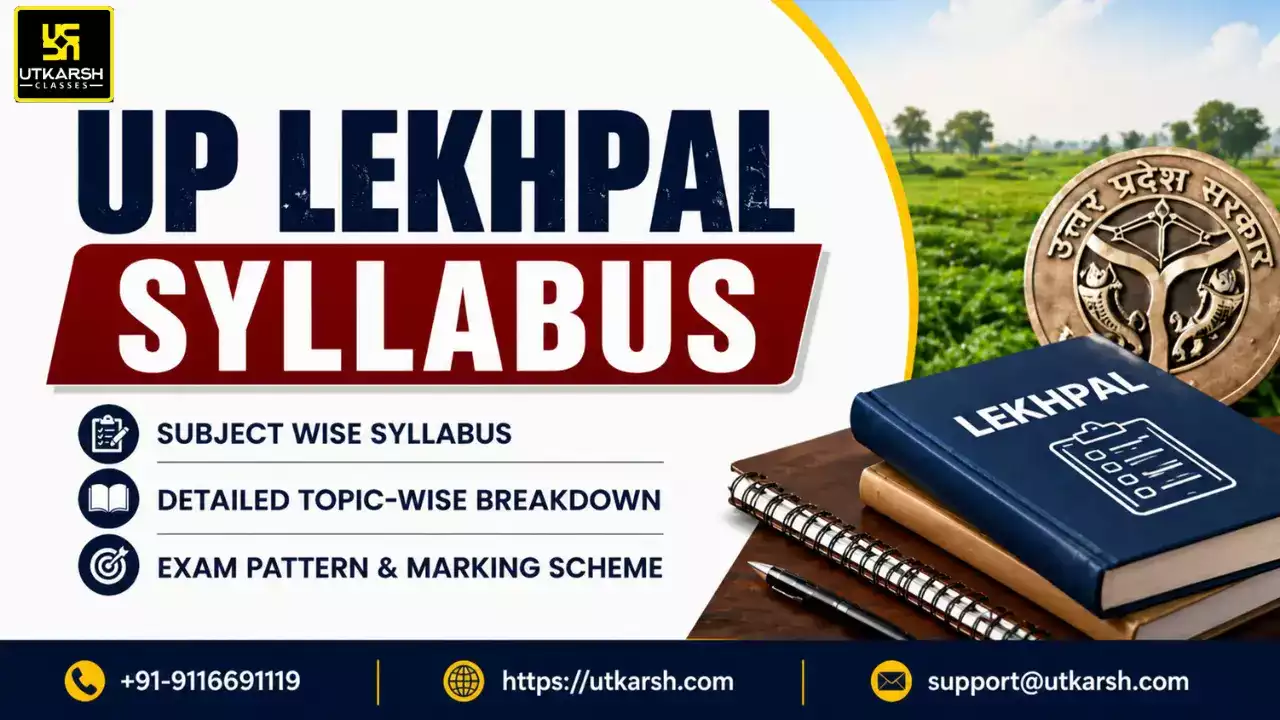
UP Lekhpal Syllabus and Exam Pattern is important for candidates preparing for the UP Lekhpal recruitment exam. The UPSSSC Lekhpal Exam is conducted by the Uttar Pradesh Subordinate Services Selection Commission (UPSSSC) to select candidates for Lekhpal posts in the state. Understanding the syllabus helps candidates become familiar with the subjects, topics, and overall structure of the written examination.
If you have applied or are planning to appear for the upcoming UP Lekhpal exam, then going through the detailed syllabus and exam pattern can help you organise your preparation in the right way. It allows candidates to understand subject-wise weightage, important topics, and the complete marking scheme of the examination.
In this blog, we have provided a complete overview of the UP Lekhpal Syllabus and Exam Pattern, including detailed subject-wise topics and important details that can help you prepare in a structured and focused manner.
Before going through the detailed UP Lekhpal Syllabus and Exam Pattern, it is important to understand the complete UP Lekhpal Selection Process. Knowing the stages of recruitment helps candidates plan their preparation properly and focus on the most important parts of the selection procedure.
The UPSSSC Lekhpal recruitment is conducted by the Uttar Pradesh Subordinate Services Selection Commission (UPSSSC), and the selection process mainly includes the following stages:
To get complete details about eligibility, UPSSSC Lekhpal syllabus, exam pattern, vacancy, and other updates, candidates should refer to the official UP Lekhpal Notification.
The UP Lekhpal Syllabus and Exam Pattern have been revised by the UPSSSC for the latest recruitment process. Candidates preparing for the upcoming UP Lekhpal exam should carefully understand the updated exam structure, marking scheme, and subject-wise distribution before starting their preparation.
Candidates are shortlisted for the Uttar Pradesh Lekhpal Main written examination on the basis of UPSSSC PET scores. The detailed UP Lekhpal Exam Pattern is given in the table below.
|
UP Lekhpal Revised Exam Pattern |
||||
|
Part |
Subjects |
Total Questions |
Total Marks |
Exam Duration |
|
Part 1 |
Hindi, History of India & National Movement, Indian Polity & Constitution, Geography of India & World, Indian Economy & Social Development, Rural Society & Development, Current Affairs, Science & Technology, Environmental Ecology, Disaster Management, Data Interpretation |
65 |
65 |
2 Hours |
|
Part 2 |
Computer & Information Technology |
15 |
15 |
|
|
Part 3 |
General Knowledge Related to Uttar Pradesh State |
20 |
20 |
|
|
Total |
100 |
100 |
||
Candidates preparing for the UP Lekhpal Recruitment should have a clear understanding of the UP Lekhpal Exam Syllabus prescribed by the Uttar Pradesh Subordinate Services Selection Commission (UPSSSC) in the official notification. The syllabus outlines the subjects and topics from which questions are asked in the written examination and helps candidates plan their preparation in a structured manner.
This section covers the major historical developments of India along with the national freedom struggle. Candidates should understand important events, socio-political changes, and the growth of nationalism in India.
|
Subject |
Topics |
|
History of India and Indian National Movement |
Information about social, cultural, economic and political aspects of Indian history. |
|
The Indian National Movement- A comprehensive information on the freedom movement, the rise of nationalism and the attainment of independence. |
This section evaluates knowledge of India’s constitutional and political framework. Candidates should understand governance systems, democratic institutions, and local administration.
|
Subject |
Topics |
|
Indian Polity and Indian Constitution |
Knowledge of the political system, including constitutional development in India, |
|
Indian Constitution |
|
|
Indian political system and governance |
|
|
Panchayati Raj and local self-governance |
|
|
Public policy & Official Issues |
|
|
Community development |
This section focuses on the physical, social, and economic geography of India and the world. Candidates should understand resources, population, agriculture, and geographical features.
|
Subject |
Topics |
|
Geography of India and the World |
India’s physical geography |
|
India’s social and economic geography |
|
|
Agriculture, horticulture, forestry, and animal husbandry |
|
|
Population and urbanisation patterns |
|
|
Smart cities and smart villages of India |
|
|
General information about world geography |
This section covers economic planning, development policies, and social progress in India. Candidates should understand reforms, infrastructure, and national development programmes.
|
Subject |
Topics |
|
Indian Economy and Social Development |
Economic planning in India: objectives and achievements |
|
Role of NITI Aayog |
|
|
Sustainable Development Goals (SDGs) |
|
|
Government budget and financial system |
|
|
Development of agriculture, industry and trade |
|
|
Land reforms in India after independence |
|
|
Globalization and liberalization in India |
|
|
Industrial policy changes and impact |
|
|
Infrastructure: power, ports, roads, airports and railways |
This section focuses on rural administration, village development, welfare schemes, and agrarian reforms. Candidates should understand the structure and progress of rural India.
|
Subject |
Topics |
|
Rural Society and Development |
Rural development programmes in India |
|
Welfare schemes |
|
|
Administrative management |
|
|
Rural health initiatives |
|
|
Social development in villages |
|
|
Land reform policies |
|
|
Agrarian reforms |
|
|
Central and state rural development schemes |
This section evaluates awareness of recent events and developments. Candidates should regularly follow important national and international updates.
|
Subject |
Topics |
|
Current Affairs |
National current affairs |
|
International current affairs |
|
|
Recent government initiatives |
|
|
Important events and developments |
This section covers practical applications of science and recent technological developments. Candidates should understand innovation, security, and emerging technologies.
|
Subject |
Topics |
|
Science and Technology |
Use of science and technology in daily life |
|
Development and national security |
|
|
Achievements of Indians in science and technology |
|
|
Indigenization of technology |
|
|
Space technology |
|
|
Defence technology |
|
|
Energy sources |
|
|
Nanotechnology |
|
|
Microbiology |
|
|
Biotechnology |
|
|
Intellectual property rights |
|
|
Digital rights |
This section focuses on environmental issues, biodiversity, climate change, and disaster response systems. Candidates should understand ecological balance and disaster management frameworks.
|
Subject |
Topics |
|
Environmental Ecology and Disaster Management |
Environmental protection |
|
Ecosystems |
|
|
Wildlife conservation |
|
|
Biodiversity |
|
|
Pollution and degradation |
|
|
Environmental impact assessment |
|
|
Climate change |
|
|
Disaster mitigation |
|
|
Disaster Management Act-2005 |
|
|
NDMA, SDMA, NDRF, SDRF |
|
|
Global disaster management efforts |
This section tests analytical ability through numerical and visual data. Candidates should practise reading charts, graphs, and statistical information.
|
Subject |
Topics |
|
Data Interpretation |
Interpretation and analysis of data |
|
Statistical analysis |
|
|
Graphs |
|
|
Diagrams |
This section evaluates grammar, vocabulary, sentence formation, official communication, and language usage. Candidates should focus on Hindi grammar and practical writing skills.
|
Subject |
Topics |
|
General Hindi |
शासकीय, अर्द्धशासकीय, वैयक्तिक तथा व्यावसायिक समस्याओं के निराकरण हेतु सम्बन्धित को सम्बोधित पत्र, कार्यालय आदेश, अधिसूचना और परिपत्र सम्बन्धी प्रश्न। |
|
वर्ण एवं ध्वनि विचार: उच्चारण, लेखन, स्वर, व्यंजन, मात्रा-पहचान और प्रयोग, ध्वनियों का वर्गीकरण। |
|
|
शब्द रचना: संधि एवं संधि विच्छेद, समास, उपसर्ग, प्रत्यय। |
|
|
शब्द प्रकार: (क) तत्सम, अर्द्धतत्सम, तद्भव, देशज, विदेशी। (ख) संज्ञा, सर्वनाम, विशेषण, क्रिया, अव्यय (क्रिया विशेषण, सम्बन्ध सूचक, विस्मयबोधक, निपात)। |
|
|
शब्द ज्ञान: पर्यायवाची, विलोम, शब्द युग्मों का अर्थ भेद, वाक्यांश के लिए सार्थक शब्द, समश्रुत भिन्नार्थक शब्द, समानार्थी शब्द, उपयुक्त शब्द चयन, सम्बन्धवाची शब्दावली। |
|
|
शब्द शुद्धि। |
|
|
व्याकरणिक कोटियां: परसर्ग, लिंग, वचन, पुरूष, काल, वृत्ति, पक्ष, वाच्य। |
|
|
वाक्य रचना: प्रकार-सरल, संयुक्त, मिश्र, वाक्य शुद्धि। |
|
|
विराम चिन्हों का प्रयोग। |
|
|
मुहावरे/लोकोक्तियां। |
This section focuses on computer fundamentals, digital tools, internet usage, and modern technological developments. Candidates should understand practical applications and cybersecurity basics.
|
Subject |
Topics |
|
Computer and Information Technology |
History, Introduction and Application of Computer, Information Technology, Internet and World Wide Web (WWW). |
|
General Knowledge related to:
|
|
|
Digital Financial Tools and Applications. |
|
|
Future Skills and Cyber Security. |
|
|
Technological Development and Innovation in the field of:
and India's achievements in this field, etc. |
This section evaluates knowledge related to the state of Uttar Pradesh. Candidates should understand history, geography, economy, administration, and current developments of the state.
|
Subject |
Topics |
|
Uttar Pradesh General Knowledge |
History of Uttar Pradesh |
|
Culture, art, architecture and festivals |
|
|
Folk dances, literature and regional languages |
|
|
Heritage, customs and tourism |
|
|
Geographical landscape and environment |
|
|
Natural resources |
|
|
Climate, soil, forests, wildlife |
|
|
Mines and minerals |
|
|
Economy, agriculture, industry and employment |
|
|
Polity and administration |
|
|
Current affairs and achievements of Uttar Pradesh |
Candidates preparing for the UP Lekhpal exam should download the official syllabus PDF to get a clear understanding of the exam pattern and subject-wise topics prescribed for the selection process. Having the syllabus in PDF format makes it easier for students to refer to it anytime during their preparation.
We are providing the UP Lekhpal Syllabus PDF in English for easy access. Candidates can click on the link below to download the syllabus and review all the topics in detail.
UPSSSC Lekhpal Syllabus PDF Download Link
Preparing for the UP Lekhpal Exam requires a clear study plan that covers all subjects mentioned in the UP Lekhpal syllabus effectively. Since the written examination includes multiple subjects with different weightage, candidates should follow a balanced preparation strategy with regular revision, practice, and mock tests.
Start your preparation by carefully going through the complete UP Lekhpal syllabus and revised exam pattern released by the recruitment authority. Understanding the subjects, topic distribution, and mark weightage will help candidates identify important areas and plan their study schedule accordingly.
Understanding the UP Lekhpal Syllabus and Exam Pattern is essential for candidates preparing for the recruitment exam. A clear understanding of the subjects and topics included in the written examination will help candidates plan their preparation effectively and improve their chances of performing well in the selection process.
|
Other Important Links for UPSSSC Lekhpal Exam Preparation |
|
About the author

Sakshi Dawar
SEO Content Writer
Sakshi Dawar is a professional content writer with over 6 years of experience in EdTech, Digital Marketing, and Law. At Utkarsh Classes, she crafts SEO-friendly, aspirant-focused content designed to simplify competitive exam updates and concepts into clear, actionable insights.

Related Exams
Related Courses
Frequently asked questions