Ready to learn?
Take the first step toward achieving your educational goals. Whether you’re preparing for exams or expanding your knowledge, getting started is just a click away. Join us today and unlock your full potential
Utkarsh Classes
Admission office
Above Arora Namkeen
Jalori Gate circle,
Jodhpur (Raj.), 342005
support@utkarsh.com
+91-9116691119, +91-9829213213
Support
Get Started


Learning Resources
Rajasthan Govt Exams
Central Govt Exams
Civil Services Exams
Nursing Exams
School Tuitions
Other State Govt Exams
Agriculture Exams
College Entrance Exams
Miscellaneous Exams

© 2026 Utkarsh Classes & Edutech Pvt. Ltd. All Rights Reserved
Home

National Current Affairs
Supreme Court
SC Rules Children Have Fundamental Right to Access & use Internet
Add as a preferred source on Google
Updated: 19 Oct 2026
3 Min Read
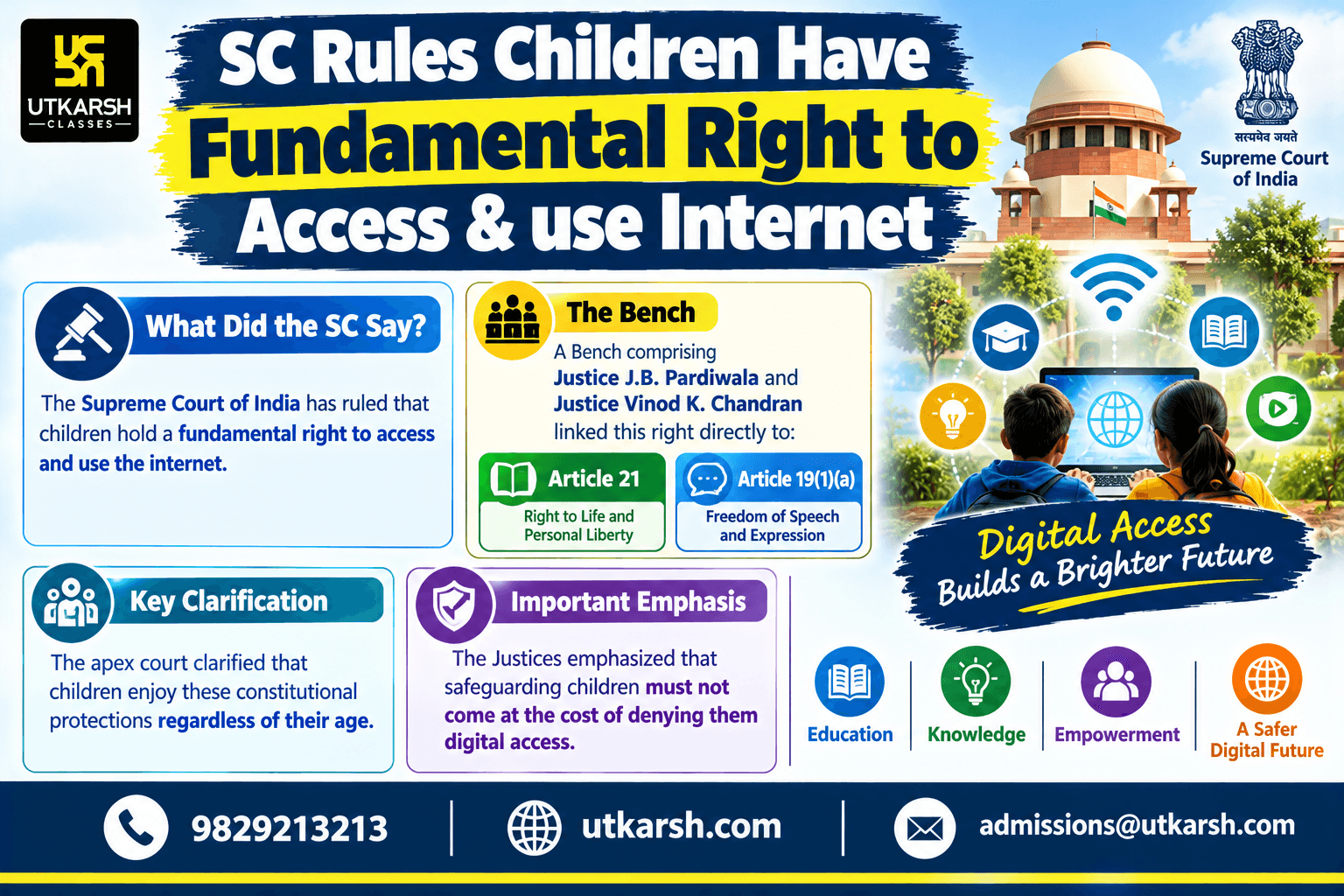
Supreme Court of India has ruled that children hold a fundamental right to access and use the internet. A Bench comprising Justice J.B. Pardiwala and Justice Vinod K. Chandran linked this right directly to Article 21 (Right to Life and Personal Liberty) and Article 19(1)(a) (Freedom of Speech and Expression).
The apex court clarified that children enjoy these constitutional protections regardless of their age. The Justices emphasized that safeguarding children must not come at the cost of denying them digital access.
The Bench strongly questioned the effectiveness of total internet or social media bans for minors. The court observed that blanket bans rarely stop children from going online. Instead, total prohibitions force minors onto unregulated, unsafe platforms and dark web spaces.

Key Hazards of Total Prohibitions:
The Supreme Court stressed that child safety and individual liberty can coexist. While opposing total bans, the court advocated for intelligent, proportionate safeguards that protect minors without infringing upon their basic constitutional freedoms.
The Supreme Court stated that no single law or restriction can ensure online safety. Effective child protection requires a coordinated effort across all sectors of society.
|
Key Stakeholder |
Core Operational Role |
|
Parents & Guardians |
Provide guidance, active supervision, and open communication. |
|
Social Media Platforms |
Build child-friendly interfaces and robust content filters. |
|
MeitY & Law Enforcement |
Enforce cyber laws and crack down on online predators. |
|
Judiciary & Regulators |
Protect digital rights while ensuring proportionate legal remedies. |
The ruling sets a landmark precedent for digital rights and child safety in India. The internet serves as a crucial tool for education, communication, and skill development.
By recognizing children’s fundamental right to digital access, the Supreme Court ensures that future regulations focus on making the digital world safer rather than smaller for India's youth.
About the author

Girish Kumar
This content is prepared by the Utkarsh Classes team to present accurate, updated, and exam-relevant current affairs in a simple and reliable format.
Latest Current Affairs
Frequently asked questions

Visit Utkarsh Classes Offline Centre Near You.

Download Last 5 Years PYQs in a Single Click
FREE PYQs exam ke level aur question pattern ko samajhne ka best tareeka