Ready to learn?
Take the first step toward achieving your educational goals. Whether you’re preparing for exams or expanding your knowledge, getting started is just a click away. Join us today and unlock your full potential
Utkarsh Classes
Admission office
Above Arora Namkeen
Jalori Gate circle,
Jodhpur (Raj.), 342005
support@utkarsh.com
+91-9116691119, +91-9829213213
Support
Get Started


Learning Resources
Rajasthan Govt Exams
Central Govt Exams
Civil Services Exams
Nursing Exams
School Tuitions
Other State Govt Exams
Agriculture Exams
College Entrance Exams
Miscellaneous Exams

© 2026 Utkarsh Classes & Edutech Pvt. Ltd. All Rights Reserved
Add as a preferred source on Google
Updated: 21 Oct 2026
5 Min Read
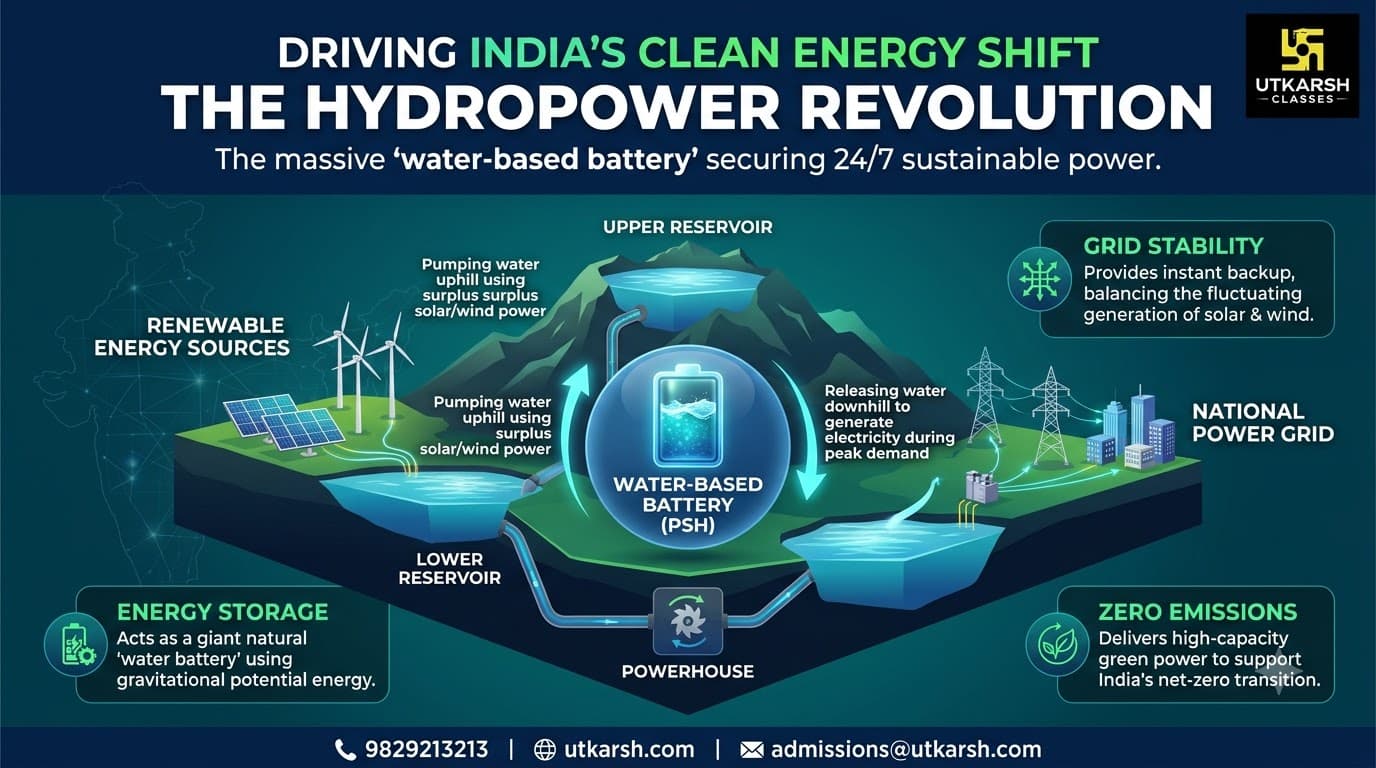
India is rapidly expanding its renewable energy capacity to build a cleaner, resilient, and reliable power grid. Solar and wind power lead this nationwide transition. However, variable weather conditions cause fluctuations in renewable generation. India requires large-scale energy storage systems to store excess electricity and discharge power during peak demand.
Pumped Storage Hydropower (PSH) functions as a massive, natural water battery. The system uses electricity to pump water to an elevated upper reservoir, storing energy as gravitational potential energy. During peak power demand, the system releases water through hydroelectric turbines to generate clean electricity instantly.
This technology helps integrate solar and wind energy, stabilizes grid frequency, and supports India's target of achieving 500 GW of non-fossil fuel-based electricity capacity by 2030.
India continues to strengthen its clean energy infrastructure. By July 2026, the country crossed 300 GW of installed non-fossil fuel generation capacity. During the 2025–26 financial year, India added 55.29 GW of non-fossil power capacity.
Solar panels produce power during daylight hours, while wind turbines depend on weather patterns. Conversely, national power consumption spikes during evening hours when solar generation drops to zero. Energy storage balances this supply-demand mismatch.

According to projections by the Central Electricity Authority (CEA), India will require 73.93 GW of total energy storage capacity by 2031–32. This mandate includes 26.69 GW from Pumped Storage Projects (PSPs) and 47.24 GW from Battery Energy Storage Systems (BESS).
India categorizes Pumped Storage Projects into three distinct technical configurations based on their connection to natural river systems:
Battery Energy Storage Systems (BESS) and Pumped Storage Projects (PSPs) fulfill distinct, complementary roles across the national power grid:
|
Parameter |
Battery Energy Storage Systems (BESS) |
Pumped Storage Projects (PSPs) |
|
Response Duration |
Seconds to milliseconds (Short-duration) |
Minutes to hours (Long-duration) |
|
Operational Lifespan |
10 to 15 years |
50 to 100+ years |
|
Primary Grid Role |
Frequency regulation & rapid balancing |
Bulk energy shifting & seasonal storage |
|
Site Constraints |
Modular; minimal land requirements |
Requires specific topography & water access |
India is expanding its pumped storage assets through active construction and an extensive project development pipeline.
As of August 2026, India maintains 7.43 GW of operational PSP capacity across 10 large projects. Another 15.87 GW across 11 projects is currently under active construction. The CEA has concurred with or appraised an additional 8 projects totaling 10.40 GW.
Comprehensive national surveys identify 320 potential PSP sites across India with a combined capacity of 345.38 GW (62 on-stream projects offering 56.67 GW and 258 off-stream projects providing 288.71 GW).

The Central Electricity Authority mapped a long-term expansion plan through 2035–36. The framework targets commissioning 100.81 GW of new PSP capacity, raising India's cumulative operational capacity to 105.56 GW.

Project commissioning will accelerate rapidly after 2028, adding 13.50 GW in 2029–30 and 21.19 GW in 2030–31.
Pumped Storage Hydropower represents over 90% of global grid-scale energy storage capacity.
According to data from the International Renewable Energy Agency (IRENA), global installed pumped hydro capacity reached 159.8 GW at the end of 2025.
India ranks fourth globally, increasing its operational capacity to 7.43 GW by July 2026.
The Government of India has introduced several key policy measures to accelerate PSP execution:
|
Parameter |
Operational & Target Statistics |
|
Installed Operational Capacity |
7.43 GW (As of August 2026 across 10 major plants) |
|
Capacity Under Construction |
15.87 GW across 11 projects |
|
Total Identified National Potential |
345.38 GW across 320 potential sites |
|
CEA 2031–32 Storage Target |
73.93 GW (26.69 GW PSP + 47.24 GW BESS) |
|
Cumulative Capacity Goal by 2035–36 |
105.56 GW total installed capacity |
|
Global Ranking |
4th Worldwide (Behind China, Japan, and the United States) |
About the author

Girish Kumar
This content is prepared by the Utkarsh Classes team to present accurate, updated, and exam-relevant current affairs in a simple and reliable format.
Latest Current Affairs
Frequently asked questions

Visit Utkarsh Classes Offline Centre Near You.

Vijayadashami Offer Is LIVE!
Get 25% EXTRA OFF on All Online Courses. Use Code WEB25 to Unlock Your Festive Discount!