Ready to learn?
Take the first step toward achieving your educational goals. Whether you’re preparing for exams or expanding your knowledge, getting started is just a click away. Join us today and unlock your full potential
Utkarsh Classes
Admission office
Above Arora Namkeen
Jalori Gate circle,
Jodhpur (Raj.), 342005
support@utkarsh.com
+91-9116691119, +91-9829213213
Support
Get Started


Learning Resources
Rajasthan Govt Exams
Central Govt Exams
Civil Services Exams
Nursing Exams
School Tuitions
Other State Govt Exams
Agriculture Exams
College Entrance Exams
Miscellaneous Exams

© 2026 Utkarsh Classes & Edutech Pvt. Ltd. All Rights Reserved
Home

International Current Affairs
Space
China Launches Gravity-1 Y4 Rocket. Places Nine Satellites into Orbit
Add as a preferred source on Google
Updated: 24 Jul 2026
2 Min Read
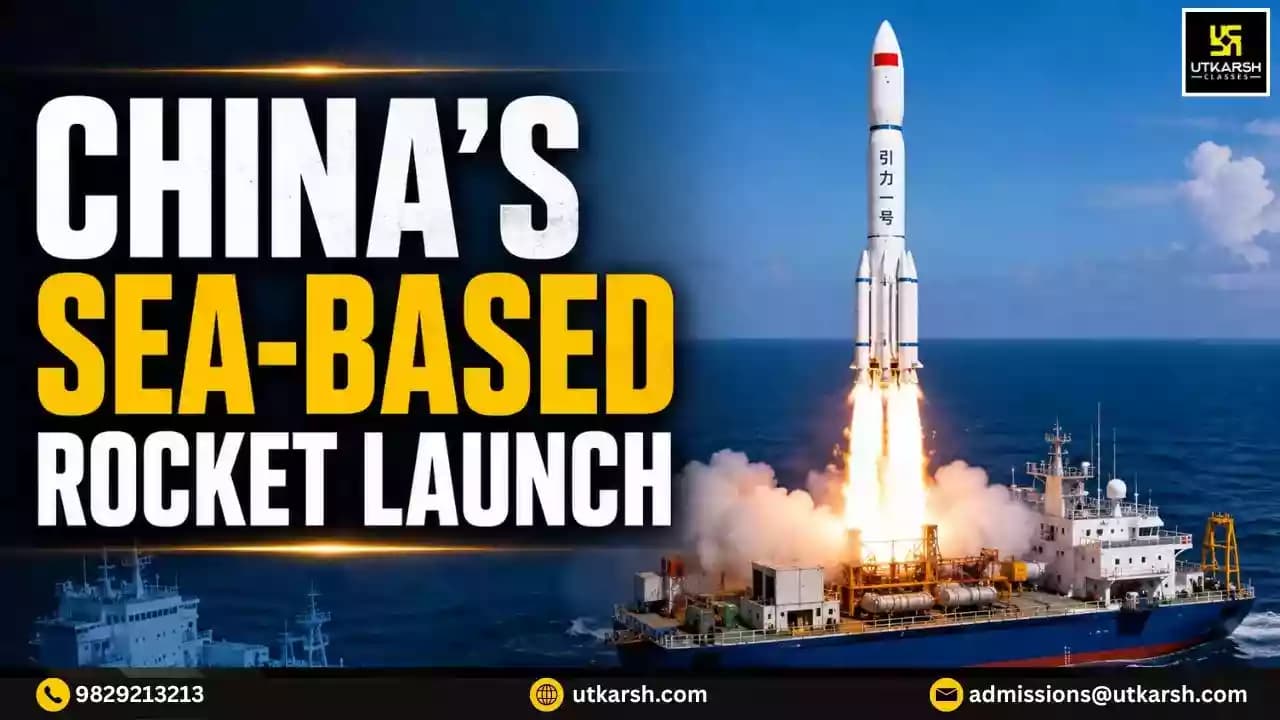
China successfully carried out a sea-based rocket launch on 22 July 2026, sending the commercial Gravity-1 rocket into space from waters roughly 170 kilometres off the coast of Shanghai in the East China Sea. Liftoff took place at 10:54 a.m. Beijing time from a mobile launch vessel, with all nine satellites onboard reaching their intended orbits. The mission was carried out by the Chinese commercial space firm Orienspace, with launch operations coordinated through the Taiyuan Satellite Launch Center. This marked Gravity-1's third flight overall and its first long-distance open-sea launch, moving well beyond the near-coastal waters used in its earlier two missions. Chinese officials described the mission as another step forward in building out the country's coordinated sea-launch network and sharpening operational flexibility for commercial missions ahead.
Gravity-1 was built by Orienspace, a private aerospace company based in China's Shandong province. The rocket has now completed three flights, all launched from sea-based platforms, with its debut mission taking place in January 2024 and its second in October 2025. This latest flight extended the company's track record of successful launches and gave its team further operational experience in managing offshore deployments.
The payload included six Dongpo satellites, Dongpo-13, Dongpo-14, Dongpo-17 to Dongpo-20, Xiguang-2 01, Tianyi-49, and Lilac-3.
Among these, two carry optical sensors fitted with AI-based systems for onboard target recognition and faster image processing, while four are synthetic aperture radar satellites designed to operate together in formation. The remaining satellites were meant for purposes spanning all-weather Earth observation, commercial applications, and technology testing, alongside one additional experimental payload flown on the mission.
About the author

Hardika Shekhawat
Current Affairs Content Writer
Hardika is a current affairs content writer at Utkarsh Classes with 3 years of experience in academic content writing. She creates clear, exam-ready current affairs articles for UPSC, SSC, RAS, Banking, Railway and State PCS aspirants.

Latest Current Affairs
Frequently asked questions

Visit Utkarsh Classes Offline Centre Near You.

Download All Exam PYQ PDFS Free!!!
Previous 5+ year Questions Papers se karen damdar practice