Ready to learn?
Take the first step toward achieving your educational goals. Whether you’re preparing for exams or expanding your knowledge, getting started is just a click away. Join us today and unlock your full potential
Utkarsh Classes
Admission office
Above Arora Namkeen
Jalori Gate circle,
Jodhpur (Raj.), 342005
support@utkarsh.com
+91-9116691119, +91-9829213213
Support
Get Started


Learning Resources
Rajasthan Govt Exams
Central Govt Exams
Civil Services Exams
Nursing Exams
School Tuitions
Other State Govt Exams
Agriculture Exams
College Entrance Exams
Miscellaneous Exams

© 2026 Utkarsh Classes & Edutech Pvt. Ltd. All Rights Reserved
Home

International Current Affairs
International news
US Proposes New Tariffs on 14 Partners: What Is the Impact on India?
Add as a preferred source on Google
The US has proposed fresh trade duties on 14 economies, and India is one of them. Here is what the proposal means for India, explained simply for exam preparation.
Updated: 26 Nov 2026
2 Min Read
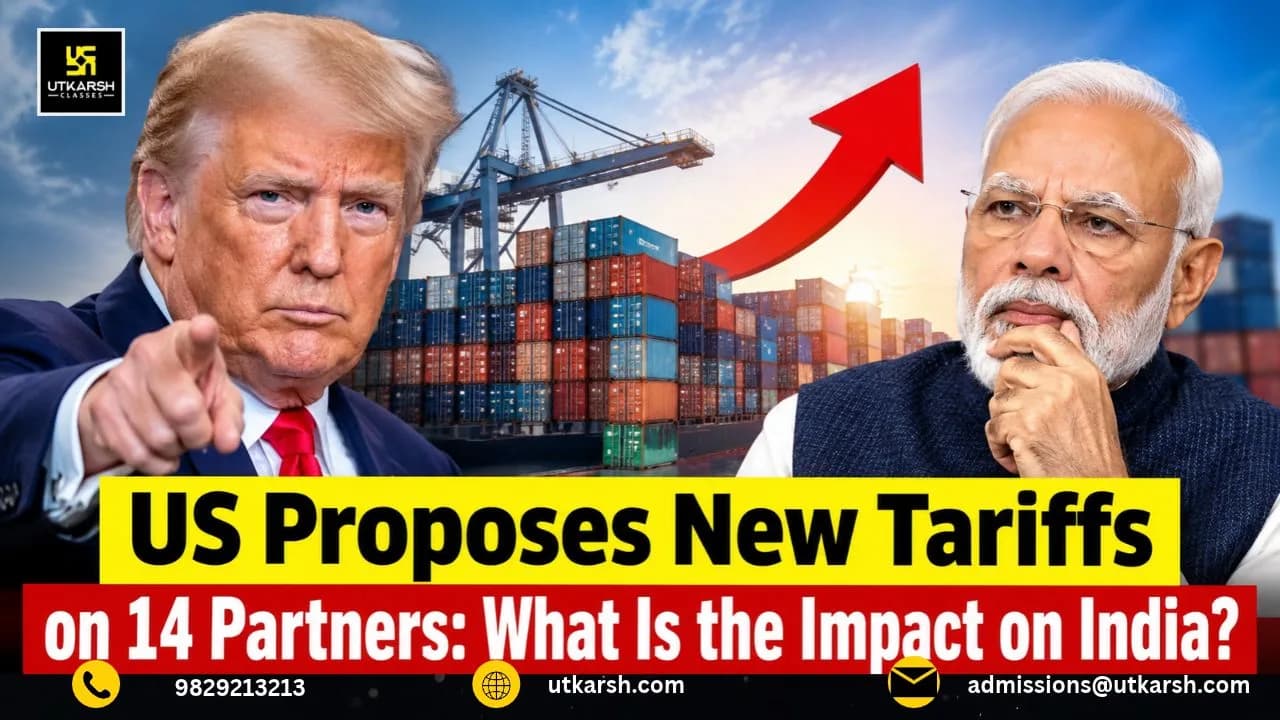
On 25 November 2026, the Office of the US Trade Representative (USTR) proposed new tariffs under Section 301 of the Trade Act, 1974. This law lets the US investigate foreign practices it considers unfair and respond with trade action.
The investigation began in March 2026 and covered 16 economies. The US found against 14 of them, including China, the European Union, Japan, South Korea, Vietnam and India. Mexico and Norway have not received a finding yet.
The USTR has proposed a tariff of up to 25% on Indian goods. The rate could fall to 17% if India signs a qualifying trade agreement with the US. The proposal is not final. Written comments are due by 5 January 2027, and a public hearing is set for 25 January 2027. The duties are expected to start in early 2027.
India’s Ministry of Commerce and Industry said the notice is under examination. It also repeated that India has no structural excess capacity in any sector. The government said it remains committed to concluding the India-US Bilateral Trade Agreement early.
The US says these countries produce far more than their own markets need. The surplus is then sold abroad at low prices, which hurts American manufacturers.
In India’s case, the USTR points to schemes such as Make in India, Atmanirbhar Bharat and the Production Linked Incentive (PLI) scheme. It argues that government-backed expansion can push output beyond domestic demand. The sectors it named are steel, solar, pharmaceuticals, medical devices and information and communications technology (ICT).
In February 2026, the US Supreme Court struck down the earlier emergency-powers tariffs. After that, the USTR started the Section 301 investigations into forced labour and excess capacity.
The new rate is meant to be counted net of existing tariffs, not simply added on top. The 50% Section 232 duties on steel and aluminium are separate and are not added to these tariffs.
About the author

Hardika Shekhawat
Current Affairs Content Writer
Hardika is a current affairs content writer at Utkarsh Classes with 3 years of experience in academic content writing. She creates clear, exam-ready current affairs articles for UPSC, SSC, RAS, Banking, Railway and State PCS aspirants.

Latest Current Affairs
Popular Tags
International news
Art and Culture
Defence
Person in News
Place in News
Summit and Conference
Science and Technology
Environment
Science
Agreements and MoU
Economy
Energy
Transport
Important Day
Committee and Commission
Industry
Tourism
Banking and Finance
Health and Disease
Award and Honour
International Organisations
Bilateral Relations
Books and Authors
Frequently asked questions

Visit Utkarsh Classes Offline Centre Near You.