Ready to learn?
Take the first step toward achieving your educational goals. Whether you’re preparing for exams or expanding your knowledge, getting started is just a click away. Join us today and unlock your full potential
Utkarsh Classes
Admission office
Above Arora Namkeen
Jalori Gate circle,
Jodhpur (Raj.), 342005
support@utkarsh.com
+91-9116691119, +91-9829213213
Support
Get Started


Learning Resources
Rajasthan Govt Exams
Central Govt Exams
Civil Services Exams
Nursing Exams
School Tuitions
Other State Govt Exams
Agriculture Exams
College Entrance Exams
Miscellaneous Exams

© 2026 Utkarsh Classes & Edutech Pvt. Ltd. All Rights Reserved
Home

International Current Affairs
Award and Honour
Indian Physicist Ashoke Sen Wins Prestigious Oskar Klein Medal
Add as a preferred source on Google
Updated: 24 Oct 2026
5 Min Read
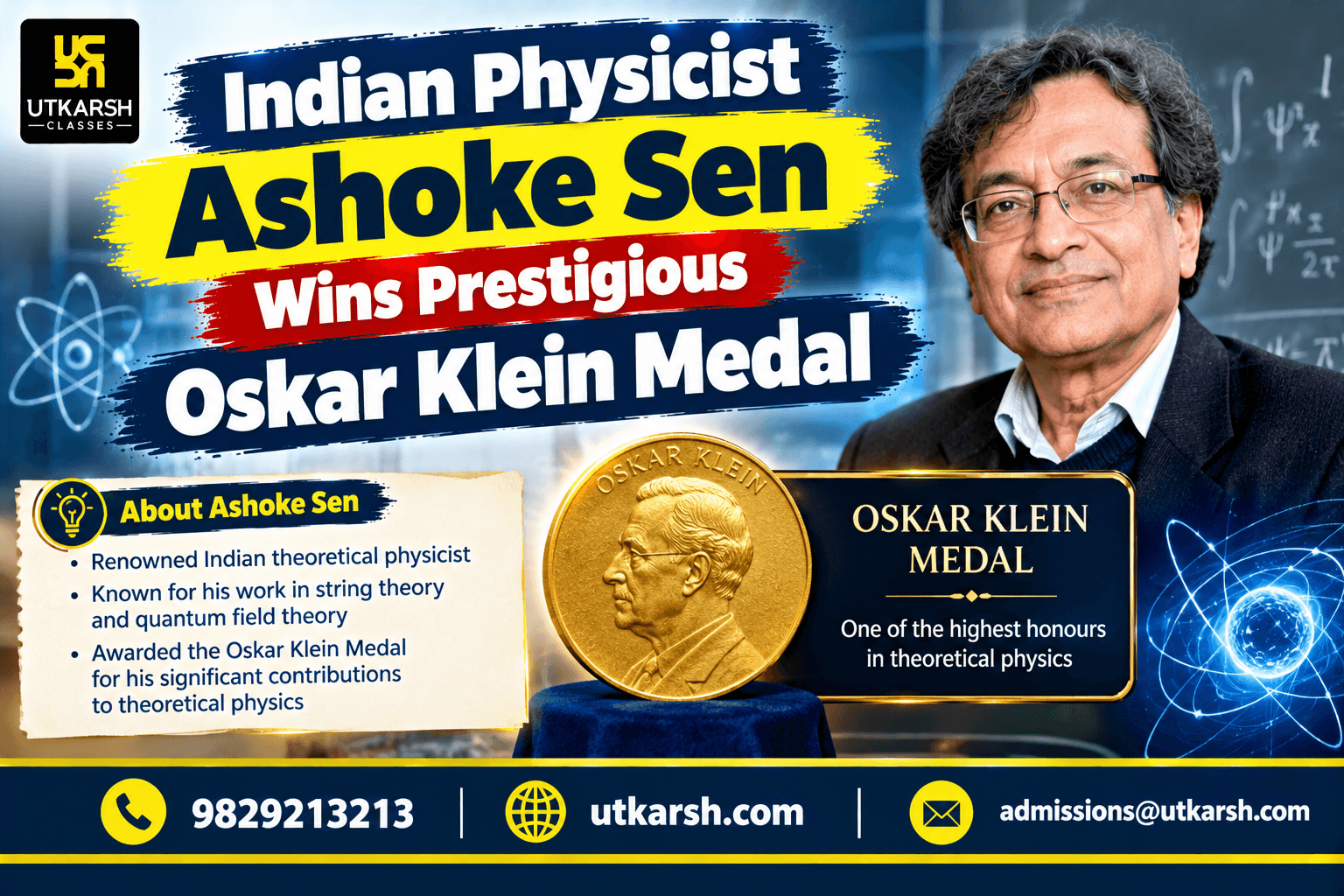
Indian theoretical physicist Ashoke Sen has won the prestigious Oskar Klein Medal. The award ranks among the highest honours in theoretical physics. The International Centre for Theoretical Sciences (ICTS), based in Bengaluru, announced the achievement. Sen works as a professor at the institution.
Sen has become the first Indian to receive the Oskar Klein Medal. Stockholm University and the Nobel Committee for Physics of the Royal Swedish Academy of Sciences award this medal every year. The award has recognised outstanding contributions to physics since 1988.
This achievement adds another major honour to Sen’s distinguished career. He has made important contributions to string theory, a field that seeks to explain some of the biggest questions in modern physics.
Ashoke Sen is a leading Indian theoretical physicist. He has earned international recognition for his research on string theory and its role in understanding the universe.
Sen holds the ICTS-Infosys Madhava Chair Professorship. His work has helped scientists explore the relationship between gravity and the fundamental building blocks of matter.
ICTS highlighted three major areas of his research: S-duality, the precision counting of black hole entropy, and string field theory. These contributions have helped shape modern string theory.
Sen has also received other major international awards. These include the Dirac Medal and the Breakthrough Prize in Fundamental Physics. Both awards recognise important contributions to fundamental physics.
The Oskar Klein Medal is a prestigious international award in physics. Stockholm University and the Nobel Committee for Physics of the Royal Swedish Academy of Sciences award it annually.
The medal honours major achievements in theoretical physics. It recognises researchers whose work advances our understanding of the laws that govern the universe.
The award has a long history, dating back to 1988. Sen’s selection marks an important moment for Indian science because he is the first Indian recipient.
As part of the award programme, Sen delivered a lecture at Stockholm University. The lecture, titled “Gravity from Strings and Strings from Gravity,” explored the connection between gravity and string theory.
String theory is an important approach in modern theoretical physics. It aims to address differences between quantum theory and Einstein’s theory of gravity.
Quantum theory explains the behaviour of matter and energy at very small scales. Gravity describes the attraction between objects and plays a major role in the structure of the universe.
Scientists face challenges when they try to explain both through one consistent framework. String theory offers a possible way to connect these ideas.
The theory proposes that the basic building blocks of nature may behave like tiny strings rather than simple point-like particles. Different ways in which these strings vibrate may correspond to different particles.
Researchers hope that string theory may help develop a unified framework for understanding particles and forces. Such a framework could explain physical processes across a wide range of scales, from subatomic particles to galaxies.
Sen’s research has helped scientists develop and examine key ideas within this field. His work on S-duality, black hole entropy and string field theory has contributed to modern theoretical physics.
1. S-Duality
S-duality is an important concept in theoretical physics. It connects different descriptions of a physical theory. It helps researchers understand how a theory behaves under certain changes in its parameters.
2. Black Hole Entropy
Black holes are regions of space where gravity becomes extremely strong. Black hole entropy helps scientists understand the information and microscopic states associated with these objects.
Sen’s work on the precise counting of black hole entropy has contributed to efforts to connect gravity, quantum theory and string theory.
3. String Field Theory
String field theory provides a framework for studying the dynamics and interactions of strings. It helps researchers investigate the mathematical structure of string theory.
These areas of research have strengthened Sen’s reputation as a leading contributor to modern string theory.
Sen’s achievement comes amid wider recognition of Indian scientists in theoretical physics.
Earlier in 2026, theoretical physicist Deepak Dhar was named a winner of the Dirac Medal. Dhar became the second Indian, after Sen, to receive this honour, according to the supplied report.
Dhar has also received the Boltzmann Medal. He is the only Indian to have won both the Dirac Medal and the Boltzmann Medal.
In 2025, Professor Jainendra Jain, an Indian-origin American physicist associated with several institutions in India, became one of the winners of the Wolf Prize.
The Dirac Medal, Boltzmann Medal and Wolf Prize rank among the major international honours in physics. Many people regard these awards as some of the highest recognitions in the field, alongside the Nobel Prize.
Sen’s Oskar Klein Medal highlights India’s contribution to global scientific research. His work demonstrates how theoretical research can advance our understanding of fundamental questions about nature.
His achievement may also encourage students and young researchers to explore physics, mathematics and other scientific fields.
The award recognises decades of important research into some of the most challenging problems in modern physics. By honouring Sen, the international scientific community has recognised his role in shaping the development of string theory.
Ashoke Sen’s Oskar Klein Medal marks a major milestone for Indian science. He has become the first Indian to receive this prestigious award, which has recognised outstanding work in theoretical physics since 1988.
His research on S-duality, black hole entropy and string field theory has helped shape modern string theory. Along with honours such as the Dirac Medal and the Breakthrough Prize in Fundamental Physics, the Oskar Klein Medal further strengthens his standing among the world’s leading theoretical physicists.
About the author

Girish Kumar
Current Affairs Content Writer
Girish Kumar is a current affairs content writer at Utkarsh Classes, with a decade of experience covering diverse contemporary issues. He develops high-quality study material for various competitive examinations, including UPSC, PSC, Bank PO etc.

Latest Current Affairs
Frequently asked questions

Visit Utkarsh Classes Offline Centre Near You.

Download All Exam PYQ PDFS Free!!!
Previous 5+ year Questions Papers se karen damdar practice