
Ready to learn?
Take the first step toward achieving your educational goals. Whether you’re preparing for exams or expanding your knowledge, getting started is just a click away. Join us today and unlock your full potential
832, utkarsh bhawan, near mandap restaurant, 9th chopasani road, jodhpur rajasthan - 342003
support@utkarsh.com
+91-9116691119, +91-9829213213
Support
Get Started


Learning Resources
Rajasthan Govt Exams
Central Govt Exams
Civil Services Exams
Nursing Exams
School Tuitions
Other State Govt Exams
Agriculture Exams
College Entrance Exams
Miscellaneous Exams

© 2026 Utkarsh Classes & Edutech Pvt. Ltd. All Rights Reserved
Add as a preferred source on Google
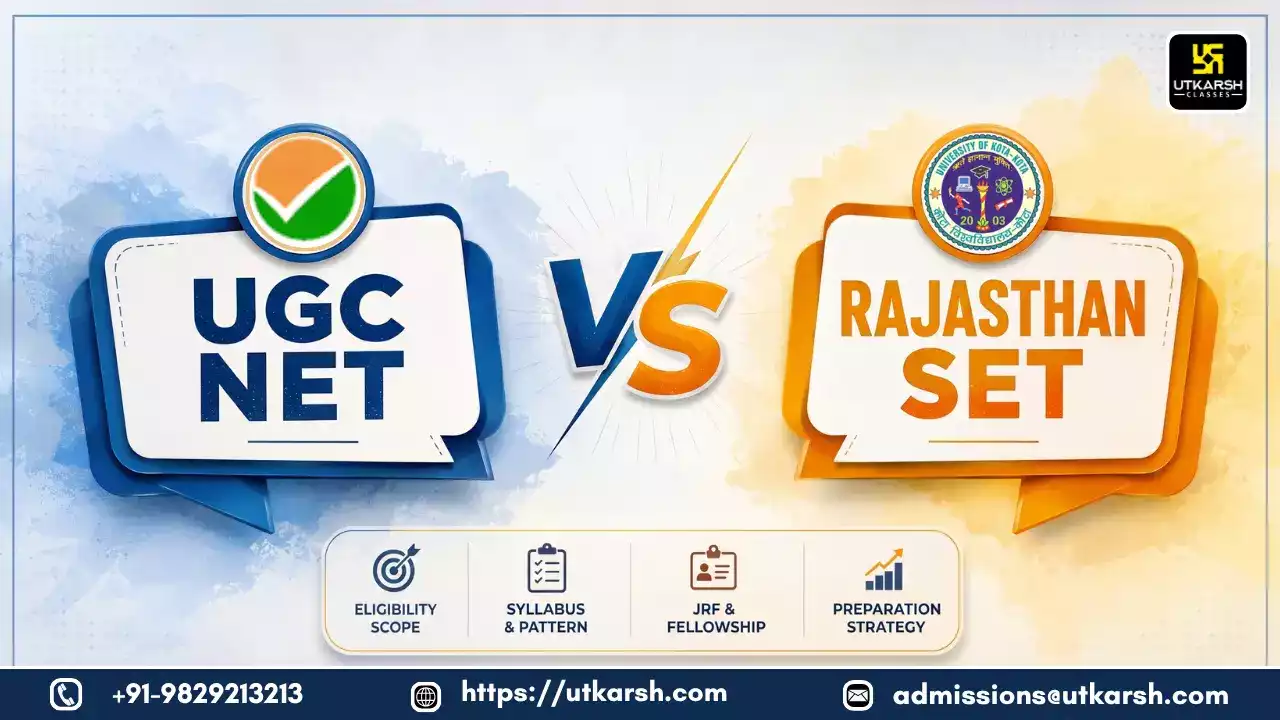
Choosing between UGC NET and Rajasthan SET can be confusing for aspirants aiming for a career as an Assistant Professor, especially because both exams have a similar two-paper structure and largely aligned syllabi. However, they differ in terms of the scope of eligibility, JRF opportunities, conducting authority, and the state or national level at which the qualification can be used. UGC NET offers national-level eligibility and JRF opportunities, while Rajasthan SET provides state-specific Assistant Professor eligibility in Rajasthan.
UGC NET is conducted at the national level by the National Testing Agency (NTA), while Rajasthan SET is a state-level eligibility test conducted by the University of Kota for Assistant Professor eligibility in Rajasthan. Understanding these differences can help you decide whether to focus on one exam or prepare for both together.
The key differences between UGC NET and Rajasthan SET are their scope of eligibility, JRF opportunities, and geographical validity.
To give you clarity right away, here is a detailed comparison of both examinations across key parameters:
|
Parameter |
UGC NET |
Rajasthan SET |
|
Full Form |
University Grants Commission National Eligibility Test |
Rajasthan State Eligibility Test |
|
Conducting Authority |
NTA on behalf of UGC |
University of Kota |
|
Exam Level |
National |
State |
|
Assistant Professor Eligibility |
Across India, subject to recruitment rules |
Rajasthan, subject to applicable recruitment rules |
|
Number of Subjects |
87 in UGC NET June 2026 |
35 in Rajasthan SET 2026 |
|
JRF |
Yes, for candidates qualifying in the applicable JRF category |
No |
|
PhD Admission |
Eligibility categories include JRF + AP + PhD, AP + PhD, and PhD-only |
Primarily Assistant Professor eligibility |
|
Validity |
Lifetime for Assistant Professor eligibility |
Lifetime for Assistant Professor eligibility in Rajasthan |
|
Exam Pattern |
2 Papers |
2 Papers |
|
Negative Marking |
No |
No |
|
PSU Opportunities |
May be used for specific PSU recruitments, depending on notification |
Not a general PSU recruitment qualification |
|
Reservation |
Central Government rules |
Rajasthan Government reservation rules apply for applicable categories |
Although UGC NET and Rajasthan SET have a similar objective-type examination structure and follow a closely aligned syllabus, they differ in terms of validity, career scope, JRF opportunities, subjects, conducting authority, and the nature of competition. The key differences are explained below.

The most important difference between UGC NET and Rajasthan SET is the geographical scope of the eligibility they provide.
Therefore, candidates who want to keep their teaching career options open across different states may prefer UGC NET, while those primarily seeking Assistant Professor opportunities in Rajasthan can consider Rajasthan SET.
UGC NET offers an important advantage for candidates interested in research. Candidates who qualify for the Junior Research Fellowship (JRF) category can pursue research with fellowship support, subject to the applicable UGC rules and conditions.
Thus, candidates whose primary goal is JRF-supported research or a PhD with JRF benefits should target UGC NET, while candidates focused on Assistant Professor eligibility in Rajasthan can consider Rajasthan SET
UGC NET offers a wider range of subjects than Rajasthan SET. The UGC NET June 2026 cycle covers 87 subjects, while the Rajasthan SET 2026 notification lists 35 subjects.
UGC NET and Rajasthan SET have a similar exam structure and syllabus framework, so their overall preparation requirements are largely comparable. However, the level of competition, subject-wise cut-offs, and individual performance can affect how difficult each exam feels. UGC NET also includes competition for the JRF category, while Rajasthan SET is focused on Assistant Professor eligibility in Rajasthan.
Neither exam can be considered universally easier or harder. Candidates should therefore consider the following factors:
Therefore, candidates should choose the examination based primarily on their career goals and eligibility requirements rather than assuming that one exam will be easier to qualify.
Before filling out application forms, you must ensure you meet the official eligibility requirements. The eligibility requirements for both examinations are broadly aligned with UGC norms, although candidates should always check the latest notification before applying.
1. Educational Qualifications & Minimum Percentage
To appear in either UGC NET or Rajasthan SET, candidates must hold a Master’s Degree or equivalent qualification from a UGC-recognized university in Humanities, Social Sciences, Computer Science, Sciences, Languages, etc.
Important Percentage Rule: If you score 54.99% in General Category or 49.99% in Reserved Category, UGC guidelines do not round it off to 55% or 50%. You must meet or exceed the exact cutoff.
2. Final Year / Result Awaited Candidates
Can you apply if you are still pursuing your Master's degree? Yes!
If you are in the final year or final semester of your Master's program (or if your results have been delayed), you can apply under the "Result Awaited" category for both UGC NET and Rajasthan SET.
3. Age Limit Rules
4. Domicile & State Reservation Rules
To know the complete Eligibility Criteria, check → UGC NET Notification & Rajasthan SET Notification
One of the biggest advantages for aspirants is that preparing for one exam naturally prepares you for the other. The structural pattern for both exams is virtually identical.

Both UGC NET and Rajasthan SET follow a 2-paper objective format administered in a single 3-hour continuous session without any break between papers.
Paper 1 covers 10 units, including Teaching Aptitude, Research Aptitude, Reading Comprehension, Communication, Mathematical Reasoning, Logical Reasoning, Data Interpretation, ICT, People & Environment, and Higher Education System.
Is there any difference in Paper 2? Rajasthan SET 2026 states that its eligibility conditions, syllabus, and other instructions follow the UGC-prescribed NET framework. Therefore, the subject-specific syllabus largely follows the corresponding UGC NET syllabus. Candidates should still check the latest Rajasthan SET notification and syllabus for their chosen subject.
To know the complete Exam Pattern and Detailed syllabus, check → UGC NET Syllabus & Rajasthan SET Syllabus
Since UGC NET and Rajasthan SET have a closely aligned examination structure and syllabus, candidates can follow a common preparation strategy for both exams. A well-planned approach should focus on conceptual clarity, regular practice, PYQs, mock tests, and revision.
If you plan to appear for both UGC NET and Rajasthan SET, avoid maintaining two completely separate preparation schedules. Build your core preparation around the UGC NET syllabus and supplement it with the latest Rajasthan SET notification and exam-specific updates.
Paper 1 tests areas such as Teaching Aptitude, Research Aptitude, Communication, Logical Reasoning, Data Interpretation, ICT, People & Environment, and Higher Education. Cover the concepts systematically before moving to intensive question practice.
Paper 2 carries twice the marks of Paper 1, making strong subject knowledge essential. Divide the syllabus into manageable units, complete one topic at a time, and maintain short revision notes for important concepts, thinkers, theories, facts, and terminology relevant to your subject.
Prepare concise handwritten notes as you complete each topic or unit. Focus on important concepts, formulas, definitions, theories, facts, and frequently confusing points rather than copying everything from books or study material. These crisp notes will make last-minute revision faster and help you quickly revisit important topics before mock tests and the examination.
Previous Year Questions (PYQs) are important for identifying recurring concepts, understanding the question level, and improving topic-wise accuracy. After completing each unit, solve relevant PYQs instead of waiting until the entire syllabus is finished.
Candidates can also refer to dedicated UGC NET PYQs and Rajasthan SET PYQs pages for additional practice strategies and topic-wise guidance.
Regular mock tests help improve speed, accuracy, and time management. Start with topic-wise tests and gradually move to full-length papers. After every test, analyse incorrect and unattempted questions and revise the concepts behind them.
Revision should be part of the preparation plan from the beginning. Revise completed units at regular intervals and always use concise notes for revising formulas, definitions, theories, important facts, and frequently confused concepts.
Both papers are conducted in a single session without a break. Practise solving questions within the allotted time and develop a strategy for moving between easy, moderate, and time-consuming questions. Since there is no negative marking in Rajasthan SET 2026, candidates should avoid leaving questions unanswered after making a considered attempt.
Qualifying either exam serves as your gateway to a professional career in higher education. Here is what your financial and career trajectory looks like after passing:
Career Progression & Salary Scale

|
If your goal is... |
Better choice |
|
Assistant Professor eligibility across India |
UGC NET |
|
Assistant Professor eligibility in Rajasthan |
Rajasthan SET |
|
JRF and fellowship opportunity |
UGC NET |
|
Prepare for both with overlapping syllabus |
Both |
|
Keep options open for national-level opportunities |
UGC NET |
About the author

Sakshi
Content Writer
Sakshi Dawar is a professional content writer with 5+ years of experience in creating SEO-friendly and engaging content. With a background across Digital Marketing, EdTech, and Law, she focuses on delivering clear, well-structured content that drives value for readers. At Utkarsh Classes, she applies this expertise to create accurate, learner-focused content for competitive exam aspirants, combining creativity with strategy to make information both impactful and easy to understand.

Course Updates Important Updates

Utkarsh Mega Monsoon Offer 2026: Up to 90% OFF + Extra 15% OFF with WEB15
Read More

Kumar Gaurav Sir's Birthday 2026: New SSC & Railway Courses, Books and Offers
Read More

UC-STAR 2026: Scholarship & Rewards by Utkarsh Classes for Offline Coaching
Read More

Big Summer Sale Live: Get Upto 90% OFF + Extra 15% Discount with WEB15
Read More
Articles
RPSC EO RO Result 2022 (Out): Download Result PDF, Check Cut-off Marks
Read More
Frequently asked questions


