Ready to learn?
Take the first step toward achieving your educational goals. Whether you’re preparing for exams or expanding your knowledge, getting started is just a click away. Join us today and unlock your full potential
Utkarsh Classes
Admission office
Above Arora Namkeen
Jalori Gate circle,
Jodhpur (Raj.), 342005
support@utkarsh.com
+91-9116691119, +91-9829213213
Support
Get Started


Learning Resources
Rajasthan Govt Exams
Central Govt Exams
Civil Services Exams
Nursing Exams
School Tuitions
Other State Govt Exams
Agriculture Exams
College Entrance Exams
Miscellaneous Exams

© 2026 Utkarsh Classes & Edutech Pvt. Ltd. All Rights Reserved
Home

State Current Affairs
Infrastructure
Noida Metro Aqua Line Corridor Extension: Cabinet Approves 8.449 km Route with 5 Stations
Add as a preferred source on Google
Updated: 12 Nov 2026
3 Min Read
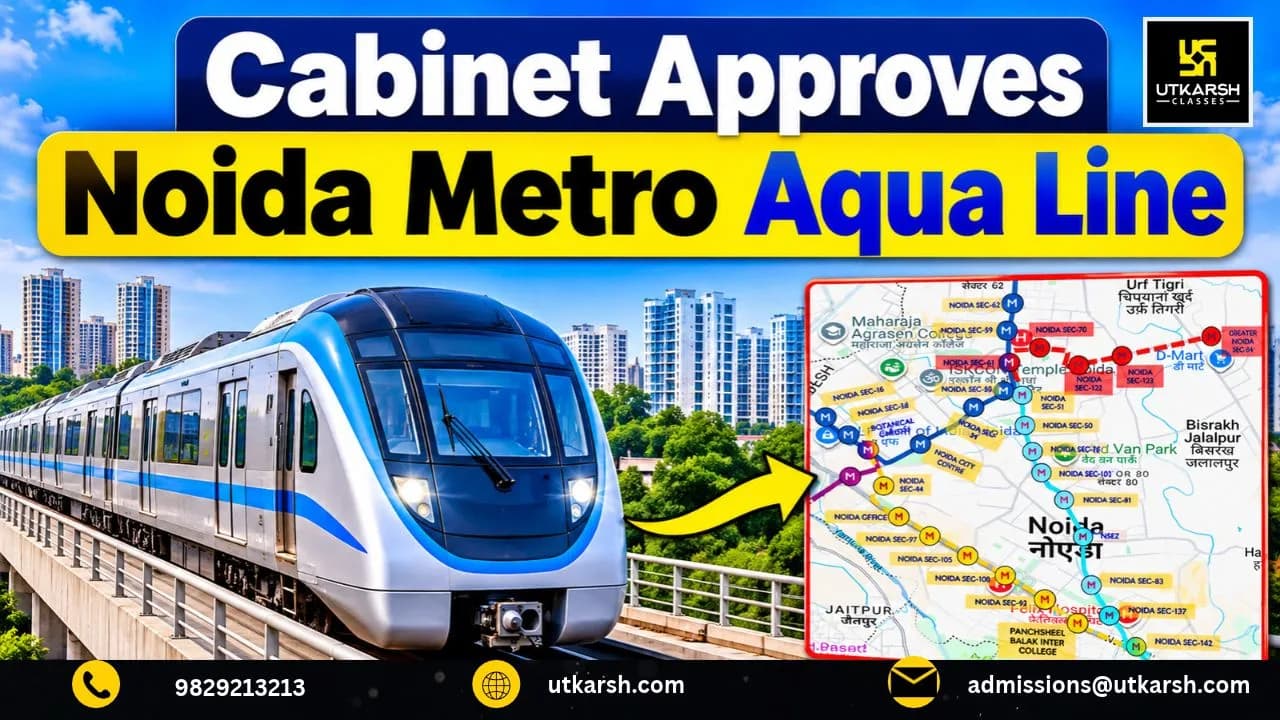
On 11 November 2026, the Union Cabinet, chaired by Prime Minister Narendra Modi, approved the extension of the Noida Metro Aqua Line from Noida Sector-51 to Greater Noida Sector-04. The 8.449 km elevated corridor will have 5 stations and an interchange with the Blue Line at Sector-61. Once it opens, Noida and Greater Noida will have a 71.878 km active metro network.
The Union Cabinet, chaired by Prime Minister Narendra Modi, approved the extension of the Aqua Line from Noida Sector-51 to Greater Noida Sector-04. The corridor is 8.449 km long and will have 5 elevated stations. The project cost is ₹2,390 crore.
Once this corridor starts running, Noida and Greater Noida will have 71.878 km of active metro network.
The route will have an interchange with the Blue Line at Noida Sector-61.
The extension aims to join the key commercial, educational, healthcare, and residential zones of Noida and Greater Noida into one network. It is meant to ease daily movement for employment, business, education, and general travel. It also builds a base for future metro expansion in the region, supporting sustainable city growth.
Here are the benefits of the Noida Metro Aqua Line Corridor Extension:
These areas currently lack efficient public transport. The new line will give residents a direct link to work, markets, colleges, and hospitals. The Blue Line interchange also makes onward travel easier.
Metro travel is an alternative to road transport, so fewer vehicles on the road should mean smoother traffic, shorter travel times and better road safety. It also cuts carbon emissions compared to fossil-fuel-based transport.
Faster travel to transport hubs such as Delhi’s airport, railway stations and bus depots can raise productivity. Businesses near the new stations may grow, and investment may reach areas that were harder to access earlier. People from all income groups get fairer access to public transport, which lowers commute time and improves access to essential services.
About the author

Hardika Shekhawat
Current Affairs Content Writer
Hardika is a current affairs content writer at Utkarsh Classes with 3 years of experience in academic content writing. She creates clear, exam-ready current affairs articles for UPSC, SSC, RAS, Banking, Railway and State PCS aspirants.

Latest Current Affairs
Frequently asked questions

Visit Utkarsh Classes Offline Centre Near You.