Ready to learn?
Take the first step toward achieving your educational goals. Whether you’re preparing for exams or expanding your knowledge, getting started is just a click away. Join us today and unlock your full potential
Utkarsh Classes
Admission office
Above Arora Namkeen
Jalori Gate circle,
Jodhpur (Raj.), 342005
support@utkarsh.com
+91-9116691119, +91-9829213213
Support
Get Started


Learning Resources
Rajasthan Govt Exams
Central Govt Exams
Civil Services Exams
Nursing Exams
School Tuitions
Other State Govt Exams
Agriculture Exams
College Entrance Exams
Miscellaneous Exams

© 2026 Utkarsh Classes & Edutech Pvt. Ltd. All Rights Reserved
Home

National Current Affairs
Economy
Government Health Expenditure Triples from ₹1.30 to ₹4.14 Lakh Crore in 10 Years
Add as a preferred source on Google
India’s government health expenditure has more than tripled in a decade, rising from ₹1.30 lakh crore in 2013-14 to ₹4.14 lakh crore in 2023-24, while the share of healthcare costs paid directly by families has fallen sharply. The National Health Accounts (NHA) Estimates 2023–24, released by the Union Ministry of Health and Family Welfare, show this change between 2013-14 and 2023–24.
Updated: 16 Nov 2026
5 Min Read
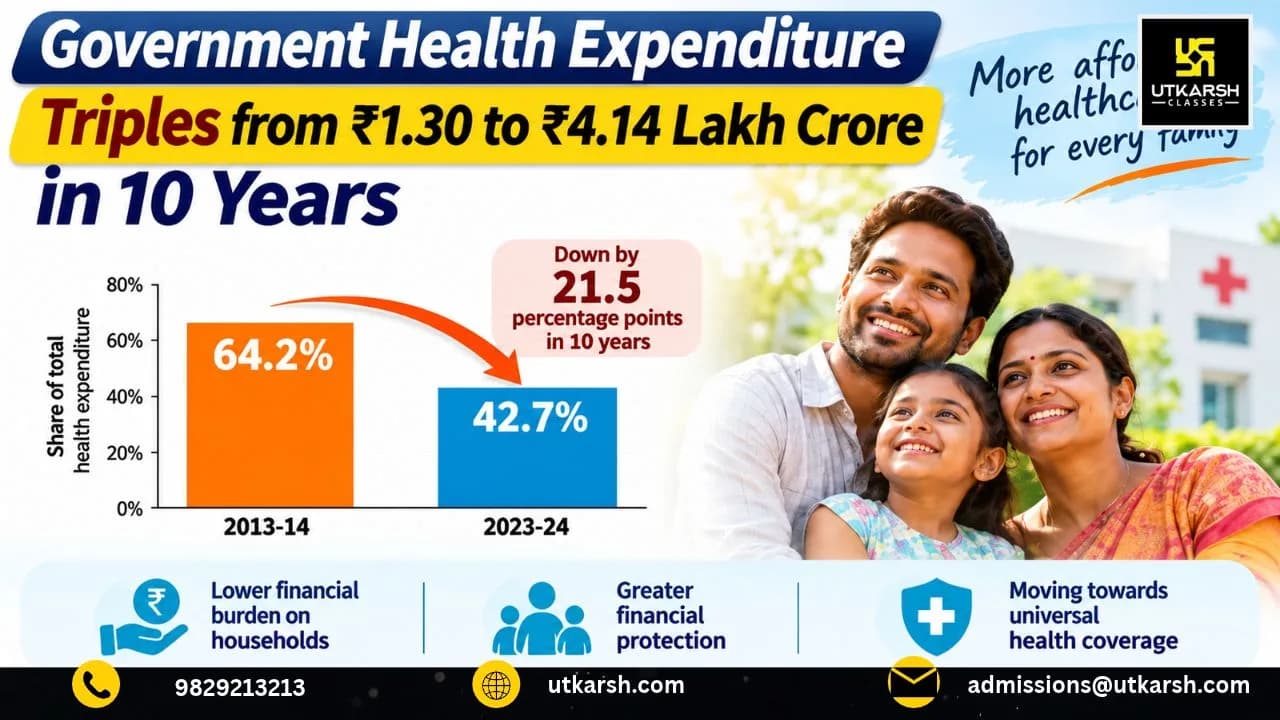
Here is the key data table for government health expenditure changes in 10 years:
|
Serial No. |
Indicator |
2013-14 |
2023–24 |
Change |
|
1 |
Government Health Expenditure (GHE) |
₹1,29,778 crore (about ₹1.30 lakh crore) |
₹4,14,196 crore (about ₹4.14 lakh crore) |
Threefold rise |
|
2 |
Out-of-Pocket Expenditure (OOPE) share of Total Health Expenditure |
64.20% |
42.70% |
Fall of 21.5 percentage points |
|
3 |
Government’s share in Total Health Expenditure |
Not given in source |
Not given in source |
Up by 14.9 percentage points (nearly 52% increase) |
|
4 |
Per capita Government Health Expenditure |
₹1,042 |
₹2,959 |
About 2.8 times |
|
5 |
Social security expenditure on health (share of THE) |
6% |
11% |
Up by 5 percentage points |
|
6 |
Private health insurance expenditure (share of THE) |
3.40% |
10.20% |
Rise of 6.8 percentage points |
Out-of-Pocket Expenditure (OOPE) is the money families pay from their own pockets for treatment, medicines and tests. It is measured here as a share of Total Health Expenditure (THE), the country’s total spending on health.
This is a fall of 21.5 percentage points over ten years. It means families now bear a much smaller part of the total healthcare bill. The fall has continued in the latest year as well.
Government Health Expenditure (GHE) rose from ₹1,29,778 crore in 2013-14 to ₹4,14,196 crore in 2023–24. That is a threefold increase.
The government’s share in Total Health Expenditure also grew by 14.9 percentage points, an increase of nearly 52%. In simple terms, public money now pays for a larger part of the country’s healthcare, so households have to pay less.
Per capita GHE is the government’s health spending divided by the population. It rose from ₹1,042 in 2013-14 to ₹2,959 in 2023–24, which is about 2.8 times higher.
Primary healthcare means basic, first-level care close to people’s homes. Government spending on it reached about ₹1.53 lakh crore in 2023–24.
This is linked to the growth of Ayushman Arogya Mandirs, which offer:
The focus is on early detection, disease prevention and care at the grassroots level.
Social Security Expenditure on Health rose from 6% of Total Health Expenditure in 2013-14 to 11% in 2023–24, a rise of 5 percentage points. It includes:
Private health insurance spending also grew, from 3.4% to 10.2% of Total Health Expenditure. This shows that more people now have health insurance, which gives added protection against medical costs.
Several schemes help reduce the cost of treatment:
Compared with 2013-14, India has seen:
The main change is the balance between who pays. A larger share of healthcare is now funded by the government, and a smaller share by families. This is seen as progress towards Universal Health Coverage.
The NHA 2023–24 is the eleventh round of estimates. It was prepared by the National Health Accounts Technical Secretariat (NHATS) at the National Health Systems Resource Centre (NHSRC), under the Ministry of Health and Family Welfare. It uses the internationally recognised System of Health Accounts 2011 framework.
The fall in out-of-pocket spending and the rise in government spending have several effects for the country and its people.
However, OOPE is still 42.7% of total health spending. This means families still pay a large part of the bill, so further progress is needed.
About the author

Hardika Shekhawat
Current Affairs Content Writer
Hardika is a current affairs content writer at Utkarsh Classes with 3 years of experience in academic content writing. She creates clear, exam-ready current affairs articles for UPSC, SSC, RAS, Banking, Railway and State PCS aspirants.

Latest Current Affairs
Frequently asked questions

Visit Utkarsh Classes Offline Centre Near You.