Ready to learn?
Take the first step toward achieving your educational goals. Whether you’re preparing for exams or expanding your knowledge, getting started is just a click away. Join us today and unlock your full potential
832, utkarsh bhawan, near mandap restaurant, 9th chopasani road, jodhpur rajasthan - 342003
support@utkarsh.com
+91-9116691119, +91-9829213213
Support
Get Started


Learning Resources
Rajasthan Govt Exams
Central Govt Exams
Civil Services Exams
Nursing Exams
School Tuitions
Other State Govt Exams
Agriculture Exams
College Entrance Exams
Miscellaneous Exams

© 2026 Utkarsh Classes & Edutech Pvt. Ltd. All Rights Reserved
Home

International Current Affairs
Important Day
World Tourism Day 2026 Theme, India's Growth, and Importance
Add as a preferred source on Google
Updated: 26 Sep 2026
6 Min Read
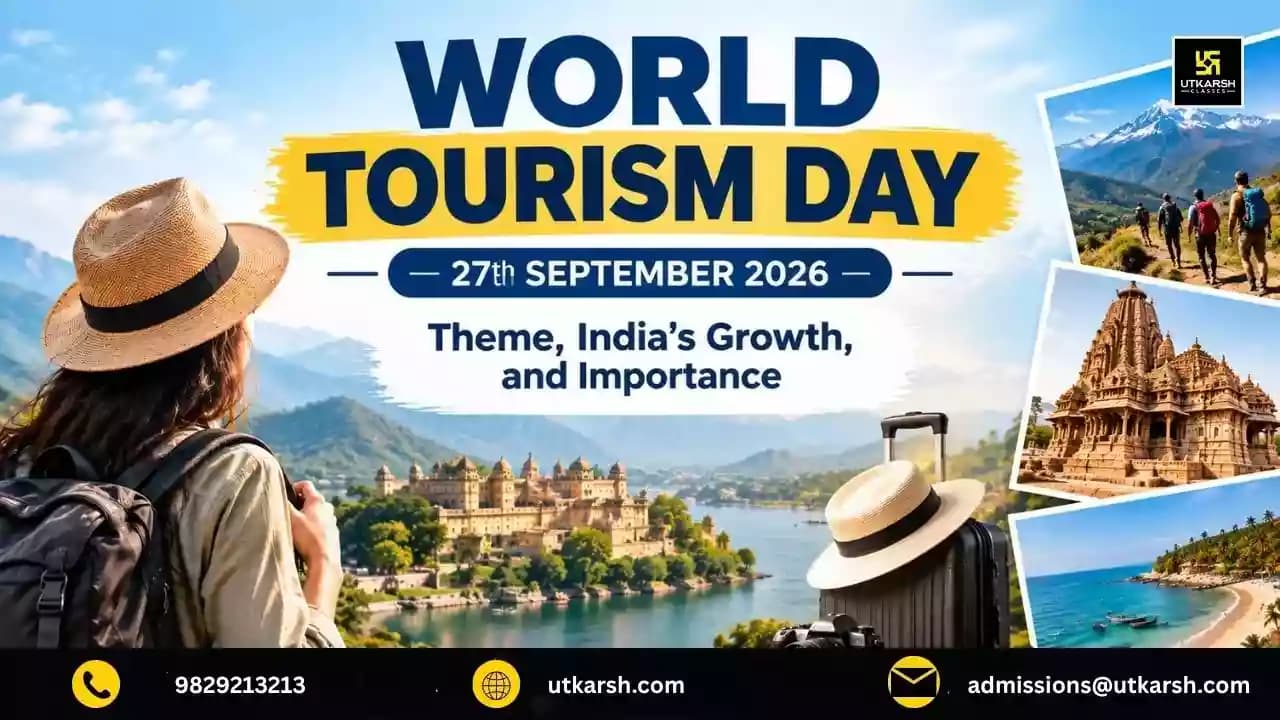
World Tourism Day is observed every year on September 27, and the 2026 edition brings a sharp focus on technology's growing role in travel. For India, the day also marks the launch of major digital and destination-focused initiatives aimed at pushing the tourism sector further.
This year's theme, "Digital Agenda and Artificial Intelligence to Redesign Tourism," points to how digital tools and AI are reshaping the way people plan, book, and experience travel. Globally, tourism contributed nearly $10.9 trillion in 2024, close to 10% of world GDP, while supporting 357 million jobs.
The global celebration for 2026 is being hosted in El Salvador, and the theme sets the tone for how technology can make tourism smarter and more sustainable in the years ahead.
World Tourism Day traces back to the United Nations World Tourism Organisation (UNWTO), which created the day to mark the anniversary of its own founding statutes, adopted in 1970. The very first celebration took place in 1980. Since then, the day has served as a platform to highlight tourism's contribution to economic development and its link to the UN's Sustainable Development Goals.
India is marking the occasion with a nationwide showcase of its culture and tourism offerings, centred around the launch of several new initiatives at Bharat Mandapam, New Delhi, by Union Tourism Minister Gajendra Singh Shekhawat.
This is an open digital public infrastructure initiative designed to make India's tourism offerings more discoverable, accessible, and trustworthy. It aims to bring various tourism-related services onto a common digital foundation, similar to how other national digital stacks have transformed sectors like payments and health.
Building on the earlier Dekho Apna Desh campaign, this updated version focuses on promoting tourism-ready but lesser-known destinations across India. The goal is to spread tourist footfall more evenly, reducing pressure on popular spots while giving emerging destinations a chance to grow.
The Ministry of Tourism is entering into new partnerships with leading industry organisations. These MoUs are aimed at improving destination visibility, strengthening digital outreach, promoting experiential and sustainable tourism, and encouraging greater community participation under the broader Incredible India framework.
Beyond the central event, states are hosting their own celebrations. Telangana is organising cultural programmes, workshops, film screenings, and artisanal stalls, alongside the Telangana State Tourism Awards recognising travel agents, hoteliers, and tour operators. Delhi is holding a two-day cultural festival called "RANG • RAS • ROOH" at Baansera park on the Yamuna, featuring art, food, and a special Qawwali performance by the Nizami Brothers.
Tourism has become a key pillar of India's economy, contributing 5.22% to national GDP and supporting 8.46 crore jobs in 2023-24. Domestic tourist visits touched 428.55 crore in 2025, while foreign tourist arrivals rose to 2.53 crore, pushing foreign exchange earnings from tourism to ₹2,76,831 crore.
India has made international travel simpler through its e-Visa system, now available to citizens of 172 countries and accepted at 88 entry points across airports, seaports, and land borders. Around 78% of all Indian visas are now issued electronically, with most applications processed within 72 hours.
The revamped Incredible India Digital Platform offers virtual previews of India's heritage, adventure, and cultural attractions, using AI to personalise recommendations and provide real-time travel information. Alongside this, NIDHI+ acts as a unified registry for hospitality businesses, currently listing tens of thousands of accommodation units and tourism service providers, making the sector more transparent and easier to navigate.
A June 2026 partnership with Google India is helping the Ministry use AI and data insights for tourism promotion and staff training. Meanwhile, tourism startups, many based in Tier II and Tier III cities, are building homestay networks, travel-tech platforms, and AI-powered trip planning tools, widening the sector's innovation footprint.
India's government has rolled out a mix of destination-development and skilling schemes, including Swadesh Darshan, PRASHAD, SASCI, and CBSP, to build tourism infrastructure and create livelihood opportunities across the country. These initiatives together aim to expand India's tourism map, improve visitor experiences, and prepare local communities to benefit from the sector's growth.
Launched in 2014-15, Swadesh Darshan develops tourist circuits around specific themes such as Buddhist, coastal, desert, Himalayan, and spiritual tourism. Under the scheme, 76 projects worth over ₹5,295 crore have been sanctioned, with most already completed. Its successor, Swadesh Darshan 2.0, takes a destination-centric approach focused on sustainable, experience-based tourism, with 53 projects worth ₹2,207 crore sanctioned so far.
A sub-scheme under Swadesh Darshan 2.0, CBDD focuses on the holistic development of destinations with high tourism potential, particularly in the spiritual and eco-tourism categories. So far, 37 projects worth nearly ₹688 crore have been sanctioned under this initiative.
Launched in 2014-15, PRASHAD supports the development of tourism infrastructure at pilgrimage and heritage sites. It provides financial assistance to states for improving visitor facilities, accessibility, cleanliness, and safety. The scheme has sanctioned 54 projects worth ₹1,726 crore, covering facilities like tourist centres, ghats, and waste management systems.
SASCI supports states in developing iconic tourist destinations to global standards, with full central funding. So far, 40 projects across 23 states have been approved, and additional funds have been released to states like Nagaland, Mizoram, and Himachal Pradesh under the scheme's revised guidelines.
This scheme focuses on skilling people who work directly with tourists, including local communities and youth from underprivileged backgrounds. An evaluation found that CBSP has trained over 1.68 lakh people and placed more than 36,000 of them in jobs between 2020-21 and 2024-25.
Launched in 2024, this initiative trains local service providers such as cab drivers, hotel staff, guides, and shopkeepers in hospitality, safety, and sustainability practices. Around 4,382 candidates have been trained so far, with a strong focus on including women and marginalised communities.
Together, these initiatives show that India's tourism story in 2026 is not just about attracting more visitors, but about building a smarter, more inclusive, and technology-driven travel ecosystem for the future.
About the author

Utkarsh Classes
Company
This content is prepared by the Utkarsh Classes team to present accurate, updated, and exam-relevant current affairs in a simple and reliable format.


Latest Current Affairs
Frequently asked questions


Download Last 5 Years PYQs in a Single Click
FREE PYQs exam ke level aur question pattern ko samajhne ka best tareeka

Still have questions?
Can't find the answer you're looking for? Please contact our friendly team.
Visit Utkarsh Classes Offline Centre Near You.