Ready to learn?
Take the first step toward achieving your educational goals. Whether you’re preparing for exams or expanding your knowledge, getting started is just a click away. Join us today and unlock your full potential
Utkarsh Classes
Admission office
Above Arora Namkeen
Jalori Gate circle,
Jodhpur (Raj.), 342005
support@utkarsh.com
+91-9116691119, +91-9829213213
Support
Get Started


Learning Resources
Rajasthan Govt Exams
Central Govt Exams
Civil Services Exams
Nursing Exams
School Tuitions
Other State Govt Exams
Agriculture Exams
College Entrance Exams
Miscellaneous Exams

© 2026 Utkarsh Classes & Edutech Pvt. Ltd. All Rights Reserved
Home

International Current Affairs
Agreements and MoU
Saudi Arabia, Turkey, and Pakistan Sign Mecca Defense Pact
Add as a preferred source on Google
Updated: 10 Aug 2026
4 Min Read
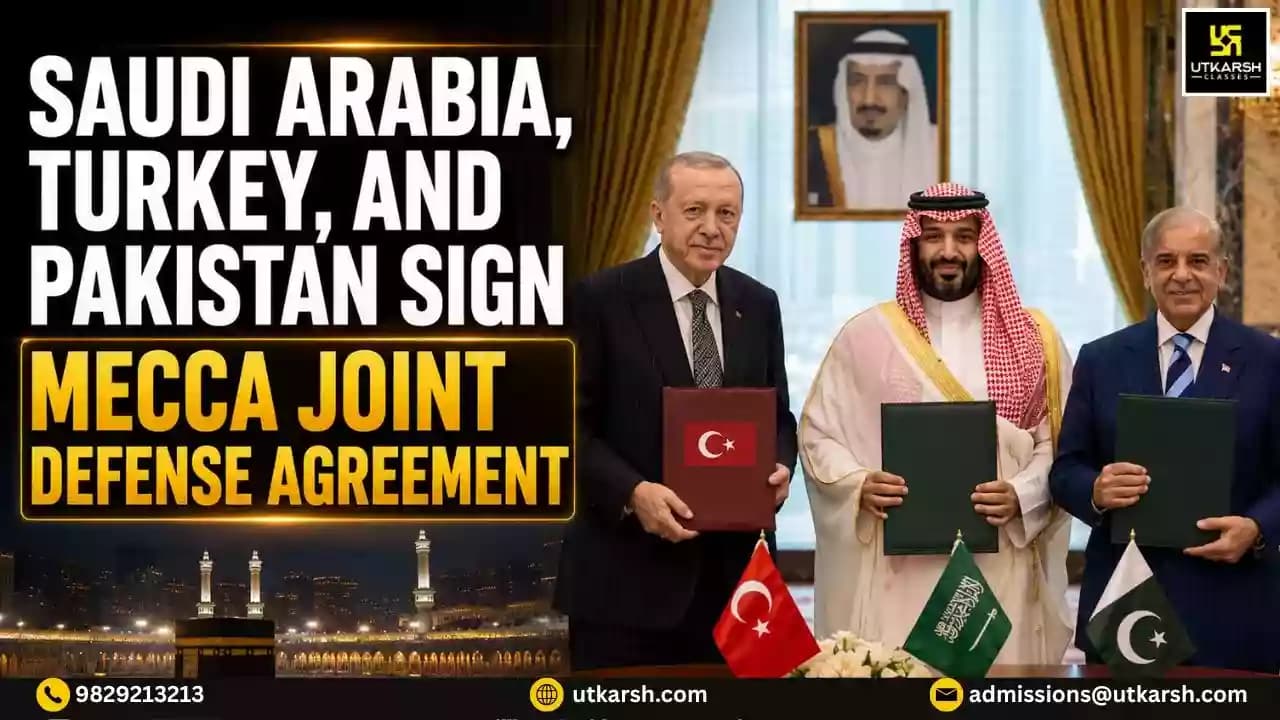
On August 7, Saudi Arabia, Pakistan, and Turkey signed the Mecca Agreement, a trilateral defence pact declaring that an attack on any one of the three nations will be treated as an attack on all. The deal gives Pakistan, the Islamic world's only nuclear power, a formal defence link with a NATO member and the Gulf's largest economy. As with the earlier Saudi-Pakistan Strategic Mutual Defense Agreement signed in September 2025, the full text remains undisclosed, with only a joint statement made public.
The Mecca Joint Defence Agreement, is a trilateral mutual defence pact signed on 7 August 2026 in Mecca, Saudi Arabia, by Saudi Arabia, Pakistan, and Turkey. The three countries have agreed that an armed attack on any one of them will be treated as an attack on all three, aimed at strengthening collective deterrence. The full text hasn't been made public — only a summary has been released.
Each country brings a different strength to the table, and together they form a kind of strategic triangle:
This mix Saudi money, Turkish defence technology, and Pakistani military muscle is central to why the pact matters strategically, beyond just the mutual defence clause.
While Iran's regional actions triggered Gulf security anxieties in the first place, the pact's real target appears to be Israel. Turkey, in particular, views Israel as a bigger long-term threat than Iran, especially given rising friction over Syria.
Timing-wise, it comes as Saudi Arabia looks to boost its military capacity after facing missile and drone attacks that depleted much of its air defence stockpile pushing it to seek closer defence partnerships beyond its reliance on the US.
Saudi Arabia gains a path toward building domestic defence manufacturing, leaning on Pakistan's institutional experience and Turkey's production strength both already collaborate on platforms like the KAAN fighter jet and Akinci drones. Pakistan and Turkey, in turn, deepen strategic ties with a wealthy Gulf partner.
For India, the key concern is Saudi Arabia drawing closer to the Pakistan-Turkey axis. This pact gives Islamabad more leverage in its relationship with Riyadh, potentially complicating India's own long-standing strategic partnership with Saudi Arabia.
Not really. NATO's Article 5 is backed by a permanent command structure, decades of established doctrine, and an implicit nuclear umbrella. The Mecca pact has none of this it's vaguer, more flexible, and leaves each country free to decide how, or whether, to respond.
About the author

Hardika Shekhawat
Current Affairs Content Writer
Hardika is a current affairs content writer at Utkarsh Classes with 3 years of experience in academic content writing. She creates clear, exam-ready current affairs articles for UPSC, SSC, RAS, Banking, Railway and State PCS aspirants.

Latest Current Affairs
Frequently asked questions

Visit Utkarsh Classes Offline Centre Near You.

Download All Exam PYQ PDFS Free!!!
Previous 5+ year Questions Papers se karen damdar practice