Ready to learn?
Take the first step toward achieving your educational goals. Whether you’re preparing for exams or expanding your knowledge, getting started is just a click away. Join us today and unlock your full potential
Utkarsh Classes
Admission office
Above Arora Namkeen
Jalori Gate circle,
Jodhpur (Raj.), 342005
support@utkarsh.com
+91-9116691119, +91-9829213213
Support
Get Started


Learning Resources
Rajasthan Govt Exams
Central Govt Exams
Civil Services Exams
Nursing Exams
School Tuitions
Other State Govt Exams
Agriculture Exams
College Entrance Exams
Miscellaneous Exams

© 2026 Utkarsh Classes & Edutech Pvt. Ltd. All Rights Reserved
Home

National Current Affairs
Bill and Act
TRAI Releases Amended Reference Interconnect Offer Rules 2026
Add as a preferred source on Google
TRAI releases the Telecommunication Interconnection (Reference Interconnect Offer) (Amendment) Regulations, 2026, updating SMP rules, LSA routing, and penalties.
Updated: 28 Nov 2026
3 Min Read
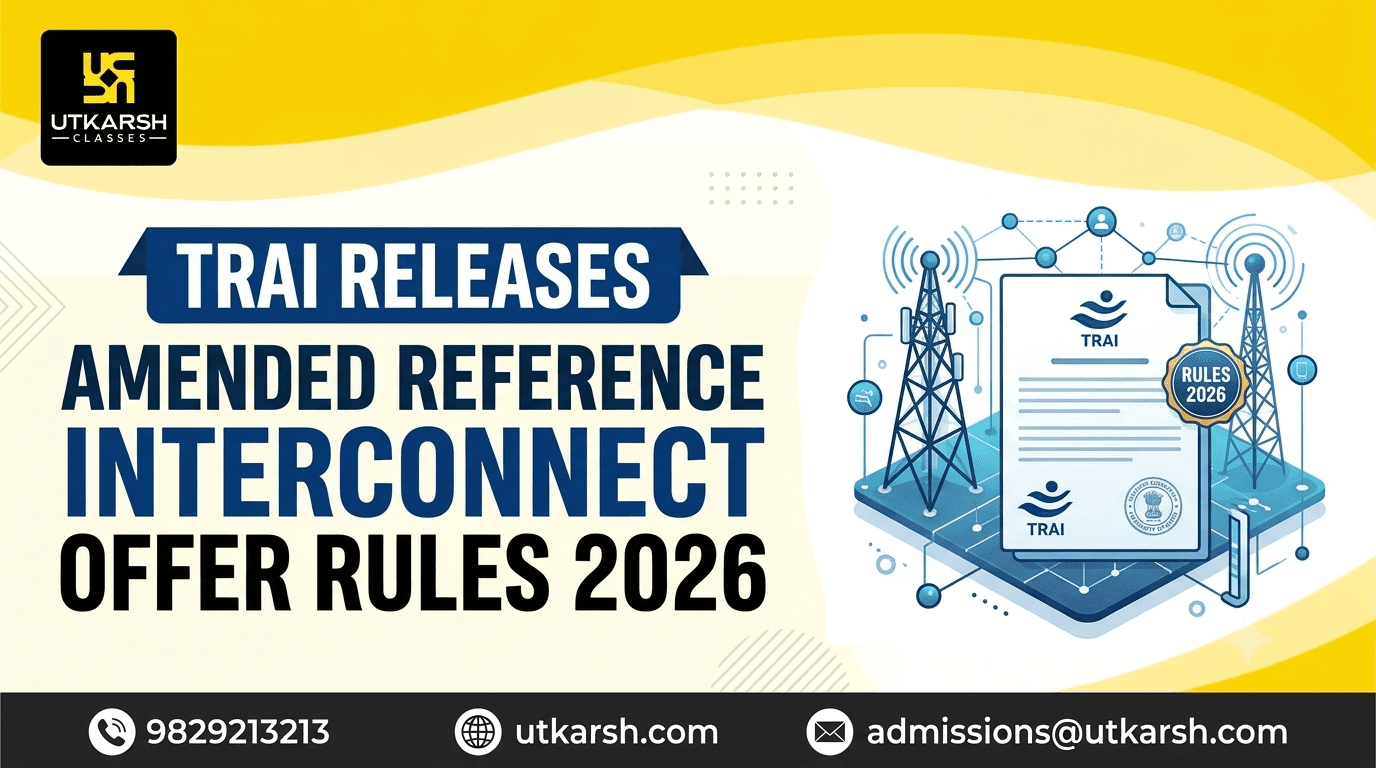
The Telecom Regulatory Authority of India (TRAI) has issued “The Telecommunication Interconnection (Reference Interconnect Offer) (Amendment) Regulations, 2026” on November 28, 2026. These revised rules modernize the framework governing Reference Interconnect Offers (RIO) and align network interconnection with India’s contemporary licensing regime and IP-based telecom infrastructure.
Taking effect on January 1, 2027, the regulations overhaul rules first notified in July 2002. They update how TRAI identifies Significant Market Power (SMP), mandate strict timelines for RIO submissions, simplify Licensed Service Area (LSA)-level call routing, and introduce graded financial disincentives for non-compliance.
Under Section 11(1)(b) of the TRAI Act, 1997, the regulator prescribes technical and commercial interconnection terms so customers of one network can seamlessly connect with users on competing networks.
Since 2002, India’s telecom networks have shifted from legacy circuit-switched, E1/TDM systems to scalable packet-switched, Internet Protocol (IP)-based architectures. To reflect this shift, TRAI launched a comprehensive stakeholder review:
|
Consultation Milestone |
Date |
|
Pre-Consultation Paper Released |
April 3, 2025 |
|
Main Consultation Paper Issued |
November 10, 2025 |
|
Stakeholder Comments & Counter-Comments |
December 15 & December 29, 2025 (17 comments, 9 counter-comments) |
|
Open House Discussion (OHD) |
January 28, 2026 |
|
Amendment Regulations Effective Date |
January 1, 2027 |
1. Periodic Determination of Significant Market Power (SMP)
TRAI will classify a service provider as holding Significant Market Power (SMP) if it commands a 30% or higher share in any of four activity parameters within a service area:
TRAI will assess SMP annually after the first quarter across four segments—Wireline Access, Wireless Access, National Long Distance (NLD), and International Long Distance (ILD)—using March 31 subscriber figures and March network capacity and traffic data. A subsequent AGR-based check may also occur without altering existing SMP designations, which remain valid until modified by TRAI.
2. Time-Bound Submission and Publication of RIO
Operators designated with SMP must submit their draft RIO to TRAI for approval within 30 days of determination and publish the approved version on their website within 15 days. If TRAI directs modifications, the provider must submit revisions within 15 days and publish the updated RIO within 15 days of approval. These strict deadlines help new entrants plan network integration without avoidable delays.
3. Transparency and Commercial Flexibility
While interconnection agreements must follow the published RIO as a non-discriminatory baseline, operators can mutually agree to modify specific terms when signing bilateral pacts. This balance preserves commercial flexibility and reduces inter-operator disputes.
4. Simplified LSA-Level Interconnection Routing
The regulations replace outdated SDCA/LDCA routing with streamlined Licensed Service Area (LSA)-level routing across PSTN-PSTN, PSTN-PLMN, PLMN-PLMN, PSTN-NLD, and PLMN-NLD networks. Covering intra-LSA, inter-LSA, and international traffic, this structure simplifies network planning for modern IP architectures.
5. Modernised Model RIO and Technical Guidelines
TRAI has updated its legacy Model RIO and guidelines to incorporate LSA-level points of interconnection (PoIs), IP-based technical standards, and contemporary quality-of-service benchmarks.
6. Graded Financial Disincentives for Violations
To enforce accountability, TRAI introduced a graded financial disincentive framework (capped per service area per violation) for delays or failures in submitting, modifying, or publishing RIOs, or failing to furnish SMP assessment data. Operators receive a fair opportunity to represent their case before penalties apply, distinguishing brief delays from prolonged non-compliance.
About the author

Girish Kumar
Current Affairs Content Writer
Girish Kumar is a current affairs content writer at Utkarsh Classes, with a decade of experience covering diverse contemporary issues. He develops high-quality study material for various competitive examinations, including UPSC, PSC, Bank PO etc.

Latest Current Affairs
Frequently asked questions

Visit Utkarsh Classes Offline Centre Near You.