Ready to learn?
Take the first step toward achieving your educational goals. Whether you’re preparing for exams or expanding your knowledge, getting started is just a click away. Join us today and unlock your full potential
Utkarsh Classes
Admission office
Above Arora Namkeen
Jalori Gate circle,
Jodhpur (Raj.), 342005
support@utkarsh.com
+91-9116691119, +91-9829213213
Support
Get Started


Learning Resources
Rajasthan Govt Exams
Central Govt Exams
Civil Services Exams
Nursing Exams
School Tuitions
Other State Govt Exams
Agriculture Exams
College Entrance Exams
Miscellaneous Exams

© 2026 Utkarsh Classes & Edutech Pvt. Ltd. All Rights Reserved
Home

International Current Affairs
Award and Honour
Francis Halzen wins Physics Nobel 2026 for IceCube neutrino discovery and astrophysical neutrinos
Add as a preferred source on Google
Updated: 06 Oct 2026
2 Min Read
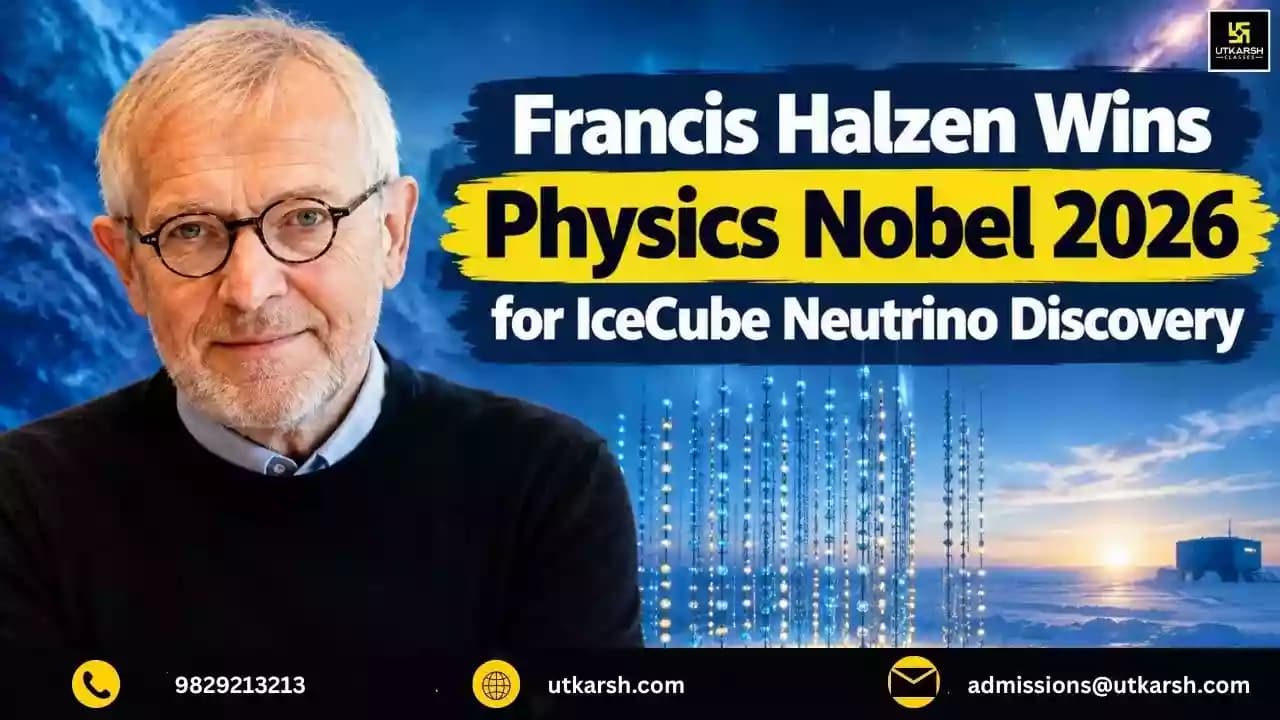
Belgian-American physicist Francis Halzen has won the 2026 Nobel Prize in Physics. The Royal Swedish Academy of Sciences announced the award on Tuesday, 6 October 2026, for his decisive contributions to the IceCube Neutrino Observatory and the discovery of high-energy neutrinos of astrophysical origin.
The prize recognises Halzen's role in creating a new way to study the universe using neutrinos. The Nobel Prize in Physics is one of the prizes set up in Alfred Nobel's will of 1895. It was first awarded in 1901. Through 2025, it had been given 119 times to 230 laureates. The 2026 prize carries 12 million Swedish kronor. Last year's winners were John Clarke, Michel H. Devoret and John M. Martinis, for work on quantum tunnelling in an electric circuit.
Halzen is a leading neutrino physicist at the University of Wisconsin–Madison. He was born on 23 March 1944 in Tienen, Belgium. Halzen realised that the huge, clear ice of Antarctica could work as a detector. He proposed placing thousands of light sensors deep inside it, an idea that became IceCube.
IceCube is a giant detector at the South Pole that uses Antarctic ice instead of a telescope. Neutrinos are tiny, electrically neutral particles. They are called "ghost particles" because they barely interact with matter, and trillions pass through our body every second.
Very rarely, a neutrino hits another particle and creates a fast-moving charged particle. This produces a faint blue glow called Cherenkov radiation in the ice. The sensors record it, and scientists work out the neutrino's direction, energy and likely source.
IceCube detected high-energy neutrinos from beyond Earth's atmosphere, opening neutrino astronomy.
This showed that extreme events in the distant universe can produce neutrinos. Normal astronomy uses visible light, radio waves, infrared, X-rays and gamma rays. Neutrinos can escape dense regions and travel almost unchanged, so they reveal places hidden from regular telescopes. This supports multi-messenger astronomy, which studies the universe using several different signals.
About the author

Utkarsh Classes
Company
This content is prepared by the Utkarsh Classes team to present accurate, updated, and exam-relevant current affairs in a simple and reliable format.


Frequently asked questions


Still have questions?
Can't find the answer you're looking for? Please contact our friendly team.
Visit Utkarsh Classes Offline Centre Near You.

Download Last 5 Years PYQs in a Single Click
FREE PYQs exam ke level aur question pattern ko samajhne ka best tareeka